Note: If you wish to receive, via e-mail, (1) my weekly newsletter or (2) daily copies of these posts, write to me at rrbates1951@gmail.com. Comments may also be sent to this address. I promise not to share your e-mail with anyone. To unsubscribe, write here as well.
Sunday
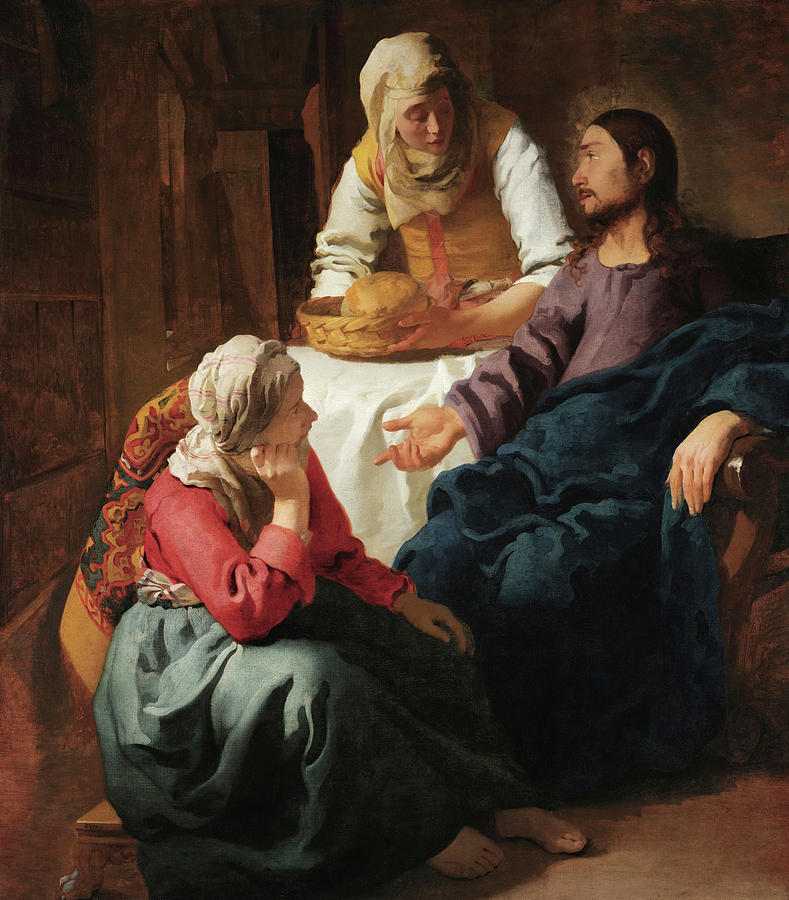
Today’s Gospel reading is the intimate story of a sibling rivalry, the one where Martha tries to enlist Jesus in prompting Mary to move to the kitchen. When Mary chooses instead to sit at the Lord’s feet and listen to what he is saying, Martha, “distracted by her many tasks,” asks Jesus, “Lord, do you not care that my sister has left me to do all the work by myself? Tell her then to help me.”
Most of the sermons I have encountered about the story endorse Mary, explaining that Jesus’s gentle reproof is a reminder to Martha not to get weighed down by busyness. After all, there are more important issues at stake. “Martha, Martha, you are worried and distracted by many things;” he tells her, “there is need of only one thing. Mary has chosen the better part, which will not be taken away from her.” As Daniel Clendenin of Journey to Jesus puts it, Jesus is counseling us to choose Mary’s centered interior life over Martha’s distracted exterior life.
There are occasional commentators who come, at least partly, to Martha’s defense. In “Martha, Martha,” Wendell Berry writes,
She has chosen a good part
and it shall not be taken away from her.
It is not the best part.
It is not the part
that will be remembered
in the morning.
So a good part. Just not the best part. Which, as far as sibling rivalry goes, stings.
The most thorough defense of Martha—or at least one that gives fullest expression to her resentment—may be Rudyard Kipling’s “Sons of Martha.” It is in line with many of those Kipling poems, often about common foot soldiers, that complain that their social contributions are unappreciated. “For it’s Tommy this, an’ Tommy that, an’ ‘Chuck him out, the brute!’/ But it’s ‘Savior of ‘is country’ when the guns begin to shoot,” he writes in “Tommy.” There’s also the much-abused Gunga Din, who gets the speaker’s full respect in the poem by that name: “Though I’ve belted you and flayed you,/ By the livin’ Gawd that made you,/ You’re a better man than I am, Gunga Din!”
In “The Sons of Martha,” Kipling extends the same recognition to engineers, whom he complains “must wait upon Mary’s Sons, world without end, reprieve, or rest.”
I imagine it took a fair amount of work to host Jesus and his twelve disciples, and none of the men in attendance would have stepped up to help out. Thoughts like this come to mind after reading Kipling’s poem, which goes into depth about the work required to sustain society.
If you want life’s necessities to be duly transported, tallied and delivered, the speaker points out, you’ve got to rely on the sons of Martha. Channeling her resentment, he gets sarcastic when talking of “the good part.” Martha’s sons “do not preach that [God’s] Pity allows them to drop their job when they damn-well choose,” he vents. “Simple service simply given” is the creed by which they live.
Here’s the poem:
The Sons of Martha
By Rudyard KiplingThe Sons of Mary seldom bother, for they have inherited that good part;
But the Sons of Martha favor their Mother of the careful soul and the troubled heart.
And because she lost her temper once, and because she was rude to the Lord her Guest,
Her Sons must wait upon Mary’s Sons, world without end, reprieve, or rest.It is their care in all the ages to take the buffet and cushion the shock.
It is their care that the gear engages; it is their care that the switches lock.
It is their care that the wheels run truly; it is their care to embark and entrain,
Tally, transport, and deliver duly the Sons of Mary by land and main.They say to mountains “Be ye removèd.” They say to the lesser floods “Be dry.”
Under their rods are the rocks reprovèd—-they are not afraid of that which is high.
Then do the hill-tops shake to the summit—-then is the bed of the deep laid bare,
That the Sons of Mary may overcome it, pleasantly sleeping and unaware.
They finger Death at their gloves’ end where they piece and repiece the living wires.
He rears against the gates they tend: they feed him hungry behind their fires.
Early at dawn, ere men see clear, they stumble into his terrible stall,
And hale him forth like a haltered steer, and goad and turn him till evenfall.
To these from birth is Belief forbidden; from these till death is Relief afar.
They are concerned with matters hidden—-under the earthline their altars are—-
The secret fountains to follow up, waters withdrawn to restore to the mouth,
And gather the floods as in a cup, and pour them again at a city’s drouth.They do not preach that their God will rouse them a little before the nuts work loose.
They do not preach that His Pity allows them to drop their job when they damn-well choose.
As in the thronged and the lighted ways, so in the dark and the desert they stand,
Wary and watchful all their days that their brethren’s ways may be long in the land.Raise ye the stone or cleave the wood to make a path more fair or flat;
Lo, it is black already with the blood some Son of Martha spilled for that!
Not as a ladder from earth to Heaven, not as a witness to any creed,
But simple service simply given to his own kind in their common need.And the Sons of Mary smile and are blessèd—-they know the Angels are on their side.
They know in them is the Grace confessèd, and for them are the Mercies multiplied.
They sit at the feet—-they hear the Word—-they see how truly the Promise runs.
They have cast their burden upon the Lord, and—-the Lord He lays it on Martha’s Sons!
For all the speaker’s bitterness, however, I’m confident that Jesus wouldn’t take it amiss. Rather he would see through the resentment to the longing to be loved and appreciated. Undoubtedly, he saw this in Martha as well. “Come unto me, all ye that labor and are heavy laden,” he would say, “and I will give you rest.”
Sometimes we need to vent but, in the end, the better part is the peace that passeth all understanding. This is the drama that ends George Herbert’s poem “The Collar,” which I can imagine ending Kipling’s drama as well:
But as I raved and grew more fierce and wild
At every word,
Methought I heard one calling, Child!
And I replied My Lord.
Jesus knows us better than we know ourselves.