Note: If you wish to receive, via e-mail, (1) my weekly newsletter or (2) daily copies of these posts, write to me at rrbates1951@gmail.com. Comments may also be sent to this address. I promise not to share your e-mail with anyone. To unsubscribe, write here as well.
Wednesday
My faculty book group discussed Robert Browning’s haunting poem “Childe Roland to the Dark Tower Came” last week, and the opening stanza couldn’t help but bring to mind Donald Trump and his administration:
My first thought was, he lied in every word,
That hoary cripple, with malicious eye
Askance to watch the working of his lie
On mine, and mouth scarce able to afford
Suppression of the glee, that pursed and scored
Its edge, at one more victim gained thereby.
The “hoary cripple” is not only lying but knows that Roland knows that he is lying. If he is experiencing barely suppressed glee, it is because his mendacity has trapped the wandering knight in a downward spiral of doubt and despair. Something like what the Nazis pulled off with the German populace in the 1930s.
I mention this parallel because I’ve just read about a recently republished 1939 German memoir by one Sebasian Haffner (pen name Raimund Pretzel), which novelist and political blogger Greg Olear says is “the single most important work I’ve come across, in terms of understanding the here and now.” Defying Hitler describes what average Germans were feeling as Hitler, first slowly and then quickly and always signaling his intent, took over the government and imposed his will.
The situation is unnervingly similar to our own, which Olear sets forth as follows:
In just a few months, a coarse, artless, criminal strongman has taken control of the entire federal government—including, as of yesterday, the nation’s capital (or “Capital,” as he writes it, capitalizing his nouns like a good German).
Trump owns the Supreme Court, the Republican Party, the Speaker of the House. Congress is powerless to stop him. The wealthiest tech-bros in Silicon Valley and most of the legacy media CEOs have lined up behind him. Colleges and universities have capitulated to his demands, as have white-shoe law firms and venerable broadcasting companies. He’s transformed U.S. Immigration & Customs Enforcement into his own secret state police. He’s using the FBI and the Justice Department to attack his enemies. He’s building concentration camps. He’s enriching himself on a grand scale. And every word that comes out of his puckered little mouth is a lie.
Non-stop lying is how Hitler pulled off his power grab, according to Haffner, with his biggest lie being that the Jews, in coordination with the communists, engineered Germany’s defeat in World War I. Hitler understood, as does Trump, that big lies go down more successfully than small lies. Observing up close the impact of Hitler’s lying, Haffner provided the following explanation of how it worked:
[I]n the big lie there is always a certain force of credibility; because the broad masses of a nation are always more easily corrupted in the deeper strata of their emotional nature than consciously or voluntarily; and thus in the primitive simplicity of their minds they more readily fall victims to the big lie than the small lie, since they themselves often tell small lies in little matters but would be ashamed to resort to large-scale falsehoods.
Because they can’t imagine someone fabricating “colossal untruths,” normal people doubt and waver in the face of them, thinking there must be some other explanation. Thus, the German notes, “the grossly impudent lie always leaves traces behind it, even after it has been nailed down, a fact which is known to all expert liars in this world and to all who conspire together in the art of lying.”
Like a slow-seeping poison, such lying takes a toll, changing the narrative and sapping the opposition. Even though the burning of the Reichstag, which the Nazis blamed on the communists, was clearly a false flag operation—in fact, Nazis even tried to prevent fire fighters from putting out the flames—the pervasive lying had already so muddied the waters that many just went along. Even though the streets were calm and everything seemed relatively peaceful—which describes life in Washington, D.C. before the National Guard moved in—many Germans surrendered to Nazi propaganda:
So the Communists had burned down the Reichstag. Well, well. That could well be so, it was even to be expected. Funny, though, why they should choose the Reichstag, an empty building, where no one would profit from a fire. Well, perhaps it really had been intended as the “signal” for the uprising, which had been prevented by the “decisive measures” taken by the government. That was what the papers said, and it sounded plausible. Funny also that the Nazis got so worked up about the Reichstag. Up till then they had contemptuously called it a “hot air factory.” Now it was suddenly the holy of holies that had been burned down. Well, what suits their book, don’t you agree, my friend, that’s politics, isn’t it? Thank God we don’t understand it. The main thing is: the danger of a Communist uprising has been averted and we can sleep easy. Good night.
The reference to the papers brings to mind our own mainstream media, which is proving eerily passive in the face of Trump. The Washington Post may assert, in its masthead, that “Democracy dies in darkness,” but yesterday it framed Trump’s military occupation of Washington as “Donald Trump fulfills a dream role: Big-city mayor.” (Yes, and Hitler fulfilled his dream of finally visiting Paris.) Meanwhile the mainstream media’s German counterparts (Olear points out) were “either incapable of asking questions or unwilling to ask them, and took the Nazi press releases at face value.”
In the face of the false flag that was the Reichstag fire, Haffner says that the Germans were guilty of a
terrible collective weakness of character…With sheepish submissiveness the German people accepted that, as a result of the fire, each one of them lost what little personal freedom and dignity was guaranteed by the constitution; as though it followed as a necessary consequence. If the Communists had burned down the Reichstag, it was perfectly in order that the government took “decisive measures”!
Such “sheepish submissiveness,” Olear says, has been
all too familiar here in the United States during the Trump era. Whether it’s Barack Obama being checkmated by Mitch McConnell with the doomed Merrick Garland SCOTUS nomination; Chuck Schumer and Hakeem Jeffries not grasping the severity of the threat to democracy posed by Trump; A.G. Garland’s feckless refusal to go hard at Donald in order to preserve “norms”; Jake Tapper and Dana Bash allowing Trump to Gish-gallop all over Biden in the first debate, not bothering to check even one of his countless lies; Joe Biden declining to use the mighty immunity powers granted him by the corrupt Roberts Court to save us from the orange menace; or the general reluctance of the press to report on Trump’s long ties to organized crime, the Kremlin, or Jeffrey Epstein, we have all seen a lifetime’s worth of pusillanimity from the “good guys.”
Haffner writes that the Germans were “under a spell,” and in Browning’s poem the same appears to be the case with Roland. Why else would he go along with the lying cripple’s agenda, which is as clear as Hitler’s and Trump’s agendas were:
What else should he be set for, with his staff?
What, save to waylay with his lies, ensnare
All travelers who might find him posted there,
And ask the road? I guessed what skull-like laugh
Would break, what crutch ‘gin write my epitaph
For pastime in the dusty thoroughfare,
If at his counsel I should turn aside
Into that ominous tract which, all agree,
Hides the Dark Tower.
Roland fatalistically—sheeplike?—does what the man wants, walking directly into his trap:
Yet acquiescingly
I did turn as he pointed: neither pride
Nor hope rekindling at the end descried,
So much as gladness that some end might be.
What ensues is a long trek through a desolate waste land that conveys Roland’s inner desolation. Yeats’s “the best lack all conviction” describes his condition, as does T.S. Eliot’s hollow men “behaving as the wind behaves.” Roland’s lost idealism–“my hope dwindled into a ghost”—could be describing Americans’ loss of faith in the American dream:
For, what with my whole world-wide wandering,
What with my search drawn out thro’ years, my hope
Dwindled into a ghost not fit to cope
With that obstreperous joy success would bring,
I hardly tried now to rebuke the spring
My heart made, finding failure in its scope.
In his trek Roland thinks back to former companions, now disgraced, which makes his quest seem all that more futile. Everyone has been dragged down by hopelessness, a situation which gives authoritarian figures and cynical operatives the advantage. Note the bleakness of his world:
So, on I went. I think I never saw
Such starved ignoble nature; nothing throve:
For flowers—as well expect a cedar grove!
But cockle, spurge, according to their law
Might propagate their kind, with none to awe,
You’d think; a burr had been a treasure-trove.
And
Now blotches rankling, colored gay and grim,
Now patches where some leanness of the soil’s
Broke into moss or substances like boils;
Then came some palsied oak, a cleft in him
Like a distorted mouth that splits its rim
Gaping at death, and dies while it recoils.
So are we all as doomed as Roland seems to be? While Olear sees Haffner’s memoir as an essential wake-up call, he also points out what’s different about our situation. We still have powerful people and powerful institutions that can push back as Germany did not:
But in 2025, the United States does have strong leaders in important and powerful positions. Gavin Newsom, lately Trump’s bugbear, presides over the world’s fourth-largest economy; the U.S. needs California more than California needs the U.S. Minnesota’s Tim Walz has been a strong resistance voice since Kamala Harris chose him to be her running mate. JB Pritzker of Illinois has not been shy about criticizing Dear Leader. Kathy Hochul, my governor here in New York, has been quieter than the others, but no less effective. And Zohran Mamdani, God bless him, is running one of the best political campaigns in recent memory and stands poised to become mayor of the country’s largest—and wealthiest—city.
Olear notes that there was no equivalent to a state governor in Nazi Germany, no opposition leaders as charismatic as the Democrats he names, and nothing like the power of individual states.
There are debates about whether the ending of Browning’s poem is negative or positive. While he sees himself as haunted by the failures of previous warriors and feels like a stag at bay—”Now stab and end the creature—to the heft!’“—yet he makes one last heroic stand:
There they stood, ranged along the hillsides, met
To view the last of me, a living frame
For one more picture! in a sheet of flame
I saw them and I knew them all. And yet
Dauntless the slug-horn to my lips I set,
And blew. “Childe Roland to the Dark Tower came.”
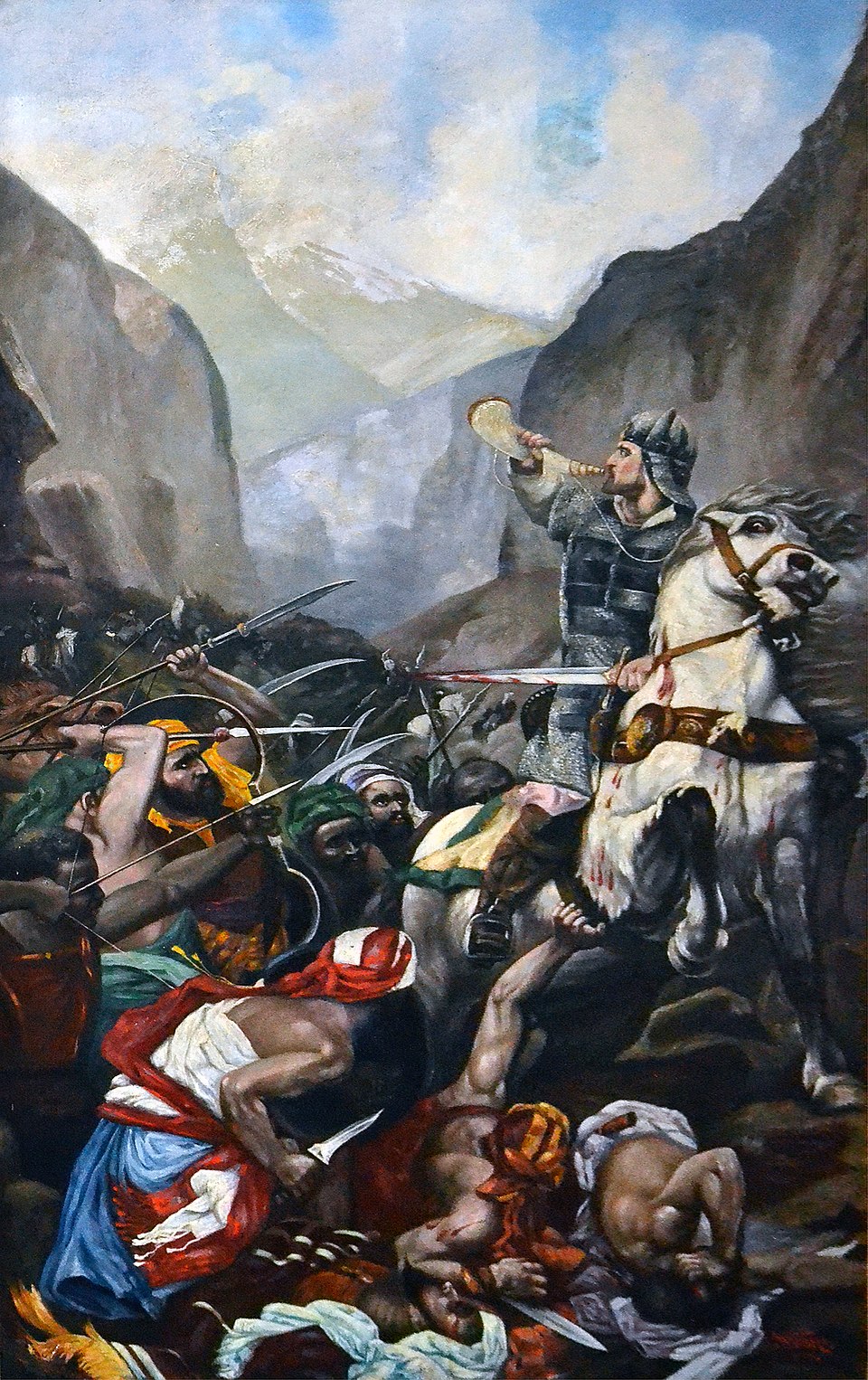
Think of the slug-horn as calling us to rise above the exhaustion, depression, and emptiness that many are experiencing. In the medieval poem Song of Roland, when the warrior blows his horn, Charlemagne responds, so that even though it’s too late for Roland, the country is saved. The very fact that, despite the odds against him, Roland is willing to face up to the darkness can serve as inspiration.
In C.S. Lewis’s Prince Caspian the embattled Narnians, at their lowest moment, blow Susan’s ancient horn and it brings in kings and queens from the past, who set things right. Think of those kings as the Enlightenment ideas upon which this country was founded. They are worth fighting for, whatever the cost.
Further note: For an instance of Democratic politicians fighting bravely, Illinois governor J.B. Pritzker particularly stands out. “If it sounds to you like I am alarmist, that is because I am ringing an alarm,” he said Monday afternoon in a magnificent speech. Here’s an excerpt in which he calls upon the press to do its job and help pull us out of our Childe Roland funk:
To the members of the press who are assembled here today, and listening across the country, I am asking for your courage to tell it like it is.
This is not a time to pretend here that there are two sides to this story. This is not a time to fall back into the reflexive crouch that I so often see, where the authoritarian creep by this administration is ignored in favor of some horse race piece on who will be helped politically by the president’s actions.
Donald Trump wants to use the military to occupy a U.S. city, punish his dissidence, and score political points. If this were happening in any other country, we would have no trouble calling it what it is: a dangerous power grab.