Note: If you wish to receive, via e-mail, (1) my weekly newsletter or (2) daily copies of these posts, write to me at rrbates1951@gmail.com. Comments may also be sent to this addss. I promise not to share your e-mail with anyone. To unsubscribe, write here as well.
Friday
This is the latest post in my on-going series on “My Life in Literature,” which appears every Friday. Because an informal autobiography written by my great grandmother Eliza Scott means so much to me—she discusses the novels that were important to her as she grew up in Victorian England—I figured I should do something similar for family members who come after me. Of course, the subject is also consistent with the mission of this blog, which is to explore the many ways that literature enhances and sometimes changes our lives.
In my last “Life in Literature” post I mentioned how, although many of my college literature essays felt like meaningless cerebral essays, occasionally I would write one where something seemed to be at stake. That was the case for an essay I wrote my senior year on D. H. Lawrence’s poetry. It was meaningful because it coincided with my blossoming love affair with Julia.
I had met Julia Ruth Miksch the year before. One of a handful of Carleton students with a farming background, Julia was touted by the Admissions Office as adding diversity to the student body. (“One of your classmates is a pig farmer’s daughter,” the admissions director informed us during first-year orientation.”) Julia had started a poetry reading group our junior year and, because she was a friend of my roommate, I wandered in. Apparently I impressed her by citing the first few lines of a Gerard Manley Hopkins poem—the very rhythmical “Leaden Echo”—but I didn’t join the group as the college newspaper was taking up all of my extra time.
We reconnected the following term, where over lunch we began a conversation that unexpectedly lasted for several hours. Conversing excitedly about ideas functioned as an aphrodisiac that led to the first real sex of my life, after which I was hooked. Over the summer Julia visited us in Sewanee after recovering from a severe case of mono contracted during her spring semester, and we decided we would get married after graduation. Senior year at Carleton proved a very rich time. Julia had to drop basketball because of the aftereffects of her sickness but found her time filled up with student teaching and preparing for comps. I, meanwhile, was editing the Carletonian while recovering from a broken leg and writing my senior thesis. Nevertheless, I would spend many nights in her room and (when the weather turned warm) out in the arboretum. Into these exhilarating days stepped Lawrence’s poetry.
Creative writing professor Keith Harrison was teaching a course on 20th century poetry, which introduced me to Lawrence. I sometimes think of D.H. as a young person’s author since his fascination with sex matches our own at that age. His collection Birds, Beasts, and Flowers, which contains pulsating poems about the natural world, was just the ticket. Take, for instance, these opening stanzas from “Tortoise Shout,” a poem about copulating turtles that, somewhat unbelievably, we had someone read at our wedding:
I thought he was dumb,
I said he was dumb,
Yet I’ve heard him cry.
First faint scream,
Out of life’s unfathomable dawn,
Far off, so far, like a madness, under the horizon’s dawning rim,
Far, far off, far scream.
Tortoise in extremis.
Why were we crucified into sex?
Why were we not left rounded off, and finished in ourselves,
As we began,
As he certainly began, so perfectly alone?
A far, was-it-audible scream,
Or did it sound on the plasm direct?
An urge driven by nature’s seething plasm? Never underestimate the power of a young person’s sexual awakening.
Some background is useful here. Both sides of my family were sexually repressed, which I duly imbibed in a deep way. Few novels have understood me as well as John Fowles’s The French Lieutenant Woman, which I read as a sophomore and which features a young man who, while an intellectually adventurous Darwinist, is otherwise tightly wound. Everything changes for him when he meets a mysterious woman—just as, a year later, everything would change for me when I met Julia.
I say my family was repressed even though my father became somewhat famous (or infamous) for his fascination with erotica. It showed up in his groundbreaking Apollinaire scholarship, in his teaching, in his poetry, and in the “Erotic Film Series” he ran for years at the University of the South. In fact, the two of us once collaborated on an essay contending that “rosebud” in Citizen Kane was originally a vulva. (It’s my most cited article.) But one can reinscribe repression in rebelling against it, which I think my father did in attempting to break free from my grandparents’ Victorian views of sex. All of which is to say that I felt boxed in by my own feelings of guilt and timidity when it came to my sexuality.
Which is why Lawrence hit with such force. Even before I encountered his poetry, I had read The Man Who Died, a novella about Christ deciding to live a very different kind of life when he returns from the dead. The original title of the work was The Escaped Cock, with the sexual pun fully intentional, and we see Jesus rejecting self-denial for a life that includes sexual pleasure. By the end, he is sleeping with and impregnating an Egyptian priestess of Isis.
Characteristic of the novel is the following passage, which now strikes me as verging on parody but which was heady stuff for a 20-year-old with my background:
He crouched to her, and he felt the blaze of his manhood and his power rise up in his loins, magnificent.
“I am risen!”
Magnificent, blazing indomitable in the depths of his loins, his own sun dawned, and sent its fire running along his limbs, so that his face shone unconsciously.
Jesus as imagined by Lawrence has cared so much for others that he has neglected his own needs, which is what he must learn. As he tells Mary Magdalene, “The teacher and the savior are dead in me; now I can go about my business, into my own single life.” And she, whom Lawrence imagines to be a former prostitute who has given up the sensual life for the spiritual, is depicted as having gone too far the other way. Your lovers, he tells her, “were much to you, but you took more than you gave. Then you came to me for salvation from your own excess.” Elsewhere the author informs us, “Now the other doom was on her. She wanted to give without taking. And that, too, is hard, and cruel to the warm body.”
Lawrence is rebelling here, not only against sexual repression but against sacrificing oneself to a life of service to others. Given that “service” could have been my middle name, and Julia’s as well, reading Lawrence at the height of the sexual revolution gave us permission to explore our bodies.
But there’s another way that Lawrence was important to me, which I explored in my essay. Even as the author imagines losing himself in a grand passion, he is also fearful of losing his individuality. His poems reflect this tension, as does his essay on Walt Whitman, who in Song of Myself sometimes focuses on the Self apart, sometimes on merging with the cosmos. Here’s Lawrence doing a version of the same in “Hummingbird”:
Before anything had a soul,
While life was a heave of matter, half inanimate,
This little bit chipped off in brilliance
And went whizzing through the slow, vast, succulent stems.
As I look back at the wedding ceremony I composed, I see that I used poetry to figure out how two people can hold on to their separate identities while still forming a more perfect union. Furthermore, I felt that I, as a non-believer, had to justify the very fact that I was getting married. Nor was that the only impediment since, to many of us at the time, marriage seemed an outdated institution (which is how Sartre saw it). Why have a ceremony at all? Since literature was my religion—it seemed to me a much richer symbol system—I turned to poetry to reconcile myself with exchanging vows before a minister.
The ceremony wasn’t a problem for Julia since she had been raised in a Moravian community and had been attending the local Moravian church in Northfield. That must have been why she gave me a free hand in writing the ceremony. In the following segment—which came after Keith Harrison reading Lawrence’s “Tortoise Shout”— I draw on an image from Archibald MacLeish’s “Ars Poetica” to capture separate-but-together and W.B. Yeats’s “A Prayer for My Daughter” to justify the ceremony. For good measure, I also throw in the Hegelian/Marxist dialectic, anticipating tension between my thesis and Julia’s antithesis but predicting a higher synthesis.
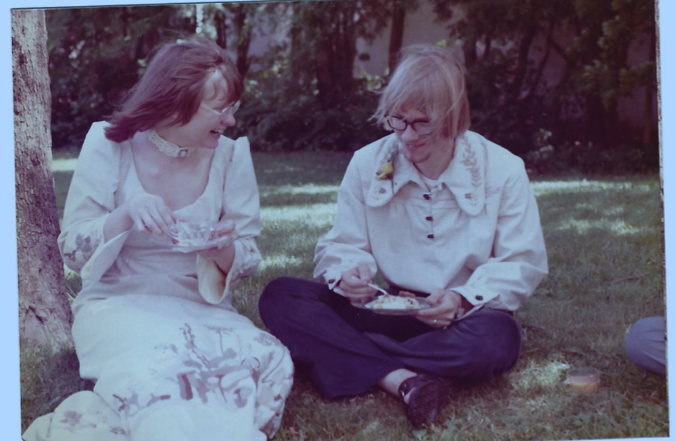
Before sharing it, let me set the scene. My sons, looking at photos, tell me that we had a hippy wedding. While I distanced myself from hippy drug culture, it’s true that I had long hair and wore blue jeans and sandals while Julia had a muslin wedding dress on which her mother and sister had embroidered mushrooms. The wedding, meanwhile was held outside and featured a classmate playing a lute, so you can tell me if my sons are right. Here’s the passage from the ceremony I’m referencing:
Minister: The marriage bond is a bond between two individuals. It does not entail a merging of one into the other, for in merging the individuality is lost.
Congregation: There must be a tension of difference. Without the tension, there can be no growth.
Minister: From the tension, this man and this woman will grow to new awarenesses and reach new syntheses. Marriage can be beautiful because it provides a unified form in which to search.
Congregation: Marriage is like a sonnet. As a fixed form, it endows a heightened beauty on the infinite number of variations within.
Minister: The bond is the attraction between two stars revolving around each other, caught in each other’s orbit but resisting an incorporation which would burn brightly but die quickly.
Congregation: “Love is the leaning grasses and two lights above the sea.”
Minister: If we are gathered together today, it is because through ritual we ascertain the symbolic nature of the bond. And only through symbolism can we touch upon the beauty and the innocence.
Congregation: “How but in custom and in ceremony
Are innocence and beauty born?
Ceremony’s a name for the rich horn,
And custom for the spreading laurel tree.”
Following the exchange of vows and a reception, Julia and I climbed into her Ford pickup and drove off into the great unknown. And here we are, still together, 53 years later.