Tuesday
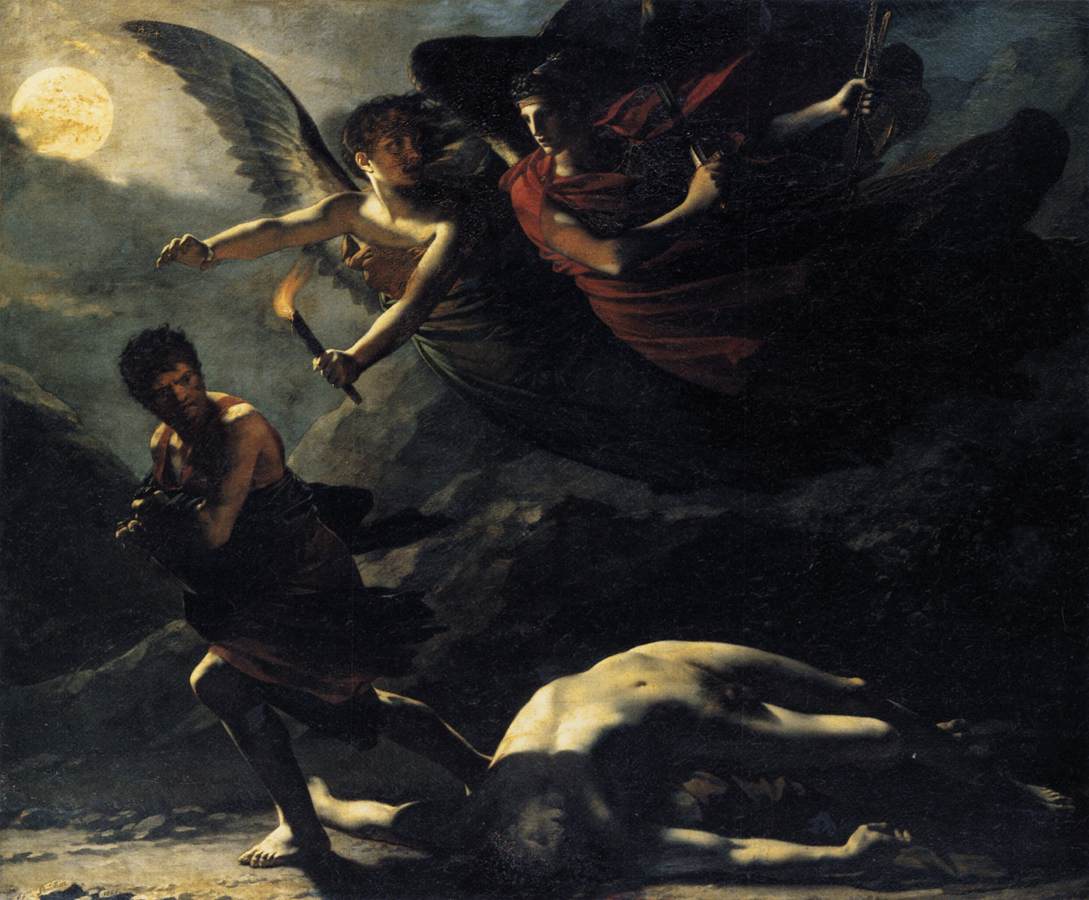
Retired General Mark Hertling, surveying Trump’s Iranian nightmare, has invoked an ancient Greek historian and a Greek goddess to explain the chaos. Herodotus, he writes in the Bulwark ,
believed the greatest danger to powerful nations was not external enemies but hubris—the arrogance that comes from believing success makes one invulnerable. That hubris always summoned Nemesis, the goddess of divine retribution, who then punished arrogant heroes and leaders.
I hadn’t heard of Nemesis as a goddess until Hertling’s piece, but I see that she shows up in The Theogony (c. 750-700 BCE), which is Hesiod’s genealogy of the gods. Nemesis is the daughter of Night, who herself is born of Chaos and who is also the mother of “hateful Doom, black Destiny and Death/ And Sleep and Dreams,” along with Disgrace, “painful Woe,” and the three fates. Hesiod concludes,
And then did deadly Night
Give birth to Nemesis, who is a blight
To mortals…
Wikipedia tells us that, while Nemesis was originally a distributor of fortune (“neither good nor bad, simply in due proportion to each according to what was deserved”), she came to be associated with “the resentment caused by any disturbance of this right proportion, the sense of justice that could not allow it to pass unpunished.”
I was unaware of Nemesis as a goddess because the references to her in Greek and Roman literature are so fleeting. She is mentioned in Sophocles’s Electra, where Orestes and Electra enact justice on their father’s murderers (their mother and her lover), and again in Ovid’s Metamorphoses, where under the name Rhamnusia she transforms the gorgeous young Narcissus into a flower that gazes perpetually upon its watery reflection. “Thus, though he should love, let him not enjoy what he loves!” pray the mountain nymphs whom Narcissus is spurning, and Ovid informs us that Rhamnusia/Nemesis “assented to a prayer so reasonable.”
Given that Trump is the quintessential narcissist, it’s appropriate that Nemesis would trap him in the lonely hell of self. Ovid does a good job of capturing the emptiness of self-obsession:
While he is drinking, being attracted with the reflection of his own form, seen in the water, he falls in love with a thing that has no substance; and he thinks that to be a body, which is but a shadow.
And further on:
In his ignorance, he covets himself; and he that approves, is himself the thing approved. While he pursues he is pursued, and at the same moment he inflames and burns. How often does he give vain kisses to the deceitful spring; how often does he thrust his arms, catching at the neck he sees, into the middle of the water, and yet he does not catch himself in them. He knows not what he sees, but what he sees, by it is he inflamed; and the same mistake that deceives his eyes, provokes them. Why, credulous youth, dost thou vainly catch at the flying image? What thou art seeking is nowhere; what thou art in love with, turn but away and thou shalt lose it; what thou seest, the same is but the shadow of a reflected form; it has nothing of its own.
It sounds like Trump seeing himself in the buildings he names after himself and in the awards he arranges to have bestowed upon him. Nemesis is indeed at work on him, making his life a misery to himself and, with the Iran debacle, punishing him for his arrogance. Unfortunately, Trump also embodies the arrogance of the country that elected him twice, and he is taking us all down with him. Multiple commentators are observing that this is how empires fall.
With its military might, America thought it could intervene in Korea, multiple Central American countries, Vietnam, Iraq (twice), Somalia, Afghanistan, Libya, Venezuela, and now Iran (I could also include various CIA-sponsored coups). In retrospect, it’s striking that Nemesis took so long to show up.
Then again, given how much blood we’ve shed and how much treasure we’ve squandered over the past 75 years, maybe she’s been with us all along.