Palm Sunday
I know of two fine poems that feature Jesus’s Palm Sunday donkey, with the later one appearing to be a response to the first. G.K. Chesterton’s “The Donkey” and Mary Oliver’s “The Poet Thinks about a Donkey tell us as much about the poets as about the Biblical passage.
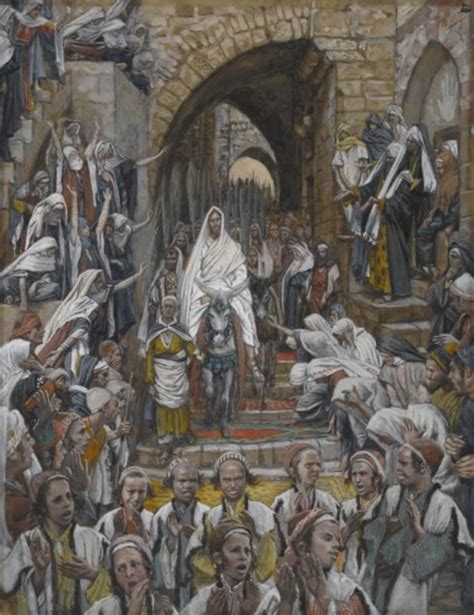
The donkey in question is mentioned in the account of Jesus’s entry into Jerusalem in anticipation of the Passover celebrations. Here is Matthew’s account (21:1-11):
When Jesus and his disciples had come near Jerusalem and had reached Bethphage, at the Mount of Olives, Jesus sent two disciples, saying to them, “Go into the village ahead of you, and immediately you will find a donkey tied, and a colt with her; untie them and bring them to me. If anyone says anything to you, just say this, `The Lord needs them.’ And he will send them immediately.” This took place to fulfill what had been spoken through the prophet, saying,
“Tell the daughter of Zion,
Look, your king is coming to you,
humble, and mounted on a donkey,
and on a colt, the foal of a donkey.”The disciples went and did as Jesus had directed them; they brought the donkey and the colt, and put their cloaks on them, and he sat on them. A very large crowd spread their cloaks on the road, and others cut branches from the trees and spread them on the road. The crowds that went ahead of him and that followed were shouting,
“Hosanna to the Son of David!
Blessed is the one who comes in the name of the Lord!
Hosanna in the highest heaven!
I sense in Chesterton’s “The Donkey” a certain amount of disgust at his own body and voice. He was bullied as a child and then grew to be over six feet tall and close to 400 pounds. His voice, meanwhile, was described as “cracked and creaking, which gave the impression of adenoids.” In certain ways, then, he relates to the donkey he describes:
The Donkey
By G.K. Chesterton
When fishes flew and forests walked
And figs grew upon thorn,
Some moment when the moon was blood
Then surely I was born.
With monstrous head and sickening cry
And ears like errant wings,
The devil’s walking parody
On all four-footed things.
The tattered outlaw of the earth,
Of ancient crooked will;
Starve, scourge, deride me: I am dumb,
I keep my secret still.
Fools! For I also had my hour;
One far fierce hour and sweet:
There was a shout about my ears,
And palms before my feet.
In the final stanza, I see the power of Jesus’s love to lift Chesterton out of his self-loathing. In this ecstatic moment, he experiences divine joy.
Whereas Chesterton’s donkey expresses the repressed resentment of one who has been abused, Oliver’s articulates the quiet humility of one who doesn’t particularly mind that it has been been overlooked–but who, nevertheless, is grateful to have this chance to serve. The poem is unusual for Oliver since she doesn’t normally allude to the Bible in such a specific way, her spiritual imagery usually being more generalized. Note how, unlike the extroverted Chesterton, the introverted Oliver identifies more with the donkey than with the celebrating crowds:
The Poet Thinks about the Donkey
By Mary Oliver
On the outskirts of Jerusalem
the donkey waited.
Not especially brave, or filled with understanding,
he stood and waited.How horses, turned out into the meadows,
leap with delight!
How doves, released from their cages,
clatter away, splashed with sunlight!
But the donkey, tied to a tree as usual, waited.
Then he let himself be led away.
Then he let the stranger mount.Never had he seen such crowds!
And I wonder if he at all imagined what was to happen.
Still, he was what he had always been: small, dark, obedient.I hope, finally, he felt brave.
I hope, finally, he loved the man who rode so lightly upon him,
as he lifted one dusty hoof and stepped, as he had to, forward.
The stanza in italics, the second one about horses and doves, captures Oliver’s inner feelings. Her poetry is filled with moments of such spiritual ecstasy, which invariably accompany nature sightings, whether of breaching whales, egrets at dawn, or small wild plums. But as far as her outer action goes, she feels she has far more in common with the “small, dark, obedient” donkey.
Notice that the donkey finds Jesus’s touch to be light and loving. To celebrate the entry of love into one’s soul, dancing isn’t essential. One has but to open one’s heart.