Tuesday
My faculty book group just finished discussing The Tempest, the last play in our Shakespeare binge, undertaken before our Shakespeare colleague Pamela Macfie moves to Maine. For years a beloved professor at the University of the South, Pamela previous led us in discussions of Hamlet, King Lear, Midsummer Night’s Dream, and Twelfth Night. As we talked about the play that many consider to be the Bard’s farewell drama, I recalled teaching it at the University of Ljubljana only hours after learning that Trump had defeated Kamala Harris.
In the course of election night, I kept changing the post I was writing on Shakespeare’s play. When it was fairly clear that Trump would emerge victorious, I introduced my essay with the following (slightly amended) note:
If today’s essay is a bit uneven, it’s because–writing it from Slovenia–I started it fairly confident that Kamala Harris would win the election, only to begin realizing we were witnessing 2016 redux as the night wore on. What Shakespeare designed as a comic if somewhat disturbing subplot in Shakespeare’s final play–inept insurrectionists trying to overthrow Prospero, destroy his magic book, and seize Miranda–suddenly became our central action. It was as if The Tempest had transmuted into Richard III. (Think of Prospero’s book as the Constitution, Miranda as reproductive freedom.) In the course of the night, my headline changed from “Caliban vs. Prospero” to “Can Caliban Defeat Prospero?” to (sadly) “Caliban Defeats Prospero.” Following Trump’s victory, white nationalist Nick Fuentes gloated, in a tweet that received 22,000 likes, “Your body, my choice. Forever.” Or as Caliban fantasizes after Prospero reminds him that he “didst seek to violate the honor of my child,”
O ho, O ho! would’t had been done!
Thou didst prevent me; I had peopled else
This isle with Calibans.
When I walked into class the following morning, I noticed that every one of my students was scrutinizing me for my reaction. How would an American respond to the dreadful news? Because I have always been careful to keep my politics out of my classes—after all, I have conservative as well as liberal students—I didn’t say much, but the students could tell my heart wasn’t in my teaching. Halfway through the class, I discovered I couldn’t go on and ended early, something I never do.
Reexamining the play a year and a half later, I find it more relevant than ever, despite its being a comedy. As Trump and various Republicans look for ways to steal the upcoming Congressional elections, it’s useful to remember that the play features a string of coups and attempted coups. First there is Antonio, Prospero’s brother, overthrowing him with the aid of Alonso, king of Naples. Prospero is cast adrift with his daughter Miranda, and only with the aid of his magical books, provided him by the kindly Gonzalo, is he able to survive.
Then Prospero himself seizes the island from Caliban. Although the monster claims ownership, however—“This island’s mine, by Sycorax my mother, which thou takest from me”—it is worth noting that Sycorax herself stole the island from Ariel, whom she imprisoned in a tree. Caliban is like those white supremacists who contend that their America is being stolen from them without acknowledging others who have equal or even prior claim.
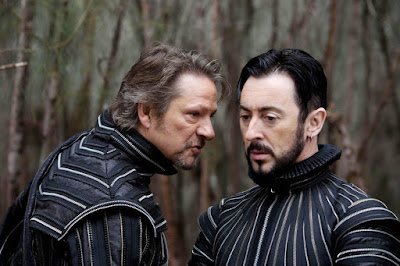
Shakespeare is not done with takeover attempts. First, Antonio suggests to Sebastian that they kill Alonso, Sebastian’s brother, in a repeat of Antonio’s seizure of power. That way Antonio will free himself of the debt he owes to Naples. Then there’s Caliban plotting with jester Trinculo and butler Stephano to kill Prospero and wed Miranda. Caliban has a variety of different plans for doing this, just as Trump has multiple ideas about stealing the next election, from seizing voter rolls and voting machines to creating racist gerrymanders to posting ICE agents at polling places to having the postal service intervene. Note how Caliban too fantasizes about the many ways he can overthrow Prospero.
Why, as I told thee, ’tis a custom with him,
I’ th’ afternoon to sleep: there thou mayst brain him,
Having first seized his books, or with a log
Batter his skull, or paunch him with a stake,
Or cut his wezand with thy knife. Remember
First to possess his books; for without them
He’s but a sot, as I am, nor hath not
One spirit to command: they all do hate him
As rootedly as I. Burn but his books.
Perhaps we can think of Prospero’s books as the Constitution, without which America is “but a sot, as I am, nor hath not one spirit to command.” Indeed, democracy rests upon the Constitution.
Fortunately for Prospero, the insurgents are as inept as those who stormed the Capitol on January 6. As I noted in my original post, when Stephano and Trinculo get to Prospero’s cave, they behave like those who wandered around the building taking selfies, trashing Nancy Pelosi’s office, and looting souvenirs. In this case, they put on Prospero’s garments, infuriating Caliban, who understands Prospero’s power:
The dropsy drown this fool I what do you mean
To dote thus on such luggage? Let’s alone
And do the murder first: if he awake,
From toe to crown he’ll fill our skins with pinches,
Make us strange stuff.
Caliban himself is like those MAGA fanatics whose cult-like devotion to their leader blind them to his buffoonery. Caliban has attached himself to Stephano in part because he is intoxicated with his liquor—”I’ll swear upon that bottle to be thy true subject; for the liquor is not earthly”—and Trump’s supporters experience a similar high. Only at the end does Caliban realize that has sworn allegiance to an idiot:
What a thrice-double ass
Was I, to take this drunkard for a god
And worship this dull fool!
We’ve been praying for a while that Trump voters will experience their own remorse.
The character of Prospero is worth examining further given our own situation. He has taken his eyes off the ball once already, failing to anticipate Antonio’s coup, and he may be naïve in thinking that all will work out in the future if he simply forgives his enemies. Here he is with his usurping brother:
For you, most wicked sir, whom to call brother
Would even infect my mouth, I do forgive
Thy rankest fault; all of them; and require
My dukedom of thee, which perforce, I know,
Thou must restore.
One can see some of the same naiveté in his daughter. When she delivers her best-known line—“How beauteous mankind is! O brave new world,/ That has such people in’t!”—three of the four she is looking at are coup plotters. One also sees such naiveté in Gonzalo, who believes that they have landed in an Edenic paradise but fails to acknowledge—as Sebastian and Antonio do–the power dynamics that are always present in human society.
Will all go well once Prospero magnanimously breaks his staff and drowns his book? To this point, he has been able to maintain social order because he can in fact command a spirit. In a way, Prospero is like those who believe our Constitutional democracy has sufficient safeguards to ward off threats. But without Ariel orchestrating a happy ending, Sebastian and Antonio would kill Alonso and Gonzalo and the Caliban crew would kill Prospero.
Although Caliban won the 2024 election, it remains an open question whether he will prevail in 2026 and 2028. “We are such stuff as dreams are made on,” Prospero famously says, and America’s Constitutional democracy is also made on a dream. Whether the usurpers will be taken down and people committed to democracy take their place—rightful rulers Ferdinand and Miranda represent a new hope—is the question of the hour.