Friday
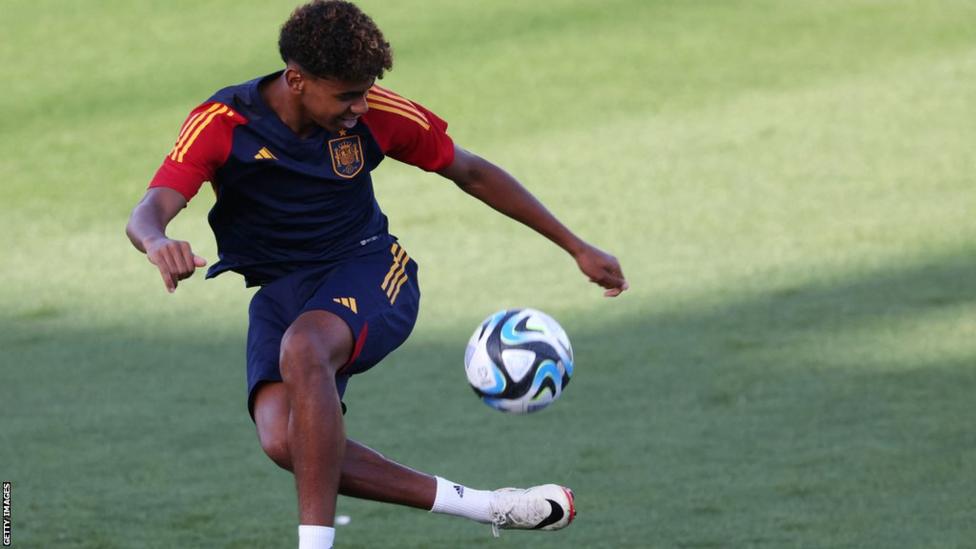
As one who is rooting for France to win the World Cup, I am terrified of Spain’s Lamine Yamal, who barely seems an adult—in fact, he looks like my youngest grandson, who sees the resemblance and is a fan—yet can do things with the ball that few men can do. While he hasn’t scored in this world cup, he is drawing multiple defenders, thereby opening up spaces for teammates.
Having beaten Belgium, the next foe is France, which Spain will play on Bastille Day. “I think that if France has anyone to fear, it’s us,” Yamal said after Spain’s recent victory. The Christopher Merrill poem below has me thinking of how Yamal’s attraction lies in part in the almost boyish joy he radiates while playing with the ball.
It also takes me back to one of my own childhood memories. We were living in the Hotel des Nations in Paris in June, which was close to the city’s Roman arena. I visited it one day around noon and saw six French school boys combining lunch with practice. Five of them were lined up, baguette sandwiches in hand, taking turns juggling a ball. Every once in a while, the boy with the ball would shoot towards the entryway, where a goalie stood. He would field the ball and roll it back to the group, whereupon another boy would begin juggling. Always, as I said, with sandwich in hand.
This was in 1963 and France wasn’t the soccer powerhouse that has since become. Nor was Paris yet the incubator of many of the world’s greatest players. Of the 1,248 players at this year’s World Cup, apparently 56 (4.3%) were born in Paris, the most of any city. (In all, 99 were born in France, with many choosing to play for other nations, including Morocco and the Côte d’Ivoire.) To be sure, the Parisian players don’t come from the Latin Quarter, where the arena is to be found, but from the working class immigrant suburbs. Still, my love of French soccer dates from this early encounter.
Here’s Merrill’s poem, which captures the love between boy and ball and reminds us that it all begins as a child’s game.
A Boy Juggling a Soccer Ball
Christopher Merrillafter practice: right foot
to left foot, stepping forward and back,
to right foot and left foot,
and left foot up to his thigh, holding
it on his thigh as he twists
around in a circle, until it rolls
down the inside of his leg,
like a tickle of sweat, not catching
and tapping on the soft
side of his foot, and juggling
once, twice, three times,
hopping on one foot like a jump-roper
in the gym, now trapping
and holding the ball in midair,
balancing it on the instep
of his weak left foot, stepping forward
and forward and back, then
lifting it overhead until it hangs there;
and squaring off his body,
he keeps the ball aloft with a nudge
of his neck, heading it
from side to side, softer and softer,
like a dying refrain,
until the ball, slowing, balances
itself on his hairline,
the hot sun and sweat filling his eyes
as he jiggles this way
and that, then flicking it up gently,
hunching his shoulders
and tilting his head back, he traps it
in the hollow of his neck,
and bending at the waist, sees his shadow,
his dangling T-shirt, the bent
blades of brown grass in summer heat;
and relaxing, the ball slipping
down his back…and missing his foot.
He wheels around, he marches
over the ball, as if it were a rock
he stumbled into, and pressing
his left foot against it, he pushes it
against the inside of his right
until it pops into the air, is heeled
over his head- the rainbow! –
and settles on his extended thigh before
rolling over his knee and down
his shin, so he can juggle it again
from his left foot to his right foot
– and right foot to left foot to thigh-
as he wanders, on the last day
of summer, around the empty field.