Wednesday
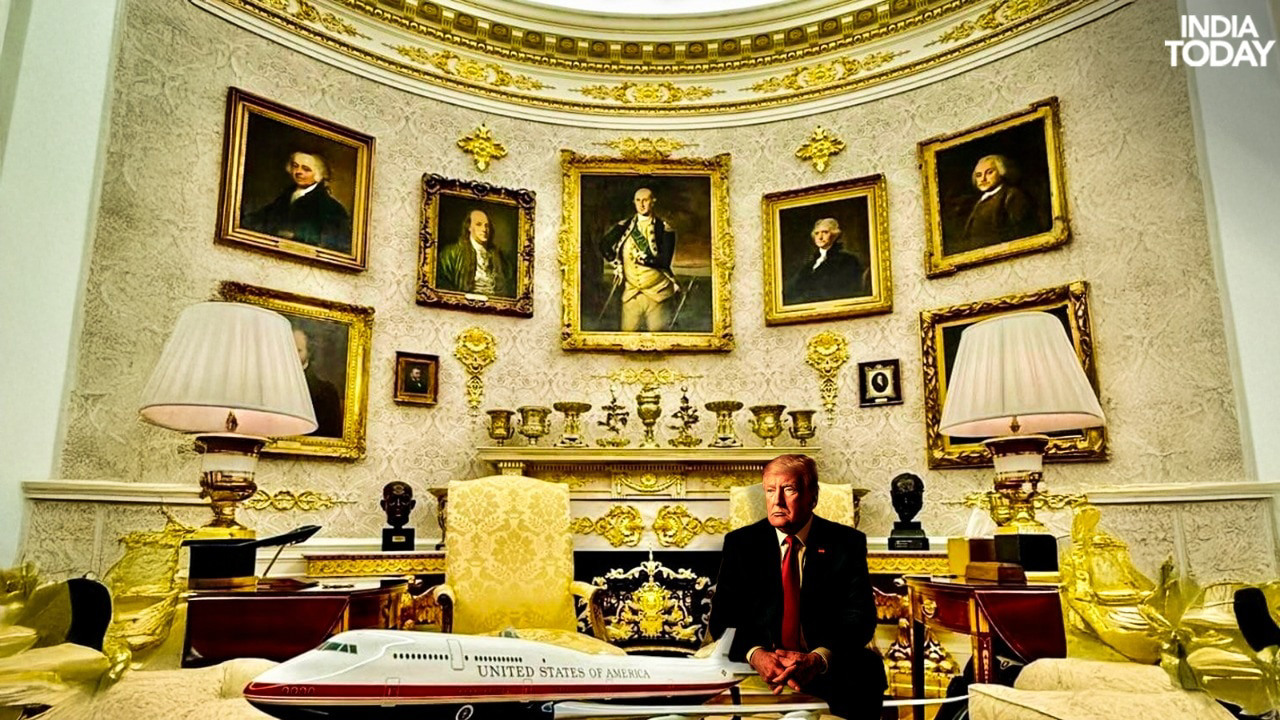
Yesterday I discussed DJT’s urge to gild everything he sees with gold leaf, including the Oval Office. I should also have mentioned the two bronze “Arts of War” statues located next to the Lincoln Memorial, “Valor” and “Sacrifice,” that the president had covered with 24-karat gold leaf for a mere $5.1 million.
More significant even than the cost is the symbolism. In an article in Architectural Digest on “The Political History of Gilding,” architect and historian Gary Lawrence observes that the wealthy in “the gilded age” (the label was coined by Mark Twain) used gold trim to signal their power. “Gold always represented a person’s status and was often overused in the homes of newly wealthy people,” he notes. “It was also used on exterior viewable things like carriages, horse fittings, and servants’ uniforms.”
Art historian Seem Rao, meanwhile, contends that “Trump’s faux gold work looks classy to someone who doesn’t know the historic markers of wealth.” Borrowed from Europe’s monarchical palaces, the gilding clashes with Washington’s neoclassical style, which was designed to invoke Athenian democracy and the Roman republic.
When I think of Trump’s love of gold trim, I fantasize about candidates for the presidency being subjected to the Portia test. This is the test in Shakespeare’s Merchant of Venice that suitors must pass if they are to win Portia’s hand. Involving a gold, a silver, and a lead casket, the test has been set up by her now-deceased father to ensure that she gets a worthy husband. One of the three contains her portrait and comes with the promise of marriage
As the Prince of Morocco, the first of her three suitors, sums up the choices,
The first, of gold, who this inscription bears,
“Who chooseth me shall gain what many men desire”;
The second, silver, which this promise carries,
“Who chooseth me shall get as much as he deserves”;
This third, dull lead, with warning all as blunt,
“Who chooseth me must give and hazard all he hath.”
How shall I know if I do choose the right?
Morocco figures that “many men” desire both gold and Portia and so chooses the gold casket. Inside he finds a picture of a skull and the following poem:
All that glisters [glitters] is not gold;
Often have you heard that told:
Many a man his life hath sold
But my outside to behold:
Gilded tombs do worms enfold.
Second suitor Aragorn figures he is too deserving to be grouped with “many men,” explaining,
I will not choose what many men desire,
Because I will not jump with common spirits
And rank me with the barbarous multitudes.
…Well, but to my choice:
“Who chooseth me shall get as much as he deserves.”
I will assume desert. Give me a key for this,
And instantly unlock my fortunes here.
His reward is a “portrait of a blinking idiot,” which is as much as he deserves.
Protagonist Bassanio rejects the gold and silver caskets, observing that “the outward shows be least themselves” because the world is too often “deceived with ornament”:
In law, what plea so tainted and corrupt,
But, being seasoned with a gracious voice,
Obscures the show of evil? In religion,
What damned error, but some sober brow
Will bless it and approve it with a text,
Hiding the grossness with fair ornament?
There is no vice so simple but assumes
Some mark of virtue on his outward parts…
He concludes,
Therefore, thou gaudy gold,
Hard food for Midas, I will none of thee;
Nor none of thee, thou pale and common drudge
‘Tween man and man: but thou, thou meagre lead,
Which rather threatenest than dost promise aught,
Thy paleness moves me more than eloquence;
And here choose I; joy be the consequence!
Although DJT, thinking himself to be the most deserving, might be tempted for a moment by the silver casket, he would undoubtedly go for “what many men desire,” starting with himself. I feel fairly confident that Barack Obama, Hillary Clinton, Joe Biden, and Kamala Harris would choose the lead casket as all are capable of setting aside ego for the good of the nation. Indeed, no president in American history would score lower on the Portia test than DJT.
Portia’s description of gold shows up in Gandalf’s letter to Frodo in Fellowship of the Ring, delivered to him by the innkeeper Butterbur. Its purpose is to assure the hobbits about Strider/Aragorn:
All that is gold does not glitter,
Not all those who wander are lost;
The old that is strong does not wither,
Deep roots are not reached by the frost.
From the ashes a fire shall be woken,
A light from the shadows shall spring;
Renewed shall be blade that was broken,
The crownless again shall be king.
While the poem describes Aragorn, it also describes Frodo, a commoner who grapples with the corrupting desire for power and prevails.
Both have deep moral roots. Neither is sidetracked by glitter.