Friday
For the foreseeable future I will be using Fridays to blog about single poems, stories, and plays that rocked my world. I distinguish these from works that I love because I love hundreds, if not thousands. These particular works must be foundational, changing the way I relate to the world. I must have felt the earth move under my feet as I encountered them.
Today I write about C.S. Lewis’s The Silver Chair, my introduction to Narnia. It stands out because it is enmeshed with Chris Mayfield, my first love at age eight.
Chris was wonderfully forthright. I remember her debating other boys in a spirited fourth grade argument about who came first, the girl scouts or the boy scouts, and refusing to back down. When the class staged a fourth-grade French play (under my mother’s direction), Chris wrote the script and then (as a reward) played the evil queen, whom she found far more interesting than Snow White. I also remember intimate conversations, such as when she told me, in great distress, that one day as a girl she would start bleeding, which she found terribly unfair. (I remember being fascinated and repulsed and wanting to change the conversation.) When J.R.R. Tolkien sent me two autographs in response to a fan letter I sent him, I gave one of them to Chris.
Chris’s family lived above us in the three-story wooden apartment building situated where Sewanee’s university library now stands. Chris’s father Judson was a seminarian at Sewanee’s School of Theology, which meant that the family was in town for three years. Perhaps he learned of Lewis’s Narnia book while at the seminary. In any event, it was Chris who introduced me to Silver Chair.
I remember standing with Chris in a large empty hall in our apartment complex—this in the winter of 1959–and her instructing me to lift up my arms as we asked Aslan to convey us to Narnia, Eustace instructs Jill to do this in the novel’s opening chapter, and I was as confused as she was. Nevertheless, I went along:
“That’s the east, facing up into the laurels. Now, will you say the words after me?”
“What words?” asked Jill.
“The words I’m going to say, of course,” answered Eustace. “Now——”
And he began, “Aslan, Aslan, Aslan!”
“Aslan, Aslan, Aslan,” repeated Jill.
“Please let us two go into——”
At this point they are threatened by bullies and must scramble to escape. In the process, they find themselves in Narnia.
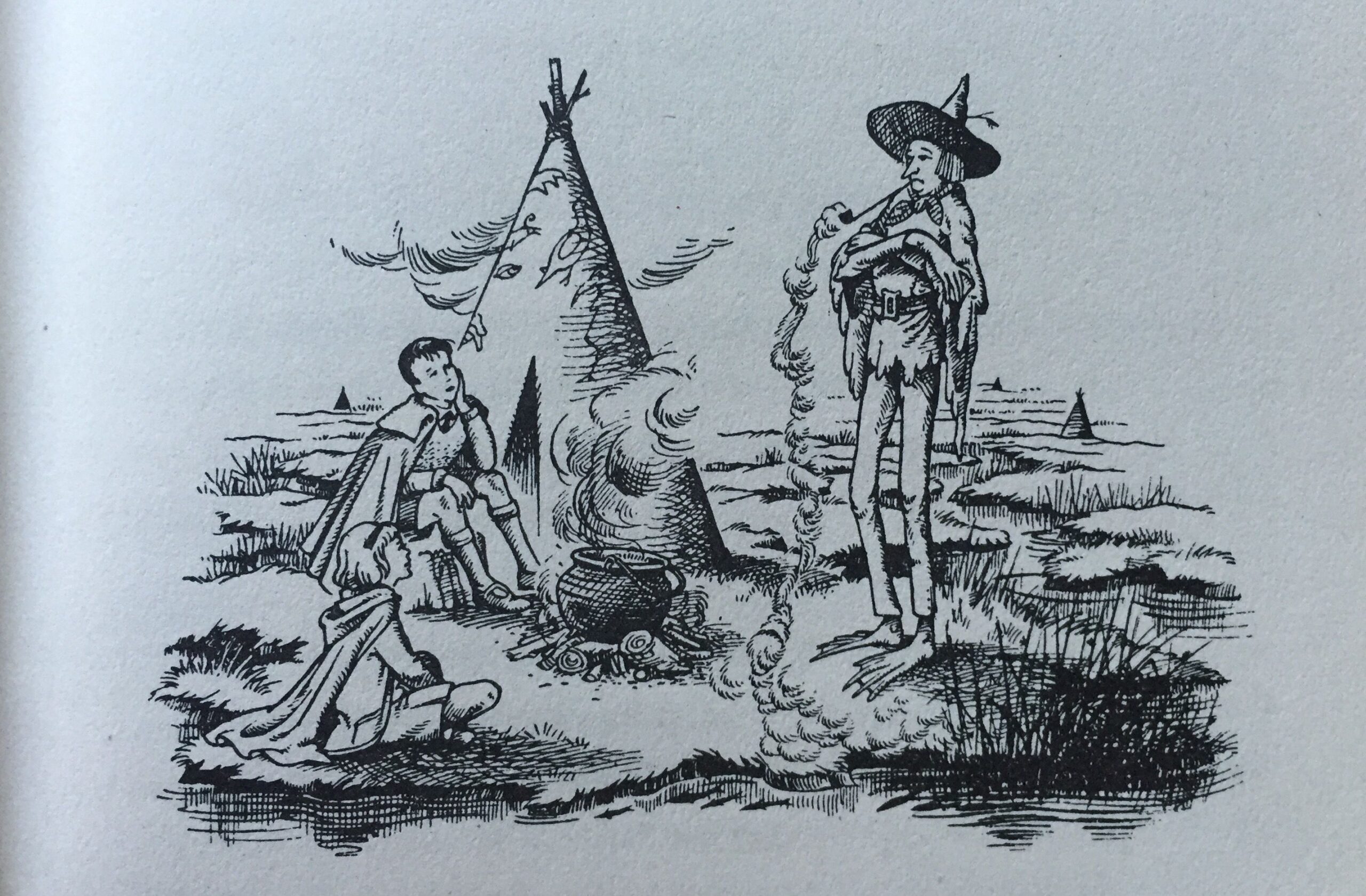
I was to discover, of course, that Narnia is a magical realm where I would (to cite W. H. Auden) “see rare beasts and have unique adventures.” Lewis borrows from Edmund Spenser’s Faerie Queene to create “the Lady of the Green Kirtle,” as well as from John Keats’s “La Belle Dame sans Merci” since she has Prince Rilian “in thrall.” There are also episodes reminiscent of Gulliver in Brobdingnag Alice falling down the rabbit hole, and John Bunyan’s Christian losing his bearings as he seeks the Celestial City. At one point Lewis alludes to Chaucer’s Parliament of Fowls, the green kirtle may echo Lady Bertilak’s green girdle in Sir Gawain and the Green Knight, and the book concludes with an Arthurian “return of the king” moment. There was much to enchant me about the book.
Its deeper significance, however, was that it revealed to me my own inner life. Jill, who to this day in my favorite Narnia character, is instructed by Aslan to remember certain signs that are to aid the children in their search for the prince. She neglects repeating them, however, gets them mixed up, and at one point dreams of an angry Aslan reminding her. I, who was obsessed with being good and never disappointing adults, carried around perpetual feelings of guilt that I was falling short. I recognized myself in this interior drama and found wonderfully healing the moment at the end where Aslan absolves Jill of her failings:
And in less time than it takes to breathe Jill forgot about the dead King of Narnia and remembered only how she had made Eustace fall over the cliff, and how she had helped to muff nearly all the signs, and about all the snappings and quarrellings. And she wanted to say “I’m sorry” but she could not speak. Then the Lion drew them towards him with his eyes, and bent down and touched their pale faces with his tongue, and said:
“Think of that no more. I will not always be scolding. You have done the work for which I sent you into Narnia.”
I now realize that Silver Chair gave Chris and me a model for our friendship. At the beginning of the book, Lewis complains that the school is co-educational, which in his eyes means that it lacks discipline and educational standards. Nevertheless, it is in this environment that Jill and Eustace become comrades, calling each other by their last names and problem solving together. Although they sometimes quarrel (as Chris and I sometimes quarreled), there is a level of equality that became my vision of how males and females should be. Although Lewis has been sometimes critiqued for his handling of women, especially Susan, my vision of a relationship was a version of Jill and Eustace going on adventures together and roughing it in the wild. Jill is the only female in the Narnia books that we see actually fighting (in The Last Battle), and the only time I was put off by her is when she acts girly. This happens when she is allaying the suspicions of their giant captors as they seek a way out of the castle:
The others admitted afterwards that Jill had been wonderful that day. As soon as the King and the rest of the hunting party had set off, she began making a tour of the whole castle and asking questions, but all in such an innocent, babyish way that no one could suspect her of any secret design. Though her tongue was never still, you could hardly say she talked: she prattled and giggled. She made love to everyone—the grooms, the porters, the housemaids, the ladies-in-waiting, and the elderly giant lords whose hunting days were past. She submitted to being kissed and pawed about by any number of giantesses, many of whom seemed sorry for her and called her “a poor little thing” though none of them explained why.
Chris and I bonded over dislike of Jill having to behave this way. While I grew up at a time of traditional housewives and southern belles, Jill—and Chris—gave me something else to look for in a woman. So, for that matter, did Aravis in The Horse and His Boy, and her relationship with Shasta/Cor may explain why this is my second favorite Narnia book. I remember enjoying Lewis’s description of their future together:
Aravis also had many quarrels (and, I’m afraid even fights) with Cor, but they always made it up again: so that years later, when they were grown up, they were so used to quarrelling and making it up again that they got married so as to go on doing it more conveniently.
I of course did not marry Chris but I did find someone like her in Julia, a woman determined to have her own career and one who insisted on an equal partnership. I regret that I lost touch with Chris, largely because I am a lousy correspondent. I know she went on to work for Southern Exposure and that she edited a book of essays on Growing Up Southern. I would reach out to her if I could find her address, but so far I have not been successful.
In the meantime, I remain deeply grateful for the role she played in my life and for being the one to introduce me to Narnia.