Monday
As we look ahead to autumn, which officially begins tomorrow, I share one of my favorite seasonal poems. Looking back, I’m amazed that I have never devoted a blog post to John Keats’s “Ode to Autumn,” which I first encountered when a high school freshman and felt instantly compelled to memorize.
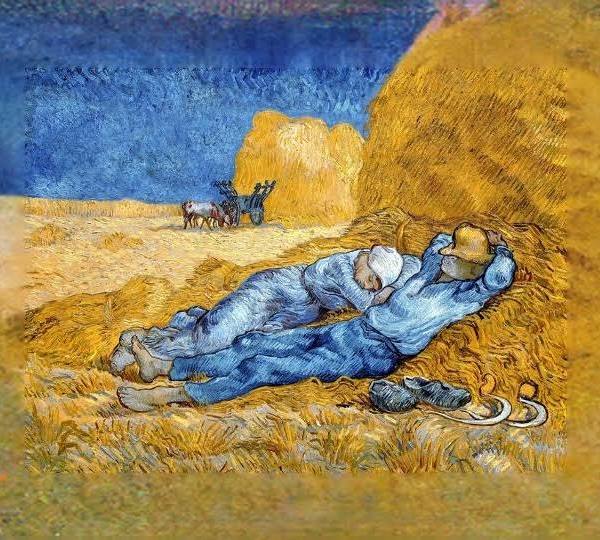
I didn’t know then that it was his last poem, that he would be dead a year later of tuberculosis. It does indeed feel like a valedictory to life, with the poet experiencing the full fecundity of nature as only someone dying can. The sun may be going down and the gathering swallows may be preparing to head south, but life feels so rich that, like the bees, the poet feels that “warm days will never cease.” Because the end is near, one can set down one’s scythe and concentrate only on the beauty of the moment. Life may be oozing away but, like the cider press, it is happening slowly and in such a way that one can watch it for hours.
We are like the small gnats, “borne aloft or sinking as the light wind lives or dies”—which is to say, vulnerable to whatever existence dishes out to us. And although spring gets all the publicity when it comes to birdsong, autumn has its own music. In the darkening landscape of the soft-dying day, with the sunset touching “the stubble plains with rosy hew,” the poet becomes attuned to nature’s chorus: gnats mourn, mature lambs bleat, hedge crickets sing, the red-breast whistles, and swallows twitter.
Many years ago I wrote about my dear friend and colleague Alan Paskow when he was dying of cancer. In the evenings we would often sit silently on his dock looking out upon a Potomac River inlet and reveling in nature’s beauty. He could fully appreciate how precious the moment was and I was privileged to see the world through his eyes.
In Alan’s memorial service, we listened to a recording Alan had taped in his final weeks of him reading a similar poem, Dylan Thomas’s “Fern Hill,” in which he also explained why it meant so much to him. (You can listen to or read the recording here.) In it he said/wrote, “There is something that lures us and that helps us and that enables us to see things, feel things, perceive things—that gives a kind of density and, for lack of a better word, significance to what we do.”
We shouldn’t have to be dying to see heaven in a wild flower and hold eternity in the palm of our hand (to borrow from another Romantic poet). “Ode to Autumn” shows us how to live into the world around us.
Ode to Autumn
By John Keats
Season of mists and mellow fruitfulness,
Close bosom-friend of the maturing sun;
Conspiring with him how to load and bless
With fruit the vines that round the thatch-eves run;
To bend with apples the moss’d cottage-trees,
And fill all fruit with ripeness to the core;
To swell the gourd, and plump the hazel shells
With a sweet kernel; to set budding more,
And still more, later flowers for the bees,
Until they think warm days will never cease,
For Summer has o’er-brimm’d their clammy cells.
Who hath not seen thee oft amid thy store?
Sometimes whoever seeks abroad may find
Thee sitting careless on a granary floor,
Thy hair soft-lifted by the winnowing wind;
Or on a half-reap’d furrow sound asleep,
Drows’d with the fume of poppies, while thy hook
Spares the next swath and all its twined flowers:
And sometimes like a gleaner thou dost keep
Steady thy laden head across a brook;
Or by a cyder-press, with patient look,
Thou watchest the last oozings hours by hours.
Where are the songs of Spring? Ay, where are they?
Think not of them, thou hast thy music too,—
While barred clouds bloom the soft-dying day,
And touch the stubble-plains with rosy hue;
Then in a wailful choir the small gnats mourn
Among the river sallows, borne aloft
Or sinking as the light wind lives or dies;
And full-grown lambs loud bleat from hilly bourn;
Hedge-crickets sing; and now with treble soft
The red-breast whistles from a garden-croft;
And gathering swallows twitter in the skies.