Sunday
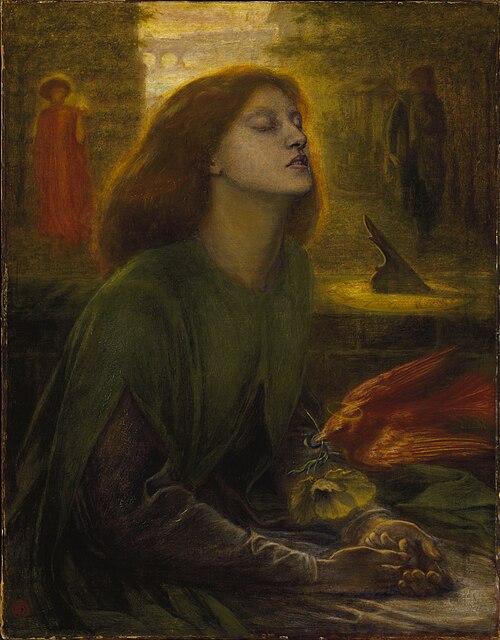
Episcopal churches can choose to read today the gorgeous depiction of Wisdom from The Book of Wisdom (or Book of Solomon). Personified as a woman, the figure is merged with Beatrice in Dante’s Divine Comedy, conducting him from Purgatorio to Paradiso. Here’s the passage:
Wisdom is radiant and unfading,
and she is easily discerned by those who love her,
and is found by those who seek her.
She hastens to make herself known to those who desire her.
One who rises early to seek her will have no difficulty,
for she will be found sitting at the gate.
To fix one’s thought on her is perfect understanding,
and one who is vigilant on her account will soon be free from care,
because she goes about seeking those worthy of her,
and she graciously appears to them in their paths,
and meets them in every thought. (Wisdom 6:12–16)
For an extended account of how a young woman that Dante met only once became his muse, I recommend Darrell Falconburg’s essay at Voegelin View Apparently the poet’s brief encounter with the young woman, who died at 24, pushed him so study philosophy. As he explains,
I quickly determined that Philosophy, who was the lady of these authors, sciences, and books, was a great thing. I imagined her fashioned as a gentle lady, and I could not imagine her in any attitude except one of compassion, so that the part of my mind that perceives truth gazed on her so willingly that I could barely turn away from her. I began to go where she was truly revealed, namely to the schools of the religious orders and to the disputations held by the philosophers, so that in a short period of time, perhaps some thirty months, I began to feel her sweetness so much that the love of her dispelled and destroyed every other thought.
In Divine Comedy it is Beatrice, at the behest of the Virgin Mary, who instructs Virgil to seek out Dante and lead him through Inferno and Purgatorio. As a pre-Christian, Virgil can’t take Dante further so Beatrice leads Dante into and through the various levels of Paradise. Dante first encounters her in the Garden of Eden atop Purgatorio:
With eyes upon the everlasting wheels
Stood Beatrice all intent, and I, on her
Fixing my vision from above removed,Such at her aspect inwardly became
As Glaucus, tasting of the herb that made him
Peer of the other gods beneath the sea.To represent transhumanise in words
Impossible were…
Through those eyes, he is able to ascend into Paradiso:
And as an arrow that upon the mark
Strikes ere the bowstring quiet hath become,
So did we speed into the second realm.My Lady there so joyful I beheld,
As into the brightness of that heaven she entered,
More luminous thereat the planet grew;And if the star itself was changed and smiled,
What became I, who by my nature am
Exceeding mutable in every guise!As, in a fish-pond which is pure and tranquil,
The fishes draw to that which from without
Comes in such fashion that their food they deem it;So I beheld more than a thousand splendors
Drawing towards us, and in each was heard:
“Lo, this is she who shall increase our love.”
Dante is not yet at the stage where he can look directly at Paradise, requiring Beatrice’s mediation. With his eyes focused on her, his affection “from every other longing was released”:
And the Lady who to God was leading me
Said: “Change thy thought; consider that I am
Near unto Him who every wrong disburdens.”Unto the loving accents of my comfort
I turned me round, and then what love I saw
Within those holy eyes I here relinquish;Not only that my language I distrust,
But that my mind cannot return so far
Above itself, unless another guide it.Thus much upon that point can I repeat,
That, her again beholding, my affection
From every other longing was released.While the eternal pleasure, which direct
Rayed upon Beatrice, from her fair face
Contented me with its reflected aspect,Conquering me with the radiance of a smile,
She said to me, “Turn thee about and listen;
Not in mine eyes alone is Paradise.”
Because, through Beatrice, he finally cleanses his heart—the process he has been undergoing ever since being lost in a dark wood—he is finally able to gaze upon the Virgin Mary and the Holy Trinity.
Or as today’s reading puts it:
Wisdom is radiant and unfading,
and she is easily discerned by those who love her,
and is found by those who seek her.