Wednesday
Yesterday, as I wrapped up my part of Ljubljana’s Shakespeare class with The Tempest, I recalled teaching it two years ago a few hours after learning that DJT had been reelected. As I wrote at the time,
If today’s essay is a bit uneven, it’s because–writing it from Slovenia–I started it fairly confident that Kamala Harris would win the election, only to begin realizing we were witnessing 2016 redux as the night wore on. What is meant as a comic if somewhat disturbing subplot in Shakespeare’s final play–inept insurrectionists trying to overthrow Prospero, destroy his magic book, and seize Miranda–suddenly became the central action. It was as if The Tempest had transmuted into Richard III. (Think of Prospero’s book as the Constitution, Miranda as reproductive freedom.) In the course of the night, my headline changed from “Caliban vs. Prospero” to “Can Caliban Defeat Prospero?” to (sadly) “Caliban Defeats Prospero.” Following Trump’s victory, white nationalist Nick Fuentes gloated, in a tweet that received 22,000 likes, “Your body, my choice. Forever.” Or as Caliban fantasizes after Prospero reminds him that he “didst seek to violate the honour of my child,”
O ho, O ho! would’t had been done!
Thou didst prevent me; I had peopled else
This isle with Calibans.
Since I was reeling from the election, I didn’t apply the play to events as thoroughly as I could have. For instance, I hadn’t realized how much the play is about the overthrow of legitimate authority and how Shakespeare fantasizes that it might be otherwise. Along with the overthrow of Prospero by his brother Antonio and king of Naples Alonso, there is the witch Sycorax imprisoning Aerial, Prospero subduing Caliban, Caliban plotting to overthrow Prospero, and Antonio and Alonso’s brother Sebastian plotting to overthrow Alonso. Yet for all that he sees, Alonso’s noble counselor Gonzalo dreams to a hippy commune in a vision that harkens back to Duke Senior in As You Like It:
I’ the commonwealth I would by contraries
Execute all things; for no kind of traffic
Would I admit; no name of magistrate;
Letters should not be known; riches, poverty,
And use of service, none; contract, succession,
Bourn, bound of land, tilth, vineyard, none;
No use of metal, corn, or wine, or oil;
No occupation; all men idle, all;
And women too, but innocent and pure;
No sovereignty…
All things in common nature should produce
Without sweat or endeavour: treason, felony,
Sword, pike, knife, gun, or need of any engine,
Would I not have; but nature should bring forth,
Of its own kind, all foison, all abundance,
To feed my innocent people.
We see a similar kind of idealism expressed by Miranda when she first encounters Alonso, Gonzalo, Antonio and Sebastian:
O, wonder!
How many goodly creatures are there here!
How beauteous mankind is! O brave new world,
That has such people in’t!
It is easy to be cynical about such idealism. In fact, Sebastian and Antonio rip Gonzalo’s vision apart, pointing out various political realities. Though Gonzalo imagines “no sovereignty,” Antonio observes, “Yet he would be king on’t,” and Sebastian follows up, “The latter end of his commonwealth forgets thebeginning.” As for idle men and women, there’s this response:
SEBASTIAN No marrying ‘mong his subjects?
ANTONIO None, man; all idle: whores and knaves.
Likewise, it’s difficult not read Aldous Huxley’s sarcasm into Miranda’s invocation of a brave new world. As I watched Trump pull off his unlikely comeback in 2024, it seemed like the Antonios and Sebastians of the world defined reality.
Indeed, if one compares Gonzalo’s naivete with Joe Biden’s, one can see it as positively dangerous. The counselor doesn’t factor in human evil. It’s all the more surprising since he witnessed Alonso’s overthrow of Prospero and so should be aware, as Biden and Attorney General Merritt Garland should have been aware, what such men are capable of. Prospero himself, who was studying his books rather than paying attention to plotters (in Biden’s case, he was trying to bring the nation back from Covid), is willing to “pardon the deceiver,” as he puts it in his epilogue. Or if not pardon, at least overlook. As he says to Antonio and Sebastian,
But you, my brace of lords, were I so minded,
I here could pluck his highness’ frown upon you
And justify you traitors: at this time
I will tell no tales.
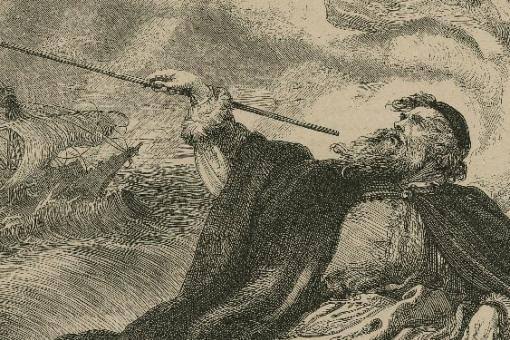
He knows that Antonio attempted to murder him and that the two were planning to murder Alonso, just as Biden and Garland knew what Trump had attempted on January 6. But he’s feeling so good that old enmities have been resolved, that the Miranda-Ferdinand marriage will bring together Milan and Naples, that he chooses to overlook what has happened. Let young people take over the future while he and Alonso retire. “But this rough magic,” he says, referring to his powers,
I here abjure, and, when I have required
Some heavenly music, which even now I do,
To work mine end upon their senses that
This airy charm is for, I’ll break my staff,
Bury it certain fathoms in the earth,
And deeper than did ever plummet sound
I’ll drown my book.
Though Prospero is no Lear, we see what happens when that king steps down prematurely—when fancy overrules political reality.
But here’s another way to see The Tempest. Cynicism doesn’t always get the last word in politics. There’s a place for Gonzalo’s, Miranda’s, and Prospero’s imagining. “We are such stuff as dreams are made on,” the duke famously says, and one can’t accuse Shakespeare of political naivete. This is the man, after all, who imagined Claudius, Macbeth, Richard III, Edmund, and many others
As I gave my own farewell to my students, I told them that it’s times for us oldies to step down, to break our staffs and drown our books, and cede the stage to them, the Ferdinands and Mirandas. They can do worse, I told them, than to Shakespeare for guidance. He gives both the human dangers to look out for and the human dreams to aspire to. He chose to end his career focused on dreaming, which isn’t a bad way to go out.