Note: If you wish to receive, via e-mail, (1) my weekly newsletter or (2) daily copies of these posts, write to me at rrbates1951@gmail.com. Comments may also be sent to this address. I promise not to share your e-mail with anyone. To unsubscribe, write here as well.
Monday
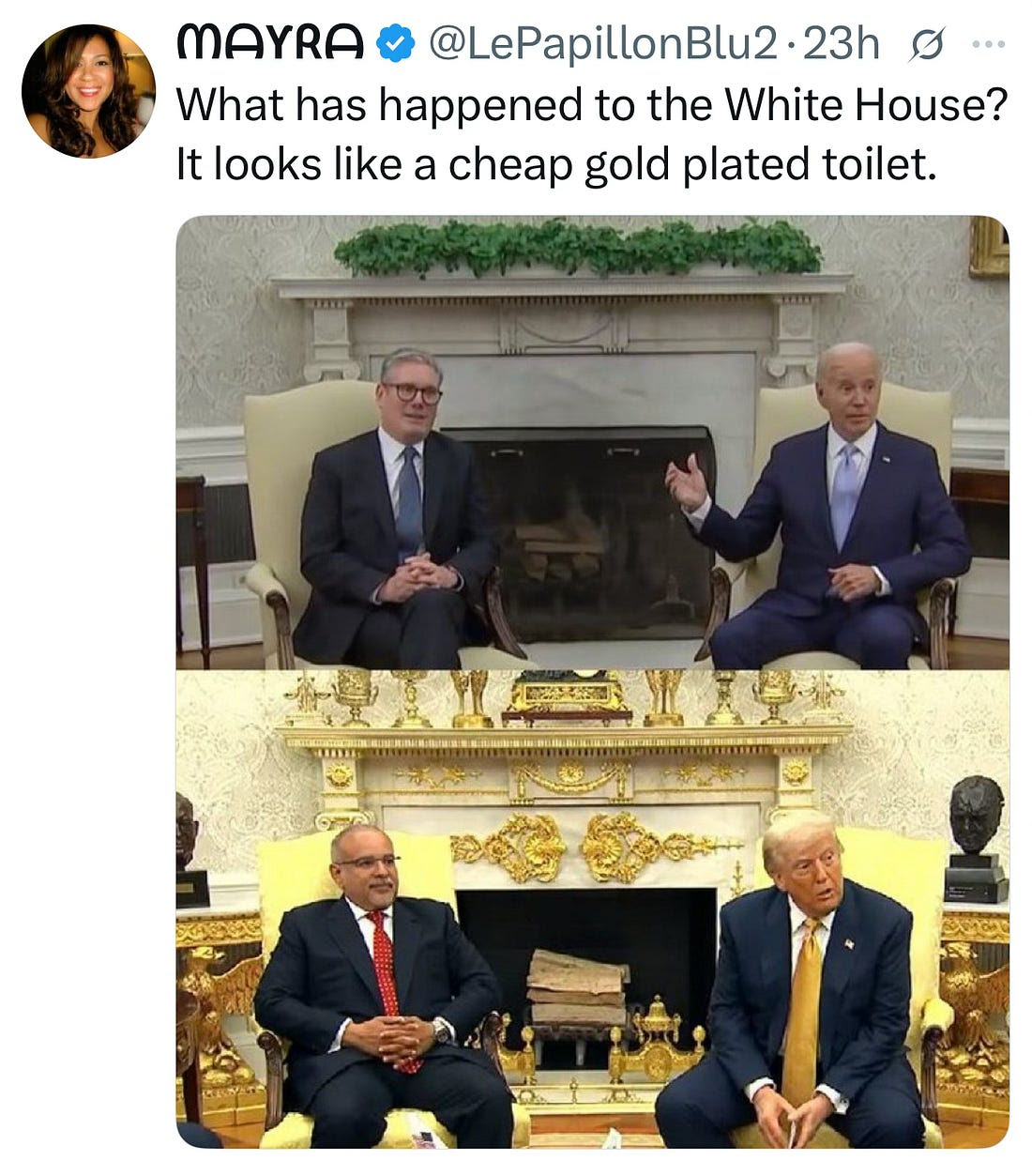
Compared to how Donald Trump and his administration are dismantling American democracy, his turning the White House into a tacky version of Versailles, gilding with gold its classical white marble, seems a minor matter. Still, it reveals his dream of being a monarch, which is at the heart of his rot. When I see photographs of his restoration job, I can’t help but think of Mrs. Elton in Jane Austen’s Emma.
Mrs. Elton is the foil of Austen’s protagonist, a daughter of new money who marries the suitor that Emma has rejected. Determined to replace Emma as the head of Highbury society, she talks incessantly about the barouche-landau owned by her wealthy brother and sister, and she is determined to show this backwater hamlet how things ought to be run. Her criticisms in the following passage are delivered aloud so that everyone can hear them:
She was a little shocked at the want of two drawing rooms, at the poor attempt at rout-cakes, and there being no ice in the Highbury card-parties. Mrs. Bates, Mrs. Perry, Mrs. Goddard and others, were a good deal behind-hand in knowledge of the world, but she would soon show them how everything ought to be arranged. In the course of the spring she must return their civilities by one very superior party—in which her card-tables should be set out with their separate candles and unbroken packs in the true style—and more waiters engaged for the evening than their own establishment could furnish, to carry round the refreshments at exactly the proper hour, and in the proper order.
One can imagine Mrs. Elton looking at the White House and concluding, like Trump, that it needs an attached ballroom.
In many ways her relationship to Emma is like Trump’s relationship to Barack Obama, who has a natural class that Trump hungers for and thinks he can achieve by amassing money and power. Oh, and by tarting up the president’s residence.
Emma, who represents old money, also has natural class. The drama of the novel, however, is whether Emma can live up to potential or whether she will descend to Mrs. Elton’s level. There are times when she is in danger of doing just that, whether by snobbishly rejecting Roger Martin as an appropriate partner for her protégé Harriet or by making a cheap joke at impoverished Miss Bates’s expense. In each case, neighboring squire John Knightley has to coach her into behavior expected of society’s leaders.
In the end, through honest self-reflection, Emma rises to the occasion, and the reward is marriage to Knightley. They have a classy and dignified wedding, and it is Mrs. Elton’s reaction to the ceremony that came to mind when I saw contrasting pictures of the White House Oval Office under Joe Biden and under Donald Trump (see picture above). Austen’s novel concludes with the following subtle and pitch perfect putdown:
The wedding was very much like other weddings, where the parties have no taste for finery or parade; and Mrs. Elton, from the particulars detailed by her husband, thought it all extremely shabby, and very inferior to her own.—“Very little white satin, very few lace veils; a most pitiful business!—Selina [her sister] would stare when she heard of it.”
To which Austen adds,
But, in spite of these deficiencies, the wishes, the hopes, the confidence, the predictions of the small band of true friends who witnessed the ceremony, were fully answered in the perfect happiness of the union.
Chef’s kiss for “in spite of these deficiencies.”
Speaking of Trump’s Obama envy, he also can’t stand that his predecessor won the Nobel Peace Prize, so much so that he even threatened the Norwegian finance minister with tariffs if Norway doesn’t give him one. This made blogger Greg Olear at Prevail think of “Ozymandias,” the well-known Percy Shelley sonnet about Egyptian pharaoh Ramesses II.
After noting that Trump has also taken over the Kennedy Center so that he can host the awards ceremony and name the recipients, Olear observes, “He wants the thing to be named after him, probably”:
This is a guy who basically spent his entire career putting his name on everything. He literally made money by licensing other people to put his name on things. So he’s big into this vainglory, right? This kind of “Me, me, me! I want to be the best. I want to be acknowledged as the greatest, as the genius, as the peacemaker, as the best supporting actor,” whatever. That’s what he wants.
Now for the poem:
I met a traveler from an antique land
Who said: “Two vast and trunkless legs of stone
Stand in the desert . . . Near them, on the sand,
Half sunk, a shattered visage lies, whose frown,
And wrinkled lip, and sneer of cold command,
Tell that its sculptor well those passions read
Which yet survive, stamped on these lifeless things,
The hand that mocked them, and the heart that fed:
And on the pedestal these words appear:
‘My name is Ozymandias, king of kings:
Look on my works, ye Mighty, and despair!’
Nothing beside remains. Round the decay
Of that colossal wreck, boundless and bare
The lone and level sands stretch far away.”
To be sure, Trump is no Ramesses II. “Lone and level sands” pretty much captures the barrenness of his interior landscape, however. And he shares Ozymandias’s ego.