Note: If you wish to receive, via e-mail, (1) my weekly newsletter or (2) daily copies of these posts, write to me at rrbates1951@gmail.com. Comments may also be sent to this address. I promise not to share your e-mail with anyone. To unsubscribe, write here as well.
Friday
I seem unable to leave off writing about my childhood so, in this Friday installment of My Life in Literature, I look once again at grades one through seven in Sewanee Public School. (In eighth grade I attended a French school in Paris, which will get its own essay.)
The years were 1957-1964 and the United States was experiencing a baby boom, which meant that our classes were packed. While we never hit 40 kids, we came up short by only two or three.
We had wooden desks joined by iron struts and featuring ink wells, although we were past the era when we used them as such. We were always seated in alphabetical order, and year after year we had the same five boys in the first row: Bruce Baird, Michael Barry Robin Bates, Binky Beaumont, and Tommy Camp (only Tommy, for whom I would later serve as best man, had eyesight and hearing difficulties and so was moved up to the front desk).
For the most part I remember school being a colossal bore. The textbooks we had were uninspired, and at nine or ten I remember arriving at the following theory: there are two kinds of reading, the reading you do in school and real reading. School reading featured dull stories with three or four questions at the end to ensure that we took something important away from the experience. Real reading involved stories and poems that we read on our own (like The Hardy Boys) or that my father read to us (Huckleberry Finn, Connecticut Yankee in King Arthur’s Court, Captains Courageous).
I’ve mentioned in the past how, because we didn’t have a television, I felt out of step with the other children. They would show up in class with the latest fad—hula hoops one year, yoyos another, troll dolls with long hair another, Beatles paraphernalia another—along with the latest fashion in notebooks and pens. I had no idea where these were coming from but everyone seemed to have them. I now realize, however, that the real reading I was doing at home gave me a kind of anchor to my being. I may not have seen the latest installment of The Beverly Hillbillies or Get Smart but I sensed that there was a richness in the world that provided life with meaning.
Seventh grade had one silver lining: we were introduced to Junior Scholastic books, which we could order for absurdly low prices. I remember purchasing Escape from Warsaw, Lost Cities and Ancient Civilizations, and a cartoon book about moments in history. These, however, were outside what was assigned. In English class, we were subjected to grammar exercises, spelling tests, and sentence diagramming, the latter of which even Mrs. Kirby-Smith didn’t totally understand. (Her name, incidentally, signaled that she was married to a descendant of the last Confederate general to surrender and who returned to Sewanee to teach math after the Civil War.)
The boredom problem existed as well with social studies. Up through fifth grade, we studied only geography, learning uninteresting facts from dull textbooks. Things got a little better in sixth grade when we studied world history. I was already prepped for this since I had been reading a lot of history at home, belonging as I did to the Landmark Book Club, which sent me a history book every month. I preferred the books about European history (the Vikings, Marco Polo, Joan of Arc, the Crusades) over those about American history (Daniel Boone, George Washington, the Civil War, the Mormons), but all of them were better than our history textbook.
I remember having one moment of revelation. The Landmark book about the Mormons was probably written by a Mormon, which meant that it was laudatory. I then read Arthur Conan Doyle’s Study in Scarlet, where Mormonism is depicted as a dark cult that will track down members who escape its clutches. For the first time in my life I realized that historical facts can be variously interpreted.
My favorite grade was fourth, partly because of the wonderful Mrs. Burton and partly because my mother came in several days a week to teach us French. I remember her cheerily greeting us with, “Bonjours, mes enfants. Comment allez-vous?” to which we would always respond, “Bonjours, Madame. Très bien, merci. Et vous?” I also remember my best friend Chris Mayfield writing the script for “Blanche Neiges and Les Sept Nains” [“Snow White and the Seven Dwarfs”], for which she got to choose her role. (Having a flair for the dramatic, Chris chose the wicked stepmother.) School was not boring in those moments.
Recess made school a little more bearable. We had two recesses a day, often unsupervised, and I remember my second-grade class once engaging in a spirited mudball fight, featuring red Tennessee clay. (The teacher must have been horrified when we trooped in, mud spattered, so that never happened again.) I also remember a moment in first grade when Jane Arlington whirled around and clocked me for something I said, bloodying my nose. We also played a lot of softball, which I enjoyed, and I particularly liked the annual field day at the end of the year, when we spent all day outside engaging in various competitions. Though small for my age, I was one of the faster runners.
I know I’m getting away from books here so I’ll round out the rest of my non-book life before finishing up. I was in the Cub Scouts and the Boy Scouts and may have been one of the few of my peers who recognized their origin in The Jungle Books. (I made it to the rank of Life but never to Eagle because, even though I had six more merit badges than was required, I wasn’t a strong enough swimmer to pass Life Saving.) I also took piano lessons and choir at the urging of my mother, a fine pianist, but exited as soon as I could. The activity I loved most was tennis, which became one of the great joys of my life and which I have been playing ever since.
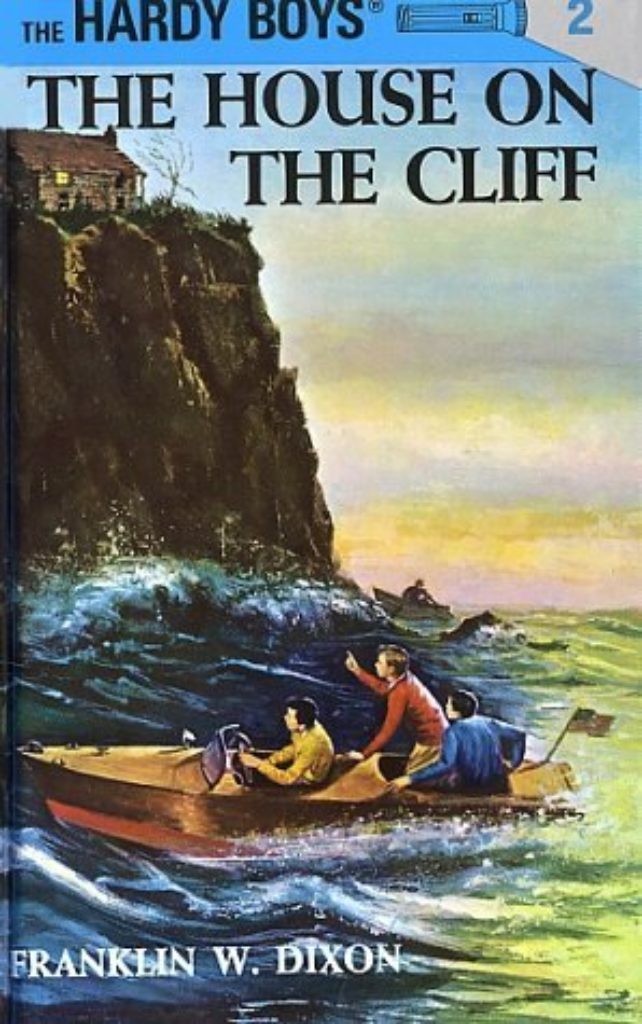
I also spent a lot of time clambering around Sewanee’s cliffs and caves, sometimes imagining myself as the Hardy Boys in The House on the Cliff; sometimes as the Bobbsey Twins (one of their books has them caught in a cave and cut off by the incoming tide); sometimes as the Scotch twins in the Lucy Finch Perkins book by that name; sometimes as Tintin in The Black Island (we had all the Tintin books, which had not yet been translated). Sewanee’s child-accessible wilderness—we could bicycle everywhere—meant that I related to books with open vistas, such as Treasure Island, Kidnapped, Swallows and Amazons, Last of the Mohicans, Wind in the Willows (the wild wood chapter), and the Oz books.
I conclude with one final memory. A high point of those seven years was a case of mononucleosis that I contracted at age 12. The mono was probably caused by the stress of our participation in a civil rights lawsuit (described here), but on the plus side it pulled me out of school for an extended period. Indeed, I think my mother, realizing how unhappy I was, allowed me to extend the home stay. In that period I buried myself in books, including (as I mentioned in a previous installment) Twelfth Night and Taming of the Shrew. I also reread Lord of the Rings, Narnia, and the George MacDonald Princess and Curdie books; listened so many times to a recording of actor Cecil Richards reading Alice in Wonderland that I had all the poems memorized; and listened to our recordings of Gilbert and Sullivan’s operettas. I didn’t miss school one bit.
As for the next “My Life in Literature” installment, allow me to announce it by borrowing from one of Howard R. Garis’s Uncle Wiggly stories, which my father read to us at a young age. Uncle Wiggly is a story-telling rheumatic rabbit whose (admittedly formulaic) adventures appeared in newspaper form for 50 years, beginning in 1910. To announce the upcoming installment, each story ended with something like “if the canary bird doesn’t take my lead pencil and stick it in his seed dish…” or “if the pussy cat doesn’t think the automobile tire is a bologna sausage, and tries to nibble a piece out to make a sandwich for the rag doll’s picnic…” So, in next Friday’s post, “if the onion doesn’t make tears come into the eyes of the potato when they’re playing tag around the spoon in the soup dish,” I’ll tell you about my book-intense year in France.