Note: If you wish to receive, via e-mail, (1) my weekly newsletter or (2) daily copies of these posts, write to me at rrbates1951@gmail.com. Comments may also be sent to this address. I promise not to share your e-mail with anyone. To unsubscribe, write here as well.
Sunday
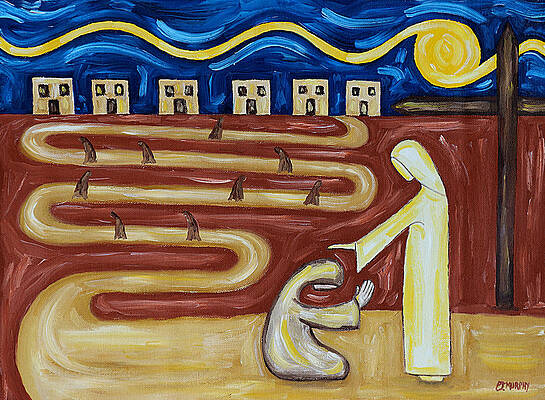
Whenever the day’s Gospel reading involves Jesus’s healing ministry, I turn to Lory Widmer Hess’s When Fragments Make a Whole: A Personal Journey through Healing Stories in the Bible. This remarkable book responds to each of those stories with a poem, an interpretation, and a personal application. For today’s story about Jesus and the ten lepers, Hess identifies with the one who has two strikes against him—he’s a leper and a Samaritan—, noting that this “leper amongst lepers” finds a higher level of healing, one that is intertwined with gratitude.
Here’s the story:
Now on his way to Jerusalem, Jesus traveled along the border between Samaria and Galilee. As he was going into a village, ten men who had leprosy met him. They stood at a distance and called out in a loud voice, “Jesus, Master, have pity on us!”
When he saw them, he said, “Go, show yourselves to the priests.” And as they went, they were cleansed.
One of them, when he saw he was healed, came back, praising God in a loud voice. He threw himself at Jesus’ feet and thanked him—and he was a Samaritan.
Jesus asked, “Were not all ten cleansed? Where are the other nine? Has no one returned to give praise to God except this foreigner?” Then he said to him, “Rise and go; your faith has made you well.” (Luke 17:11–19)
The action of turning back brings to Hess’s mind Lot’s wife, who also turned back. That story too involves the number 10, since
For ten good men
God would have saved
a city doomed
to perish in flames.
Connecting the two stories, Hess identifies more with the unrighteous than the righteous, with the one who is doubly cursed and who is
always to be kept
at a distance, apart
from the righteous, uncorrupted ones.
But although, in her dark moments, she has identified with Lot’s wife, looking back at the life she lost and standing “like a pillar pointing nowhere,” she then realizes that there’s another way of turning back. Although she has been trapped in salt, which carries with it associations with tears, she can break out of that static pose and journey back in a different way, which the tenth leper does:
Let the life in me rise
and break through my salt.
Let the pillar be gone.
I will find a new direction.
I will point toward him.
Here’s her poem:
Turned Back
By Lory Hess
For ten good men
God would have saved
a city doomed
to perish in flames.
But ten good men
could not be found.
Corruption reigned.
The city burned.
The righteous fled.
And one, unsaved,
was turned to salt,
to stand forever
looking back.
Even before
my skin turned to salt
I was one of the untouchables.
A Samaritan stands beyond the pale
for the ones who turn
toward Zion’s hill,
always to be kept
at a distance, apart
from the righteous, uncorrupted ones.
And never, never allowed to return
to the heart of their life,
to the God of their truth.
Now here we stand
in the space between:
nine men who might be good enough,
and one apart,
a leper among lepers.
I can stand among them,
but am not one of them.
I can cry out with them,
but their God will not hear me.
I can look back to the life I lost
and stand like a pillar
pointing nowhere.
But here comes life
along the road.
Here he is,
the Living One,
the one who will hear me,
the one who will answer,
the one who despises
nothing that lives.
Let the life in me rise
and break through my salt.
Let the pillar be gone.
I will find a new direction.
I will point toward him.
Let the others go on their righteous way
I will not move without giving thanks
to the one who turns toward our salvation.
He didn’t have to look for us.
He didn’t have to hear our cry.
He could have gone on, but he turned back.
He turned me back to myself.
And now
forever
I turn
to him
As Hess sees it, there are two steps in the healing process. The nine non-Samaritan lepers take only the first whereas the Samaritan experiences “an awakening of the true self”:
As we worship in spirit and in truth, we are healed of divisions arising from inessentials. The men who did not turn back were cleansed, they underwent catharsis, but were they truly healed? We need to add another step to the process, an awakening to the source of our blessings, turning toward it to form a new relationship full of love, mutual acceptance and gratitude. This does not happen unconsciously as we walk dully along our usual paths. It is an awakening of the true self: an activity that can be called “faith,” which leads to resurrection.
Applying the story to the times when she herself has grappled with illness, Hess says that the story reminds her of the importance of gratitude in the healing process. She says she is grateful, not only for the healing she has experienced, but for the illness itself, which has allowed her to know the power of healing. Put another way, she says she is grateful, “not only for the homecoming, but also for the journey into distant, uncomfortable and frightening places,” since that journey has enabled her “to truly know, appreciate, and value home upon my return.”
She concludes,
Gratitude for the gift of life, and for all that enables me to live, can germinate in the place of emptiness, and when it grows and expands, it makes me strong to receive all the further gifts God wants to bestow upon me.