Note: If you wish to receive, via e-mail, (1) my weekly newsletter or (2) daily copies of these posts, write to me at rrbates1951@gmail.com. Comments may also be sent to this addss. I promise not to share your e-mail with anyone. To unsubscribe, write here as well.
Wednesday
Of the many responses to playwright Tom Stoppard’s recent death, the most interesting to me has been a letter written to (I think) the London Times by Michael Baum, Professor Emeritus of Surgery and Visiting Professor of Medical Humanities at University College London. According to Wikipedia, Baum pioneered a radical breakthrough in breast cancer treatment, one that led to a 30% drop in mortality (!) while providing effective prevention in susceptible women. Baum said he owes the breakthrough in part to Stoppard’s play Arcadia.
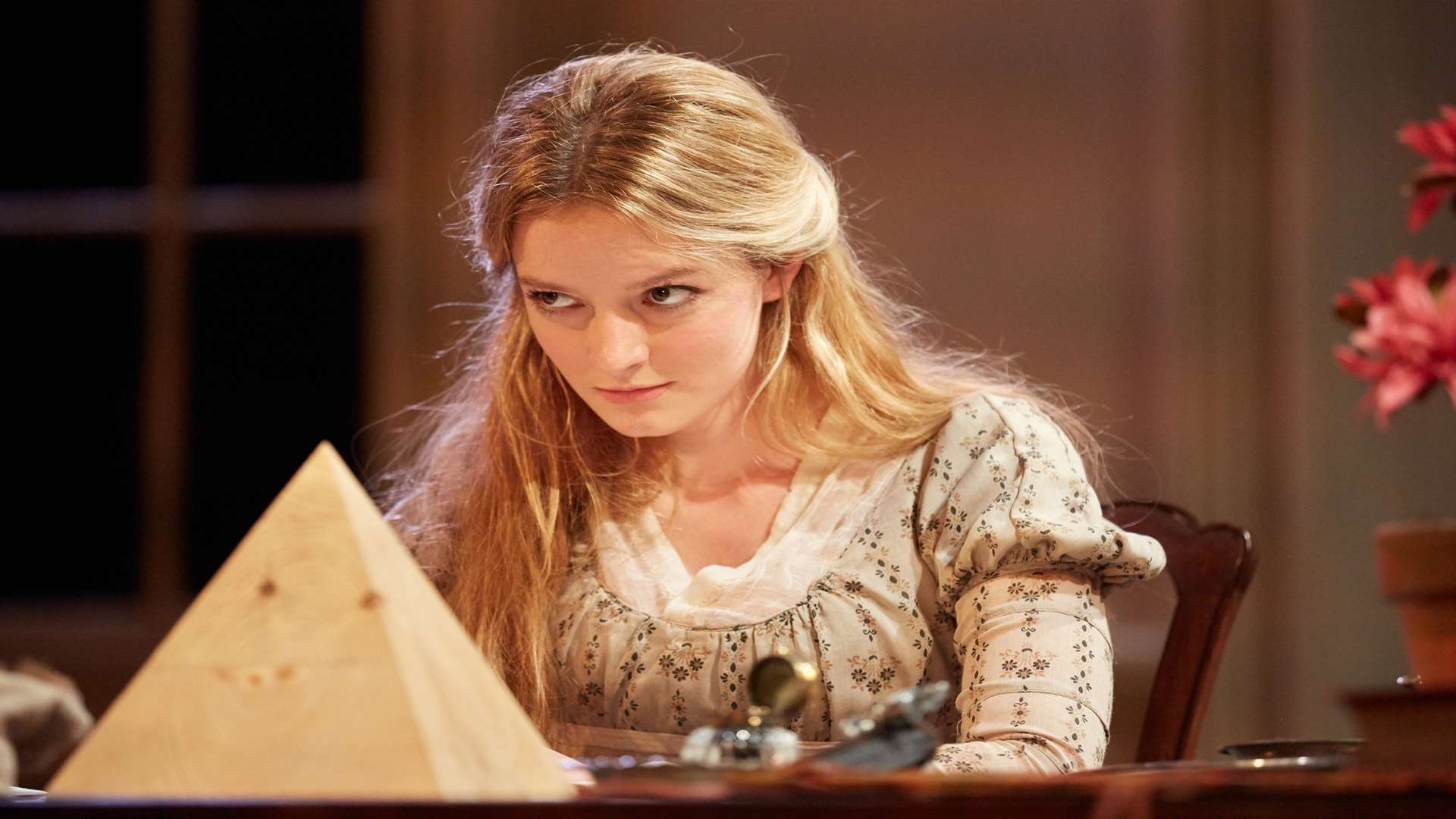
Perhaps Stoppard’s best play and my personal favorite, Arcadia features 17-year-old Thomasina, who is based on mathematical genius Ada Lovelace. The daughter of Lord Byron, Lovelace anticipated the invention of the computer while her work on fractals was a century ahead of its time. (It would take computers to prove her right.) In the play Thomasina points out that the Euclidean geometry of her day doesn’t come close to capturing the complexity of nature:
Thomasina: Each week I plot your equations dot for dot, xs against ys in all manner of algebraical relation, and every week they draw themselves as commonplace geometry, as if the world of forms were nothing but arcs and angles. God’s truth, Septimus, if there is an equation for a curve like a bell, there must be an equation for one like a bluebell, and if a bluebell, why not a rose? Do we believe nature is written in numbers?
Septimus: We do.
Thomasina: Then why do your equations only describe the shapes of manufacture?
Septimus: I do not know.
Thomasina: Armed thus, God could only make a cabinet.”
Later she points out,
Mountains are not pyramids and trees are not cones. God must love gunnery and architecture if Euclid is his only geometry. There is another geometry which I am engaged in discovering by trial and error…
The play toggles between past and present, with contemporary historians discovering Thomasina’s amazing work. They find a journal in which the 17-year-old declares,
I, Thomasina Coverly, have found a truly wonderful method whereby all the forms of nature must give up their numerical secrets and draw themselves through number alone. This margin being too mean for my purpose, the reader must look elsewhere for the New Geometry of Irregular Forms discovered by Thomasina Coverly.
We also see Thomasina’s insights into the nature of entropy:
When you stir your rice pudding, Septimus, the spoonful of jam spreads itself round making red trails like the picture of a meteor in my astronomical atlas. But if you stir backward, the jam will not come together again. Indeed, the pudding does not notice and continues to turn pink just as before. Do you think this is odd?
And one more observation:
If you act only on what you should do without heed for what you want to do, you’re nothing more than a machine, a phenomenon.
Dr. Baum calls his medical breakthrough a road-to-Damascus moment:
Sir,
In 1993 my wife and I went to see the first production of Arcadia by Tom Stoppard (obituary, Dec. 1), and in the interval I experienced a Damascene conversion. As a clinical scientist I was trying to understand the enigma of the behavior of breast cancer, the assumption being that it grew in a linear trajectory spitting off metastases on its way. In the first act of Arcadia, Thomasina asks her tutor, Septimus: “If there is an equation for a curve like a bell, there must be an equation for one like a bluebell, and if a bluebell, why not a rose?” With that Stoppard explains chaos theory, which better explains the behavior of breast cancer. At the point of diagnosis, the cancer must have already scattered cancer cells into the circulation that nest latent in distant organs. The consequence of that hypothesis was the birth of “adjuvant systemic chemotherapy,” and rapidly we saw a striking fall of the curve that illustrated patients’ survival.
Stoppard never learnt how many lives he saved by writing Arcadia.
I’m no scientist but it sounds like the play did more than provide Baum with compelling metaphors for chaos theory. Arcadia shows a character refusing to be bound by conventional categories and choosing instead to think outside the box—which it sounds like Baum did to arrive at his discovery.
Amazing things happen when scientists interact with the work of creative writers. Another reason why pre-med students should take literature courses.