Note: If you wish to receive, via e-mail, (1) my weekly newsletter or (2) daily copies of these posts, write to me at rrbates1951@gmail.com. Comments may also be sent to this addss. I promise not to share your e-mail with anyone. To unsubscribe, write here as well.
Thursday
On Tuesday I applied Shakespeare’s Macbeth to the Trump administration, seeing rising levels of violence associated with both. I look today at how Macbeth orders one of the killings since there’s currently disagreement as to who, in the U.S. military, gave the order to kill two survivors clinging to the wreckage of one of the boats destroyed by the Navy. Of course, the initial attack was already a crime, but the so-called “double tap” is particularly egregious given that killing survivors is specifically spelled out and expressly forbidden in the Navy handbook.
The act was so bad that even Trump and Hegseth are attempting to pass the buck, Trump to Hegseth and Hegseth to commander of the operation Admiral Frank “Mitch” Bradley. Hegseth had originally ordered Bradley to “kill everybody,” and perhaps Bradley took to heart Hegseth’s words—this when he postured before the nation’s military leaders this past September–that we
don’t fight with stupid rules of engagement. We untie the hands of our warfighters to intimidate, demoralize, hunt, and kill the enemies of our country. No more politically correct and overbearing rules of engagement, just common sense, maximum lethality, and authority for warfighters.
If he chose to dispense with the rules of engagement, Bradley may be sweating bullets as Hegseth now appears to be backing away from him. Hegseth’s declaration, “I stand by him and the combat decisions he has made” is not the same as “Bradley carried out my orders.” While acknowledging that he witnessed the initial strike, the Defense Secretary said he left the room before the double tap because “at the Department of War we got a lot of things to do.” He also said that the “fog of war” obscured what actually happened.
Macbeth too seeks to distance himself from the crime he is orchestrating. As he addresses the two men who are to kill his former companion Banquo, he acknowledges that he could “with barefac’d power sweep him from my sight.” Doing so, however, would alienate certain allies. “I must not,” he says,
For certain friends that are both his and mine,
Whose loves I may not drop, but wail his fall
Who I myself struck down: and thence it is
That I to your assistance do make love [beg your help],
Masking the business from the common eye
For sundry weighty reasons.
In addition to masking the business, he tells the men to make sure they kill Banquo far from the palace.
Catching my eye in Macbeth’s exchange is the Trumpian tactic of inflaming grievances to get people to do one’s dirty work. Banquo had done you wrong, he tells the two men, which sounds a lot like Trump and Hegseth inflaming passions against (in this case) the men in the boats. Now, we don’t have any evidence that Banquo has in fact rendered the murderers’ lives destitute and miserable, just as there’s no evidence that the drugs on board the boats (if drugs were in fact involved) were bound for the U.S. But facts don’t matter to autocrats. Still, Macbeth’s killers, like Trump’s supporters, buy into his accusations:
Mabeth: Both of you
Know Banquo was your enemy.
Both Murderers: True, my lord.
For his part, Bradley sounds like he bought the Trumpian line of drug traffickers at war with the U.S., rationalizing that the survivors “were still legitimate targets because they could theoretically call other traffickers to retrieve them and their cargo.” Realizing how problematic this sounded, the Joint Special Operations Command subsequently said the second strike was not to kill survivors but to remove a navigation hazard.
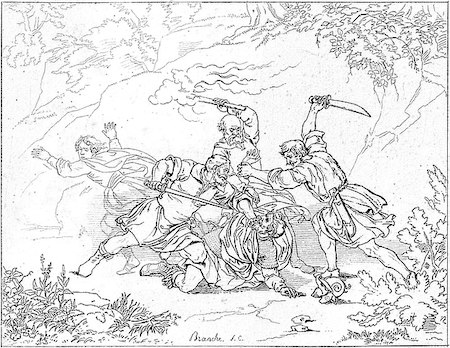
Macbeth doesn’t only seek to stir up vengeful resentment but also challenges the killers’ manhood. Do you let religion get in your way, he asks at one point, and at another, are you hounds and demi-wolves or lapdogs and spaniels? Tell me you’re “not i’ th’ worst rank of manhood,” he demands. Pete Hegseth made his own macho challenge when strutting before the generals. “Weak men won’t qualify because we’re not playing games,” he said at one point and, at another, “Should our enemies choose foolishly to challenge us, they will be crushed by the violence, precision, and ferocity of the War Department. In other words, to our enemies, FAFO [Fuck Around and Find Out]. If necessary, our troops can translate that for you.”
So, if you don’t blast small boats out of the water, you’re not real men.
“Banquo, thy soul’s flight, if it find heaven, must find it out tonight,” Macbeth gloats after the murderers leave, and I can imagine Hegseth indulging in his own private gloating. But people who thrill to the prospect of killing people we call sociopaths and psychopaths.
The difference between the two is that sociopaths are at least capable of feeling guilt. This would make the Macbeths sociopaths since they both arrive at moments of searing self-reflection. “Out, damned spot! out, I say!” says Lady Macbeth as she walks in her sleep and then, “What, will these hands ne’er be clean?….Here’s the smell of the blood still: all the perfumes of Arabia will not sweeten this little hand.”
Macbeth, meanwhile, comes to realize the hollowness of his life and the emptiness of ambition in one of literature’s most memorable passages:
Tomorrow, and tomorrow, and tomorrow,
Creeps in this petty pace from day to day,
To the last syllable of recorded time;
And all our yesterdays have lighted fools
The way to dusty death. Out, out, brief candle!
Life’s but a walking shadow; a poor player,
That struts and frets his hour upon the stage,
And then is heard no more: it is a tale
Told by an idiot, full of sound and fury,
Signifying nothing.
Trump and Hegseth are both idiots full of sound and fury. Will they ever be capable of realizing it?