Thursday
Teacher and author Brendan James Murray has written a lovely Guardian article about how our society and our schools are failing to foster childhood imaginations and what we must do to compensate. The article has me revisiting both my own childhood and how I parented my children.
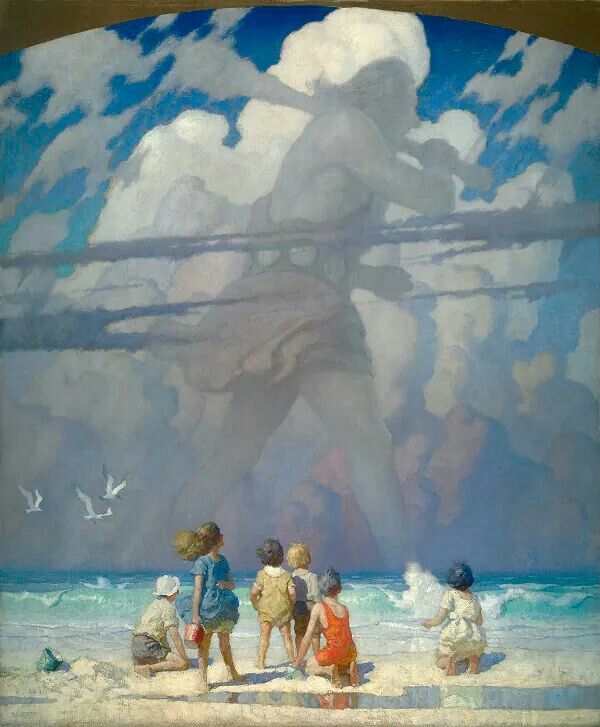
Murray begins with an N.C. Wyeth painting of six children on a beach rapturously gazing up at a cloud giant. With no adults in sight, the children have the freedom to let their minds roam where they will. There are no tests here, no carefully scheduled activities, nothing but the power of the imagination.
I’m thinking that Murray could also have included in his piece—and perhaps does in Childhood, the book from which the article is excerpted—the opening paragraph of Alice’s Adventures in Wonderland:
Alice was beginning to get very tired of sitting by her sister on the bank and of having nothing to do; once or twice she had peeped into the book her sister was reading, but it had no pictures or conversations in it, ‘and what is the use of a book,’ thought Alice, ‘without pictures or conversation?’
At this point, Alice’s mind goes down a rabbit hole, as it were, and we’re off and running as Lewis Carroll pushes back against his increasingly pragmatic society. It’s a reminder that suspicion of the imagination has a history: the Victorians’ Puritan work ethic has a lot to answer for. Carroll’s nonsense takes constant aim at poems meant to teach stern moral lessons and rigid educational programs designed to teach practical knowledge.
In the topsy-turvy world of Wonderland, education is turned on its head. When Alices asks the Mock Turtle and Gryphon what they were taught in school, she gets a wondrous response:
‘Well, there was Mystery,’ the Mock Turtle replied, counting off the subjects on his flappers, ‘ – Mystery, ancient and modern, with Seaography; then Drawling – the Drawling-master was an old conger-eel, that used to come once a week; he taught us Drawling, Stretching, and Fainting in Coils.’
‘What was that like?’ said Alice.
‘Well, I can’t show it you myself,’ the Mock Turtle said, ‘I’m too stiff. And the Gryphon never learnt it.’
‘Hadn’t time,’ said the Gryphon, ‘I went to the Classics master, though. He was an old crab, he was.’
‘I never went to him,’ the Mock Turtle said with a sigh, ‘he taught Laughing and Grief, they used to say.’
‘So he did, so he did,’ said the Gryphon, sighing in his turn; and both creatures hid their faces in their paws.
‘And how many hours a day did you do lessons?’ said Alice in a hurry to change the subject.
‘Ten hours the first day,’ said the Mock Turtle, ‘nine the next, and so on.’
‘What a curious plan!’ exclaimed Alice.
‘That’s the reason they’re called lessons,’ the Gryphon remarked, ‘because they lessen from day to day.’
Contrast this with the educational system as depicted by Murray:
The truth is that all very young children do have rich imaginations and navigate rich imaginative worlds. However, almost all will lose this faculty by their mid-teens, or have it dimmed nearly out of existence.
This is something that is accepted and largely unquestioned in our culture, as though loss of imagination is an inevitability of growing up. Through this lens, imagination becomes associated with immaturity.
Murray wonders whether western culture’s reprioritization can be attributed to an industrialized society in which unfettered imagination didn’t appear to serve capitalist needs. “To invite children into an activity free of demands,” he writes, “is to face the adult anxiety of those children achieving nothing”:
The need for students to create products and demonstrate measurable skills is predicated on the belief that we can only know that a child has developed if we are able to gather objective data. Were we to say, “Those children benefited from imagining a giant in the sky,” a modern educator (myself included) might be tempted to counter: “What data do you have to support that?”
Murray complains that the emphasis on data and criteria even crop up in classes designed to teach creativity:
With the introduction of criteria to assess any of the create-ivity emerging from the students’ closely surveilled efforts, we have perhaps the most stifling and sanitized imaginative space conceivable. Write a story, but it must follow the conventions of science fiction. Write a poem, but it must employ the poetic style of Emily Dickinson. Write a paragraph, but it must begin with a topic sentence. Must. Instruction; structure; walls and barriers and limits.
Murray calls out himself in the process:
Teachers like myself are so focused on the power of criteria to guide students that we almost never acknowledge the absolutely unavoidable reality that every criteria has a shadow criteria, that which implies all the infinite things the students cannot do. In some sense, criteria are imagination’s opposite, its antonym. Give us what we want. Imagination blotted out by insistence on a specific product demanded by an authority figure. All the freedom of water poured into a concrete aqueduct. Learn the rules so you can break them? Only if the rules don’t break you first.
Looking back at my own childhood, I realize how lucky I was to have a father who encouraged non-stop creativity. Mostly he conveyed this through reading to us every night, but we also witnessed his poetry and his paintings, which often involved nails, hinges, and other hardware. At times he appeared more a child than an adult, especially at Christmas.
I remember how the stories we encountered would shape our childhood activities. Thanks to living in the small and safe mountaintop community of Sewanee, Tennessee, we could bicycle everywhere, and I remember thinking of myself as Lucy Fitch Perkins’s Scottish Twins as I explored Sewanee’s caves and as E. Nesbit’s Bastable children as I played with my brothers. Meanwhile, my grandparents’ Peoria mansion, with its mysterious servant stairways and spacious attic, was rendered especially magical because we saw it through the lens of The Lion, the Witch, and the Wardrobe and The Magician’s Nephew.
With this upbringing, I understood what drove Tom Sawyer when he incorporates his reading into his play. There’s the oath he has his gang swear at the beginning of Huckleberry Finn (inspired, Huck says, by his “pirate-books and robber-books”) and the elaborate escape he engineers for Jim. When Huck is confused as to why they need to bake a pie to smuggle in a saw to free the prisoner, Tom reveals his sources:
“Why, you just said a body could lift up the bedstead and slip the chain off.”
“Well, if that ain’t just like you, Huck Finn. You can get up the infant-schooliest ways of going at a thing. Why, hain’t you ever read any books at all?—Baron Trenck, nor Casanova, nor Benvenuto Chelleeny, nor Henri IV., nor none of them heroes? Who ever heard of getting a prisoner loose in such an old-maidy way as that? No; the way all the best authorities does is to saw the bed-leg in two, and leave it just so, and swallow the sawdust, so it can’t be found, and put some dirt and grease around the sawed place so the very keenest seneskal can’t see no sign of it’s being sawed, and thinks the bed-leg is perfectly sound. Then, the night you’re ready, fetch the leg a kick, down she goes; slip off your chain, and there you are. Nothing to do but hitch your rope ladder to the battlements, shin down it, break your leg in the moat—because a rope ladder is nineteen foot too short, you know—and there’s your horses and your trusty vassles, and they scoop you up and fling you across a saddle, and away you go to your native Langudoc, or Navarre, or wherever it is. It’s gaudy, Huck. I wish there was a moat to this cabin. If we get time, the night of the escape, we’ll dig one.”
To these works I would add the sequel to Alexander Dumas’s Three Musketeers, which features such an escape.
Of course, the scene seems less funny to me now that I can see how Tom is using a grown man as a toy (not unlike how the South at the time was infantilizing African Americans). But as a child, I saw Tom’s imagining as simply what one did.
I’ve written about how, in third grade, I distinguished between “school reading” and “real reading”—school reading had a deflating set of questions at the end, which further ruined an already boring and agenda-driven story—and that I remember few assignments that spurred my imagination indicates just how seldom it happened. But I do remember my otherwise awful sixth grade teacher (Miss Esther) telling us to bring in items inspired by Roman history. (I created a Roman scroll, from which I read Twain’s humorous piece in Innocents Abroad on gladiatorial combat.) And there was Audrey Goldfinch, my seventh grade homeroom teacher, who had the entire class (all 38 of us) write a Halloween horror story, in which we were only allowed to read the paragraph written by the person directly ahead of us. (It meandered wonderfully and had a boffo ending that I still remember: “I knew I was to become one of those floating bodies.”) So it’s not as though school didn’t have potential. It just seldom lived up to it.
The opportunity to indulge the imagination was one of the most rewarding aspects of fatherhood. Not only did I read every night to my three sons, but I made up stories as we commuted to soccer and baseball practice. When we would pass an old African American man walking near the “Honey Bunny Daycare Center” (honestly, that was its name), I informed them that the center was an undercover CIA operation and the man was actually a spy. The stories spiraled from there.
I also learned that I could trigger their imaginations and then get out of the way. When Justin, at 12, informed me that Julia and I weren’t his real parents. I asked him to tell me about his actual parents and got an extended story that provided insight into some of his frustrations. (As I recall, after allowing Justin to vent, the story ended on a forgiving note with him concluding that Julia and I were adequate as substitutes.) All of which is to say that there is a role for adults in their children’s imagining lives. After all, those Wyeth children on the beach would not be imagining a giant if some adult hadn’t told or read them fairy tales. Our job is to listen, to respect, and to encourage.
Oh, and regarding the issue of practicality? My sons are gainfully employed–one in marketing, one in teaching—and their fellow employees love working with them. They light up every room they enter.