Sunday
This week my monthly book group will be discussing Chaucer’s Wife of Bath, who does a wonderfully comic—and possibly blasphemous—take on today’s Gospel reading. Alisoun invokes the loaves and fishes story in a defense of her lusty nature.
After Chaucer I turn to Mary Oliver, whose take is more serious and yet, curiously, not altogether different.
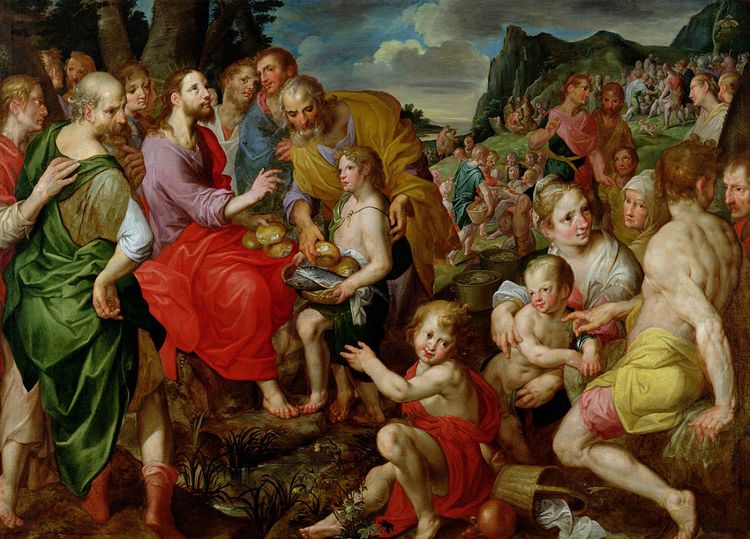
Let’s start with the story as it appears in Matthew (14:13-21):
Jesus withdrew in a boat to a deserted place by himself. But when the crowds heard it, they followed him on foot from the towns. When he went ashore, he saw a great crowd; and he had compassion for them and cured their sick. When it was evening, the disciples came to him and said, “This is a deserted place, and the hour is now late; send the crowds away so that they may go into the villages and buy food for themselves.” Jesus said to them, “They need not go away; you give them something to eat.” They replied, “We have nothing here but five loaves and two fish.” And he said, “Bring them here to me.” Then he ordered the crowds to sit down on the grass. Taking the five loaves and the two fish, he looked up to heaven, and blessed and broke the loaves, and gave them to the disciples, and the disciples gave them to the crowds. And all ate and were filled; and they took up what was left over of the broken pieces, twelve baskets full. And those who ate were about five thousand men, besides women and children.
Alisoun, who has had five husbands and is probably looking for a sixth on this pilgrimage to Canterbury, has spent her entire life being judged by men. Given a captive audience, she takes the opportunity to defend her sexual nature. While acknowledging that men prefer the purity of the Virgin Mary to lusty widows, she asks how anyone would be born if all women were virgins. “Are you telling me,” she asks her stunned audience, “that our ‘instruments’ were only made for urinating?”
Then she changes tack, acknowledging that Christ was a virgin (not a normal way of describing him), as were many saints. She points out, however, that the world needs all kinds, both white bread virgins and barley bread wives like herself. This leads to the Biblical reference:
Christ was a maid, and yet shaped like a man,
And many a saint, since this old world began,
Yet has lived ever in perfect chastity.
I bear no malice to virginity;
Let such be bread of purest white wheat-seed,
And let us wives be called but barley bread;
And yet with barley bread (if Mark you scan)
Jesus Our Lord refreshed full many a man.
In such condition as God places us
I’ll persevere, I’m not fastidious.
In wifehood I will use my instrument
As freely as my Maker has it sent.
If I be niggardly, God give me sorrow!
In other words, she is like Christ, refreshing multitudes with her barley bread. Some of the pilgrims are scandalized while others are titillated and fully entertained. I put Chaucer in the latter category as I find Alisoun to be one of the most vibrant characters in all of literature, up there with Falstaff and Tom Jones.
Now to Mary Oliver, who has a compelling explanation for Jesus’s miracle. When we reflect upon the story, we should not worry “about what is reality, or what is plain, or what is mysterious.” If we had been part of that crowd, she says, “the felt ferocity” and “the felt necessity” of Jesus’s love for us would make anything seem possible:
Logos
By Mary Oliver
Why worry about the loaves and fishes?
If you say the right words, the wine expands.
If you say them with love
and the felt ferocity of that love
and the felt necessity of that love,
the fish explode into many.
Imagine him, speaking,
and don’t worry about what is reality,
or what is plain, or what is mysterious.
If you were there, it was all those things.
If you can imagine it, it is all those things.
Eat, drink, be happy.
Accept the miracle.
Accept, too, each spoken word
spoken with love.
Although the extroverted Wife of Bath and the introverted Oliver could not be further apart, each has the same passionate intensity for life. For Oliver, the feeding of the multitude becomes a kind of eucharist, where she experiences Jesus’s love as something sensuous: the eating and drinking are part of accepting Jesus’s vision of love.
This merging between eating and ecstatic communion is more clearly captured in Oliver’s death-and-resurrection poem about a fish she has caught (“The Fish”). After watching it die and then eating it, she writes,
Now the sea
is in me: I am the fish, the fish
glitters in me; we are
risen, tangled together, certain to fall
back to the sea. Out of pain,
and pain, and more pain
we feed this feverish plot, we are nourished
by the mystery.
While I know Chaucer is (at least here) a comic satirist while Oliver is more of a mystic, Alisoun’s vision of herself as sacramental barley bread now seems less outlandish. We will learn, from her tale, that she too is looking for love—for a man who will listen to her, respect her, and love her for who she is. She is the Samaritan woman at the well, and if men misinterpret her passionate search—well, that’s on them.
Jesus would speak to her with love.