Monday
Daniel Mendelsohn, Editor-at-Large of The New York Review of Books and recent Odyssey translator, has a free podcast where he discusses Christopher Nolan’s film. While generally open to artists riffing off Homer—they’ve been doing so for at least as far back as Euripides–he is critical of the way that the director has radically altered the character of the protagonist. Because Nolan focuses on men haunted by how they have unleashed destruction upon the world–think Robert Oppenheimer and the atomic bomb in Nolan’s previous film—the director passes over Odysseus’s wit and his charm. Matt Damon’s Odysseus is a guilt stricken man.
Mendelsohn also notes that Nolan doesn’t handle women well in any of his films, including this one. As a result, we have one-dimensional depictions of Circe, Penelope, and especially Kalypso, who in Homer voices one of early literature’s greatest protests against the gods as she seeks to hold on to Odysseus. To help rectify this imbalance, I share how women writers have rethought Circe and Penelope.
In the past I’ve written posts on feminist treatments of Circe by Margaret Atwood and Madeline Miller (here) and of Penelope by Atwood and one of my former students (here). I share today two Circe poems by Nobel laureate Louise Glück and a Penelope poem by Britain’s former poet laureate Carol Ann Duffy.
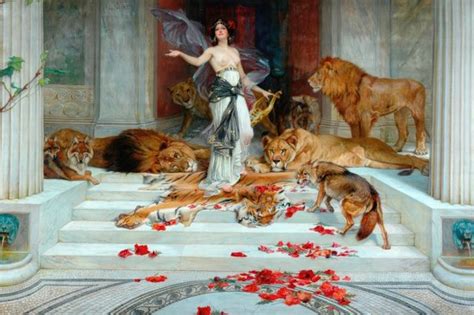
In Glück’s “Circe’s Power,” the sorceress makes a point that Nolan’s Circe also makes, that she didn’t turn the men into pigs but just made them “look like pigs.” “Your men weren’t bad men,” she explains. “Undisciplined life did that to them.” Indeed, “under the care of me and my ladies, they sweetened right up.”
As for her tears about Odysseus leaving, she shows greatness of mind in understanding her limitations. Having seen the essence of Odysseus’s men, she adds that “nobody sees essence who can’t/ Face limitation.” The limitation is that she can’t hold Odysseus if he wants to leave. She could “hold you prisoner” but chooses not to:
Circe’s Power
By Louise Glück
I never turned anyone into a pig.
Some people are pigs; I make them
Look like pigs.
I’m sick of your world
That lets the outside disguise the inside. Your men weren’t bad men;
Undisciplined life
Did that to them. As pigs,
Under the care of
Me and my ladies, they
Sweetened right up.
Then I reversed the spell, showing you my goodness
As well as my power. I saw
We could be happy here,
As men and women are
When their needs are simple. In the same breath,
I foresaw your departure,
Your men with my help braving
The crying and pounding sea. You think
A few tears upset me? My friend,
Every sorceress is
A pragmatist at heart; nobody sees essence who can’t
Face limitation. If I wanted only to hold you
I could hold you prisoner.
“Circe’s Grief,” meanwhile, is a warning to men who cheat on their wives (and probably vice versa). Even if the husband (or wife) has left the lover and returned home pretending nothing has happened, the spouse knows. It is as though the abandoned lover has goddess-like powers. “If I am in her head forever,” Circe says ominously, “I am in your life forever.”
Circe’s Grief
By Louise Glück
In the end, I made myself
Known to your wife as
A god would, in her own house, in
Ithaca, a voice
Without a body: she
Paused in her weaving, her head turning
First to the right, then left
Though it was hopeless of course
To trace that sound to any
Objective source: I doubt
She will return to her loom
With what she knows now. When
You see her again, tell her
This is how a god says goodbye:
If I am in her head forever
I am in your life forever.
Duffy has a different take. Penelope may have taken up weaving to occupy her time while waiting for Odysseus to return, but in the end the weaving has become her main interest. Upon her loom she depicts “the smile of a woman at the center/ of this world, self-contained, absorbed, content.” When her needle’s “leaping fish” creates a river, it is a river that doesn’t need to reach the sea.
Penelope
By Carol Ann Duffy
At first, I looked along the road
hoping to see him saunter home
among the olive trees,
a whistle for the dog
who mourned him with his warm head on my knees.
Six months of this
and then i noticed that whole days had passed
without my noticing.
I sorted cloth and scissors, needle, thread,
thinking to amuse myself,
but found a lifetime’s industry instead.
I sewed a girl
under a single star—cross-stitch, silver silk—
running after childhood’s bouncing ball.
I chose between three greens for the grass;
a smoky pink, a shadow’s grey
to show a snapdragon gargling a bee
I threaded walnut brown for a tree,
my thimble like an acorn
pushing up through umber soil.
Beneath the shade
I wrapped a maiden in a deep embrace
with heroism’s boy
and lost myself completely
in a wild embroidery of love, lust, lessons learnt;
then watched him sail away
into the loose gold stitching of the sun.
And when the others came to take his place,
disturb my peace,
I played for time.
I wore a widow’s face, kept my head down,
did my work by day, at night unpicked it.
I knew which hour of the dark the moon
would start to fray,
I stitched it.
Grey threads and brown
pursued my needle’s leaping fish
to form a river that would never reach the sea.
I tried it. I was picking out
the smile of a woman at the center
of this world, self-contained, absorbed, content,
most certainly not waiting,
when I heard a far-too-late familiar tread outside the door.
I licked my scarlet thread
and aimed it surely at the middle of the needle’s eye once more.
When Odysseus walks through the door, she doesn’t miss a beat.
The poem reminds me of one of Atwood’s Circe poems that I discuss in the essay linked to above. Odysseus is so obsessed with movement—Atwood could have Tennyson’s Ulysses in mind here as well—he doesn’t appreciate the here and now. As Circe’s Atwood puts it:
There must be more for you to do
than permit yourself to be shoved
by the wind from coast
to coast to coast, boot on the boat prow
to hold the wooden body
under, soul in control
And further:
Don’t you get tired of saying Onward?
Then she gives her own version of the peace that Duffy’s Penelope finds:
Ask at my temples
where the moon snakes, tongues of the dark
speak like bones unlocking, leaves falling
of a future you won’t believe in
Ask who keeps the wind
Ask what is sacred
Miller’s Circe discovers something similar:
I stepped into the woods and my life began.
I learned to braid my hair back, so it would not catch on every twig, and how to tie my skirt at the knee to keep the burrs off. I learned to recognize the different blooming vines and gaudy roses, to spot the shining dragonflies and coiling snakes. I climbed the peaks where the cypresses speared black into the sky, then clambered down to the orchards and vineyards where purple grapes grew thick as coral. I walked the hills, the buzzing meadows of thyme and lilac, and set my footprints across the yellow beaches. I searched out every cove and grotto, found the gentle bays, the harbor safe for ships. I heard the wolves howl, and the frogs cry from their mud. I stroked the glossy brown scorpions who braved me with their tails. Their poison was barely a pinch. I was drunk, as the wine and nectar in my father’s halls had never made me. No wonder I have been so slow, I thought. All this while I have been a weaver without wool, a ship without the sea. Yet now look where I sail.…And when I did get lonely, … then there was always the forest. The lizards darted along the branches, the birds flashed their wings. The flowers, when they saw me, seemed to press forward like eager puppies, leaping and clamoring for my touch.
In his podcast, Mendelsohn thinks that Nolan could have spared himself the criticism of classicists like himself if he had titled his film An Odyssey rather than The Odyssey. An Odyssey would have signaled that he was going to create an Odysseus markedly different from Homer’s.
It’s clear what Atwood, Miller, Glück, and Duffy are up to. Faced with a seminal work in western civilization that has helped shape how men see women, they rewrite it to open up new possibilities.
None of this detracts from Homer’s original work. The Greeks were elastic with their gods, Mendelsohn writes, and works as great as The Odyssey stimulate artists for centuries afterwards.