Wednesday
Why have a book festival in the middle of a war?
Why have a war in the middle of a book festival?
So begins an inspiring essay by historian Timothy Snyder on a Ukrainian book fair held in the face of ongoing Russian attacks. On May 24 alone, Snyder reports, Russia launched more than six hundred missiles and drones at the capital city of Kyiv and environs. Nevertheless, Book Arsenal, Kyiv’s annual festival, continued on.
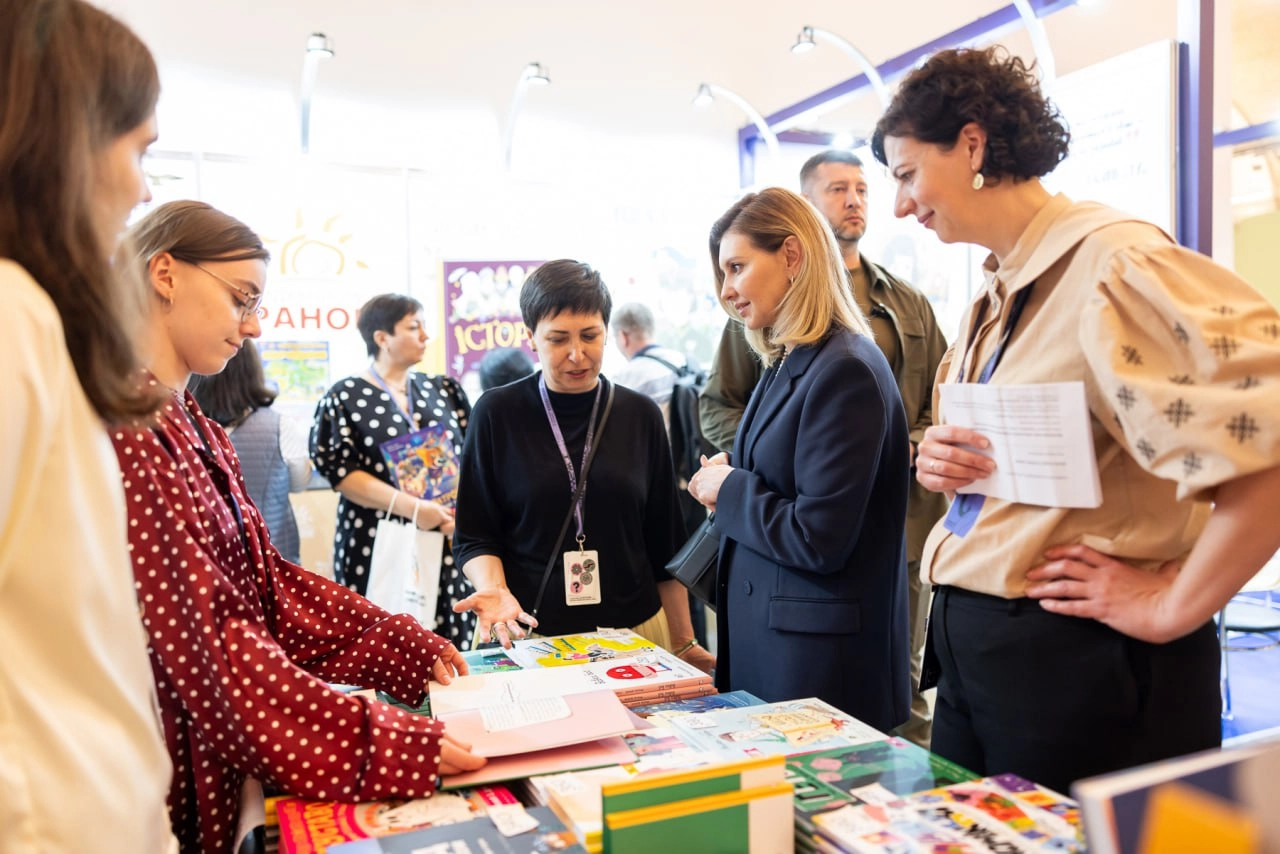
Book publishing apparently is currently undergoing “an extraordinary renaissance” in Ukraine. Over 100 book publishers showed up for the fair and tens of thousands visited the 240 events. This year’s motto was “Bear your freedom.”
As for the missiles, Snyder’s contact informed him that one waits for them to pass and then goes on as usual:
Air raids are an interruption; when they are finished, participants in Book Arsenal go back to talking about books. People in Kyiv are frustrated by these interruptions, or angry, or sleepless; but after four years these Russian war crimes become a part of life, to which one adapts.
Snyder says that the danger can be judged and navigated thanks to apps and Telegram channels, which alert people to impending air raids. Nevertheless, four were killed and a hundred injured in the May 24 bombings. On June 1 another 18 died as Russia fired 700 missiles and drones at Dnipro and Kyiv.
Russia has particularly targeted cultural sites, publishing houses, archives, libraries, and museums. In occupied zones, Russians collect and burn Ukrainian books, and the 2024 Arsenal Festival featured an exhibit on “Books Destroyed by Russia.” “Genocide,” Snyder observes, “is about eliminating a people, and it includes the attempt to eliminate their ability to think for themselves, as themselves, in their own language.” Therefore, book publication is seen as self-defense and reading as a form of resistance. The historian states that
good books liberate us from the obvious and prepare us for the real. It might seem like, at the edge, where life meets death, we should put the books down; this is not what one sees in Ukraine. The last time I went to the front I rode with soldiers who were bringing books to other soldiers.
The Roman stoic philosopher Seneca is particularly popular at the moment, especially his essay “On the Shortness of Life.” In it he argues that life is long enough if we do what is important.
Along these lines, blogger Matt Labash recently alerted me to a poem about those who do what is important in the face of death. It takes a poem to do justice to these “Local Heroes” because, Labash says, poetry stands up “when prose fails to answer the call.” Author Thomas Lynch, who is a Michigan undertaker, has a particular perspective on “what matters and what doesn’t.”
Local Heroes
By Thomas Lynch
Some days the worst that can happen happens.
The sky falls or weather overwhelms or
The world as we have come to know it turns
Towards the eventual apocalypse
Long prefigured in all the holy books —
The end times of floods and conflagrations
That bring us to the edge of our oblivions.
Still, maybe this is not the end at all,
Nor even the beginning of the end.
Rather, one more in a long list of sorrows,
To be added to the ones thus far endured,
Through what we have come to call our history:
Another in that bitter litany
That we will, if we survive it, have survived.
Lord, send us in our peril, local heroes,
Someone to listen, someone to watch,
Someone to search and wait and keep the careful count
Of the dead and missing, the dead and gone
But not forgotten. Sometimes all that can be done
Is to salvage one sadness from the mass of sadnesses,
To bear one body home, to lay the dead out
Among their people, organize the flowers
And casseroles, write the obits, meet the mourners at the door,
Drive the dark procession down through town
Toll the bell, dig the hole, tend the pyre.
It’s what we do. The daylong news is dire —
Full of true believers and politicos
Old talk of race and blame and photo ops.
But here brave men and women pick the pieces up.
They serve the living tending to the dead.
They bring them home, the missing and adrift,
They give them back to let them go again.
Like politics, all funerals are local.
Ukrainians undoubtedly know well what Lynch is talking about. Thousands of them are local heroes.