Wednesday
As we celebrate last Tuesday’s rejection of Trumpism, we don’t know how much damage the president and fascist enabler Stephen Miller can do in the remaining two years. The final scene in Umberto Eco’s The Name of the Rose offers us one dark scenario.
I’m traveling and so don’t have the novel before me, but (as I recall) disaster strikes after justice has seemingly prevailed Franciscan monk Williams of Baskerville (the Sherlock Holmes reference is deliberate) has been called in to solve a murder in a Benedictine abbey with an impressive library. Further murder are committed while he is there, some of them involving blackened lips and fingers. Ultimately we learn that a lost Aristotle manuscript is at the heart of the mayhem.
Before moving on, here’s an observation by Baskerville assistant Adso of Melk about the library:
Until then I had thought each book spoke of the things, human or divine, that lie outside books. Now I realized that not infrequently books speak of books: it is as if they spoke among themselves. In the light of this reflection, the library seemed all the more disturbing to me. It was then the place of a long, centuries-old murmuring, an imperceptible dialogue between one parchment and another, a living thing, a receptacle of powers not to be ruled by a human mind, a treasure of secrets emanated by many minds, surviving the death of those who had produced them or had been their conveyors.
Adso comes to realize how vulnerable books are:
A book is a fragile creature, it suffers the wear of time, it fears rodents, the elements and clumsy hands. so the librarian protects the books not only against mankind but also against nature and devotes his life to this war with the forces of oblivion.
Given the dangers of oblivion, the monks find intoxicating the discovery of work by Aristotle that no one knew existed. Eco imagines this work to be a sequel to The Poetics, Aristotle’s exploration of theatrical tragedy. This second work discusses the virtues of comedy. It’s a discovery of cosmic proportions, and no monk who comes across the volume can resist opening it and diving in.
The blind monk Jorge, however, believes the book to be an abomination because he regards laughter as a sin. Given the veneration that monastic scholarship accords to Aristotle, he fears that a book celebrating comedy will corrupt all who read it. He therefore coats the edges of the manuscript with arsenic, correctly figuring that anyone reading it would lick his finger to turn the pages.
Baskerville confronts Jorge with his crime and, very much in the manner of Holmes, explains how he has penetrated the mystery. As I recall, he exhibits some of the same smug self-satisfaction that we see in Doyle’s great detective. Readers, meanwhile, are glad the crime has been solved. We’re at the point in my political parallel where America rejoices over the country’s rejection of Trumpism.
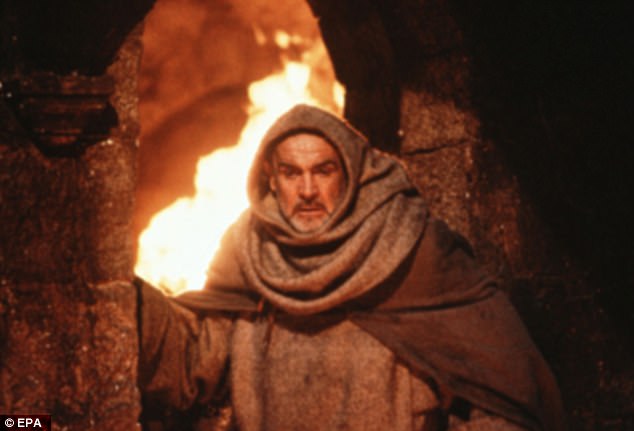
Unfortunately, the self-destructive blind monk still has a trick up his sleeve. First, he begins to eat the poisoned pages. Then, when a horrified Adso rushes forward to prevent him, he grabs the lantern (he can sense its heat) and disappears into the stacks. Before long, the entire library is aflame and the great collection is destroyed. Baskerville and his assistant escape the conflagration but leave the scene with their spirits broken.
Will Trump and Miller do something comparable, setting the world on fire now that they are desperate. Rightwing commentator Tucker Carlson, who has become critical of the president, fears that he will drop a nuclear bomb on Iran. Miller, meanwhile, burns with the fanaticism of the true believer, which means that he may double down on his attacks on immigrants, small fishing vessels, and people he disagrees with. We can expect that Russell Vought, a primary architect of the Heritage Foundation’s Project 2025, to be similarly fanatical. Their goal is maximum destruction.
At the end of the novel we are told Adso returns to the ruins of the abbey years later. His goal: to salvage scraps and fragments and begin building a new library. We need our own rebuilding project.