Note: If you wish to receive, via e-mail, (1) my weekly newsletter or (2) daily copies of these posts, write to me at rrbates1951@gmail.com. Comments may also be sent to this address. I promise not to share your e-mail with anyone. To unsubscribe, write here as well.
Thursday
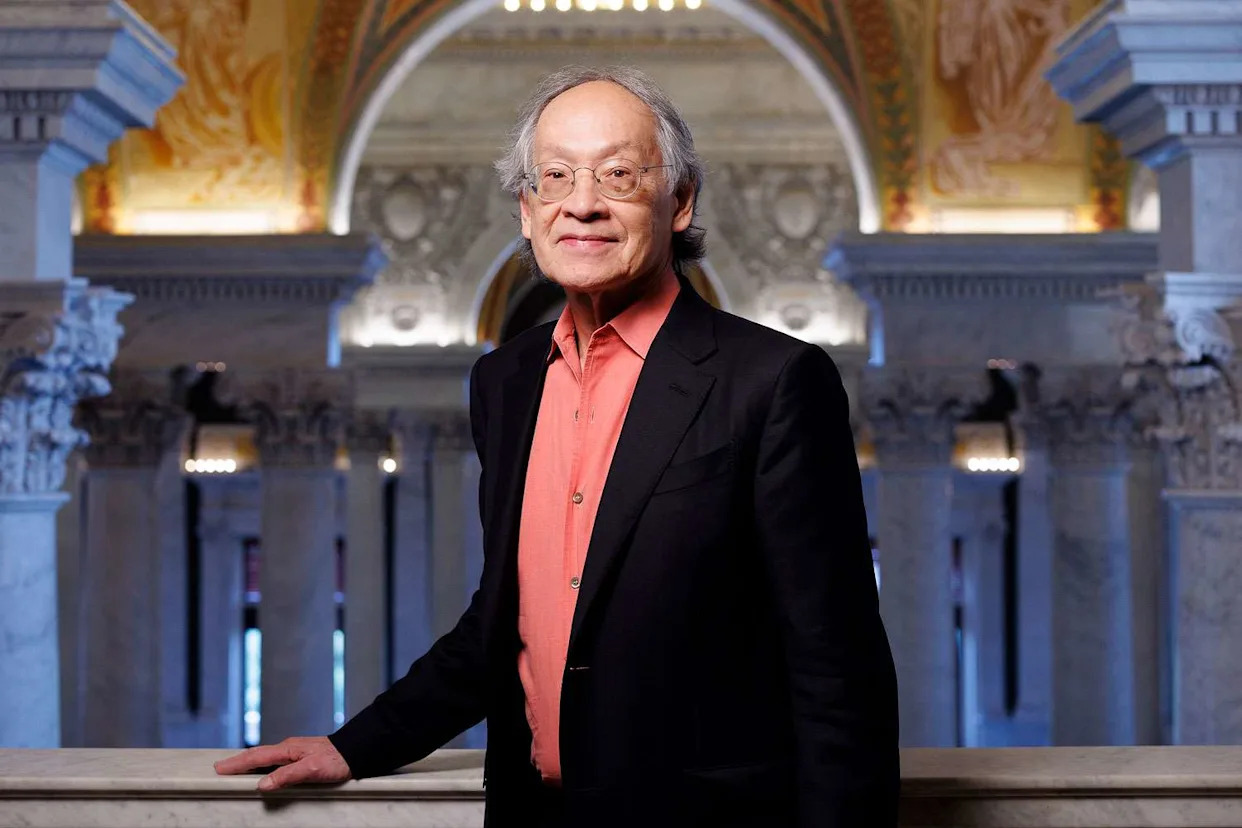
I’m reposting this essay from 2021 as Chinese-American Arthur Sze has just been named our national poet laureate, a post that over the years has been occupied by such luminaries as Robert Frost, William Carlos Williams, Gwendolyn Brooks, Stanley Kunitz, Howard Nemerov, Robert Penn Warren, Rita Dove, Billy Collins, W.S. Merwin…the list goes on and on.
Sze’s family immigrated to America in the 1930s, fleeing the Japanese. Thus his memories of the Yangtze River are family memories, not his own. The poem in some ways works as a riddle only the riddle is the mystery of life, which means an answer can never be pinned down.
But we know that, if we do not pluck the apple from the tree, it will die on the branch. We must go searching, even if we never find this mysterious “it.” Sze doesn’t call it “God” because that word is too heavy and seems too definite (even though God is never definite). What the poet knows is that it’s in the capillaries of our lungs, “in a corpse burning on the Ganges,/ in rain splashing on banana leaves.”
The ever-flowing river, like ever-flowing life, captures this spirit of this “it.” So does the ever-spinning top, describing a cone as it gathers together past, present, future. Look for it “in the smell of an avocado blossom, and in the true passion of a kiss.” Plato may inform us that the apple we know is only a shadow of the ideal form, but given that we can only know that apple that we see, taste, smell, and hold in our hand, that’s where we must go to find mystery.
The Unnamable River
By Arthur Sze
1
Is it in the anthracite face of a coal miner,
crystallized in the veins and lungs of a steel
worker, pulverized in the grimy hands of a railroad engineer?
Is it in a child naming a star, coconuts washing
ashore, dormant in a volcano along the Rio Grande?
You can travel the four thousand miles of the Nile
to its source and never find it.
You can climb the five highest peaks of the Himalayas
and never recognize it.
You can gaze though the largest telescope
and never see it.
But it’s in the capillaries of your lungs.
It’s in the space as you slice open a lemon.
It’s in a corpse burning on the Ganges,
in rain splashing on banana leaves.
Perhaps you have to know you are about to die
to hunger for it. Perhaps you have to go
alone in the jungle armed with a spear
to truly see it. Perhaps you have to
have pneumonia to sense its crush.
But it’s also in the scissor hands of a clock.
It’s in the precessing motion of a top
when a torque makes the axis of rotation describe a cone:
and the cone spinning on a point gathers
past, present, future.
2
In a crude theory of perception, the apple you
see is supposed to be a copy of the actual apple,
but who can step out of his body to compare the two?
Who can step out of his life and feel
the Milky Way flow out of his hands?
An unpicked apple dies on a branch:
that is all we know of it.
It turns black and hard, a corpse on the Ganges.
Then go ahead and map out three thousand mile of the Yantze;
walk each inch, feel its surge and
flow as you feel the surge and flow in your own body.
And the spinning cone of a precessing top
is a form of existence that gathers and spins death and life into one.
It is in the duration of words, but beyond words—
river river river, river river.
The coal miner may not know he has it.
The steel worker may not know he has it.
The railroad engineer may not know he has it.
But it is there. It is in the smell
of an avocado blossom, and in the true passion of a kiss.