Note: If you wish to receive, via e-mail, (1) my weekly newsletter or (2) daily copies of these posts, write to me at rrbates1951@gmail.com. Comments may also be sent to this addss. I promise not to share your e-mail with anyone. To unsubscribe, write here as well.
Sunday
aIn his ecstatic poem “Hurrahing the Harvest,” Gerard Manley Hopkins’s heart is lifted up by both the harvest season and by the prospect of meeting God face to face. Fall here is not a season for mourning, as it is in Hopkins’s “Spring and Fall,” but a time of ecstatic joy. As the old hymn has it, “we shall come rejoicing, bringing in the sheaves.”
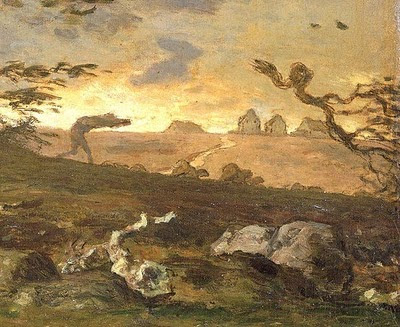
The hymn, however, doesn’t entirely capture the fullness of Hopkins’s heart, which is lifted up as he sees the wild wind whipping around the grain dust and shredding the clouds. The immense joy he feels is God: in this harvest time he is “glean[ing] our Savior,” whose “rapturous love” greets us with realer and rounder replies than can the eyes, heart, looks, and lips of our fellow human beings. The hills he views in the distance, hung as though from the azurous blue sky, he imagines to be Christ’s “world-wielding shoulder.” They are like a mighty stallion although this stallion is sweet as well as strong.
This vision has been there all along, the speaker acknowledges in the last four lines, only he has been wanting in appreciation. Once we are awakened to the God’s grandeur (to borrow from another Hopkins poem)—once beholder and Savior meet—watch out! At that point the heart grows wings and hurls itself upwards, even as the earth hurls off below it:
Hurrahing the Harvest
By Gerard Manley Hopkins
Summer ends now; now, barbarous in beauty, the stooks arise
Around; up above, what wind-walks! what lovely behavior
Of silk-sack clouds! has wilder, wilful-wavier
Meal-drift moulded ever and melted across skies?
I walk, I lift up, I lift up heart, eyes,
Down all that glory in the heavens to glean our Savior;
And, eyes, heart, what looks, what lips yet gave you a
Rapturous love’s greeting of realer, of rounder replies?
And the azurous hung hills are his world-wielding shoulder
Majestic—as a stallion stalwart, very-violet-sweet!—
These things, these things were here and but the beholder
Wanting; which two when they once meet,
The heart rears wings bold and bolder
And hurls for him, O half hurls earth for him off under his feet.
The concluding bird image brings to mind maybe my favorite Hopkins poem, “The Windhover,” which opens with a similar soaring of the heart:
I caught this morning morning’s minion, king-
dom of daylight’s dauphin, dapple-dawn-drawn Falcon, in his riding
Of the rolling level underneath him steady air, and striding
High there, how he rung upon the rein of a wimpling wing
In his ecstasy! then off, off forth on swing,
As a skate’s heel sweeps smooth on a bow-bend: the hurl and gliding
Rebuffed the big wind. My heart in hiding
Stirred for a bird, – the achieve of, the mastery of the thing!
When he became a Jesuit priest, Hopkins apparently stopped writing poetry out of fear that his poems were too sensual. Fortunately, his religious superiors encouraged him to return, and the result is a visceral experience of religious transcendence that reminds one of St. Teresa of Ávila, St. John of the Cross, Hildegard of Bingen and Meister Eckhart. The key to reading Hopkins is to give oneself over to the dazzling images and the explosive rhythms. Perhaps it was his attempt to contain these feelings over the period of silence that led to them to come bursting out as they do.