Thursday
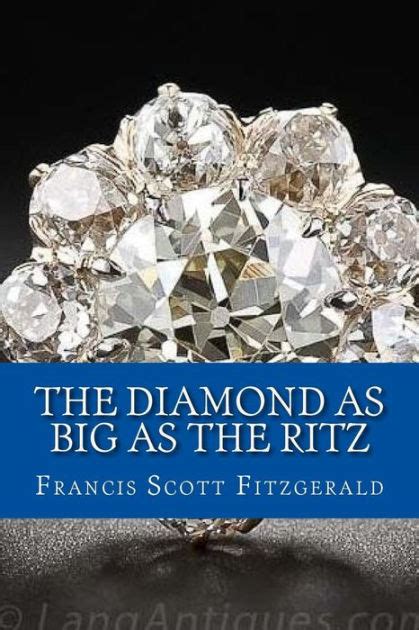
There’s an apocryphal exchange between F. Scott Fitzgerald and Ernest Hemingway about the super wealthy. Fitzgerald supposedly observed, “The rich are different from you and me,” to which Hemingway curtly replied, “Yes, they have more money.” While Hemingway gets in the zinger, however, I want to weigh in on Fitzgerald’s side after reading a disturbing Atlantic article about Amazon head Jeff Bezos. In stories like The Great Gatsby and “The Diamond as Big as the Ritz,” Fitzgerald shows that he understood in a profound way how money rewires the existential reality of the rich. Hemingway’s retort fails to acknowledge this.
First, a note on the story. A website devoted to setting the record straight tells what actually took place between the two authors. Hemingway took the line from Fitzgerald’s story “The Rich Boy” and quoted it out of context in an early version of his story “The Snows of Kilimanjaro.” Here’s what Hemingway wrote:
The rich were dull and they drank too much, or they played too much backgammon. They were dull and they were repetitious. He remembered poor Scott Fitzgerald and his romantic awe of them and how he had started a story once that began, ‘The very rich are different from you and me.’ And how someone had said to Scott, Yes, they have more money. But that was not humorous to Scott. He thought they were a special glamorous race and when he found they weren’t it wrecked him as much as any other thing that wrecked him.
Hemingway had to change the name from “Scott Fitzgerald” to “Julian” in the revised story because Fitzgerald was legitimately outraged. Here’s the context for the quote from “Rich Boy,” in which very little romantic awe is expressed:
Let me tell you about the very rich. They are different from you and me. They possess and enjoy early, and it does something to them, makes them soft where we are hard, and cynical where we are trustful, in a way that, unless you were born rich, it is very difficult to understand. They think, deep in their hearts, that they are better than we are because we had to discover the compensations and refuges of life for ourselves. Even when they enter deep into our world or sink below us, they still think that they are better than we are. They are different.
Fitzgerald knew what Noah Hawley discovered when he wrote “What I Learned about Billionaires at Jeff Bezos’s Private Retreat.” The creator of the FX series Fargo and Alien: Earth, Hawley learned that (to quote the article’s subtitle) “For the richest men on Earth, everything is free and nothing matters.”
The article is chilling and explains a lot about the behavior of our own billionaires, such as Peter Thiel and Elon Musk. Although I first thought of Tom and Daisy when I read the piece—I wrote about The Great Gatsby last week in relation to our billionaires—“A Diamond as Big as the Ritz” captures even better the essence of what Hawley discovered. I’ll look first at his article and then Fitzgerald’s story.
Hawley notes that figures like Bezos, Mark Zuckerberg, and Elon Musk have left the world of consequences behind. Because they “float in a sensory-deprivation tank the size of the planet, in which their actions are only ever judged by themselves,” everything becomes effectively free, nothing can ever be lost, failure fails to mean anything, and they come to feel invulnerable.
This feeling of vulnerability, Hawley goes on to say, has “deep psychological ramifications”:
If everything is free and nothing matters, then the world and other people exist only to be acted upon, if they are acknowledged at all. This is different from classic narcissism, in which a grandiose but fragile self-image can mask deep insecurity. What I’m talking about is a self-definition in which the individual grows to the size of the universe, and the universe vanishes. Asked recently if there is any check on his power, President Trump—himself a billionaire, and by far the richest president in American history—said, “Yeah, there is one thing. My own morality. My own mind. It’s the only thing that can stop me.” Not domestic or international law, not the will of the voters, not God or the centuries-old morality of civic and religious life.”
Hawley points out how most of us develop moral reasoning. The very fact that our actions have consequences means that we are continually having to accommodate ourselves to reality as it actually is. “When you can buy your way out of any mistake,” Hawley explains, “when you can fire anyone who disagrees with you, when your social circle consists entirely of people who need something from you, the basic mechanism by which humans learn that other people are real goes dark.”
Thus you have such jaw-dropping statements and erratic as the following:
When Peter Thiel said, “I no longer believe that freedom and democracy are compatible,” he wasn’t talking about your freedom. He was talking about his own. You don’t exist. When Musk took a chainsaw to the federal government as part of the inside joke he called DOGE, he did so with the air of a man who believed that nothing matters—poverty, chaos, human suffering. He was having fun. It didn’t even matter that the entire destructive exercise ultimately yielded no practical financial gains. For him, the outcome was a foregone conclusion: He could only win, because losing had lost its meaning.
This psychological phenomenon also explains the assault on empathy we have been witnessing, especially from Musk:
Since the 2024 election, there has been a philosophical shift on the right, and especially among tech billionaires, to vilify the idea of empathy. Musk has called empathy “the fundamental weakness of Western civilization.” He sees it as a weapon wielded by liberal society to bludgeon otherwise rational people into operating against their own interests. Empathy is something done to you by others—a vulnerability they exploit, a back door through which they gain access to your resources and will. This rejection of empathy as a human value gives cover to people who don’t want to feel anything at all. If empathy is the problem, then lack of it isn’t a deficiency—it’s an advantage.
“Diamond as Big as the Ritz” dramatizes Hawley’s observations to perfection. John Unger, from a respectable family in the Midwest, attends a fancy prep school out east (St. Midas, fittingly enough) and makes friends with one Percy Washington. Percy invites John out to his place in the Montana Rockies and, on the train ride out there, confides to him that his father “is by far the richest man in the world,” although no one knows this. His wealth lies in the mountain upon which he lives, which is one large diamond.
All this must be kept secret, however, because, if it were known, diamond prices worldwide would collapse, along with the economies based on them. The sense of entitlement that this immense wealth brings with it, along with the measures needed to maintain secrecy, result in the characters exhibiting the same psychological behavior described in the Atlantic article.
First of all, there are the ways that the Washingtons have manipulated things to hide the mountain from government surveyors. Think of this as a version of the GOP’s Big Beautiful Bill, which billionaires got Congress to pass, even though health and safety net programs had to be slashed to provide them with their tax breaks. Think also of the way tax laws have been set up to insure that billionaires will pay almost nothing. In “Big as the Ritz,” Percy reveals how billionaire intervention has three times stymied the government from surveying the diamond mountain:
The first time my grandfather corrupted a whole department of the State survey; the second time he had the official maps of the United States tinkered with–that held them for fifteen years. The last time was harder. My father fixed it so that their compasses were in the strongest magnetic field ever artificially set up. He had a whole set of surveying instruments made with a slight defection that would allow for this territory not to appear, and he substituted them for the ones that were to be used. Then he had a river deflected and he had what looked like a village built up on its banks–so that they’d see it, and think it was a town ten miles farther up the valley.
Hawley’s observation that the wealthy don’t encounter any checks is captured in the Washingtons’ golf course. John learns that it is all greens and contains “no fairway, no rough, no hazards.”
The one thing the Washingtons cannot escape, however, is airplanes, and we start getting a glimpse of how wealth has warped them in the casual way that Percy remarks on the aviators they have in captivity. Elon Musk would be proud in how he’s shut down his empathy:
We’ve got half a dozen anti-aircraft guns and we’ve arranged it so far–but there’ve been a few deaths and a great many prisoners. Not that we mind that, you know, father and I, but it upsets mother and the girls, and there’s always the chance that some time we won’t be able to arrange it.
The corruption is on full display in an interchange between Percy’s father and one of the captive pilots:
“Let me ask you a few questions!” he cried. “You pretend to be a fair-minded man.”
“How absurd. How could a man of my position be fair-minded toward you? You might as well speak of a Spaniard being fair-minded toward a piece of steak.”
At this harsh observation the faces of the two dozen fell, but the tall man continued:
“All right!” he cried. “We’ve argued this out before. You’re not a humanitarian and you’re not fair-minded, but you’re human–at least you say you are–and you ought to be able to put yourself in our place for long enough to think how–how–how–”
“How what?” demanded Washington, coldly.
“–how unnecessary–”
“Not to me.”
“Well–how cruel–”
“We’ve covered that. Cruelty doesn’t exist where self-preservation is involved. You’ve been soldiers; you know that. Try another.”
While all this is going on, John and the younger Washington daughter are falling in love and are even fantasizing about marriage. At this point, if not earlier, it begins to dawn on the reader that John himself is not all that safe. In fact, we learn (this when Kismine inadvertently blurts out the truth) that he will be bumped off before the visit ends. John learns that this has happened many times before. I quote at length from their conversation because it captures just how wealth distorts the wealthy. Other people are nothing more playthings, to be used for all the pleasure that can be got out of them and then discarded:
“Do you mean to say that your father had them murdered before they left?”
She nodded.
“In August usually–or early in September. It’s only natural for us to get all the pleasure out of them that we can first.”
“How abominable! How–why, I must be going crazy! Did you really admit that–”
“I did,” interrupted Kismine, shrugging her shoulders. “We can’t very well imprison them like those aviators, where they’d be a continual reproach to us every day. And it’s always been made easier for Jasmine and me, because father had it done sooner than we expected. In that way we avoided any farewell scene–”
“So you murdered them! Uh!” cried John.
“It was done very nicely. They were drugged while they were asleep–and their families were always told that they died of scarlet fever in Butte.”
“But–I fail to understand why you kept on inviting them!”
“I didn’t,” burst out Kismine. “I never invited one. Jasmine did. And they always had a very good time. She’d give them the nicest presents toward the last. I shall probably have visitors too–I’ll harden up to it. We can’t let such an inevitable thing as death stand in the way of enjoying life while we have it. Think of how lonesome it’d be out here if we never had anyone. Why, father and mother have sacrificed some of their best friends just as we have.”
Along with sacrificing invited guests, the elder Washington even thinks he can buy off God. In one surreal scene we see him proffering a huge diamond of incalculable value to the Almighty if only He will swallow up the aviators.
While I assume that our billionaires aren’t directly killing people, they are more than willing to sacrifice the rest of us, along with American democracy, in their quest for ever more wealth. They’re sitting on a diamond as big as the Ritz and it’s still not enough.