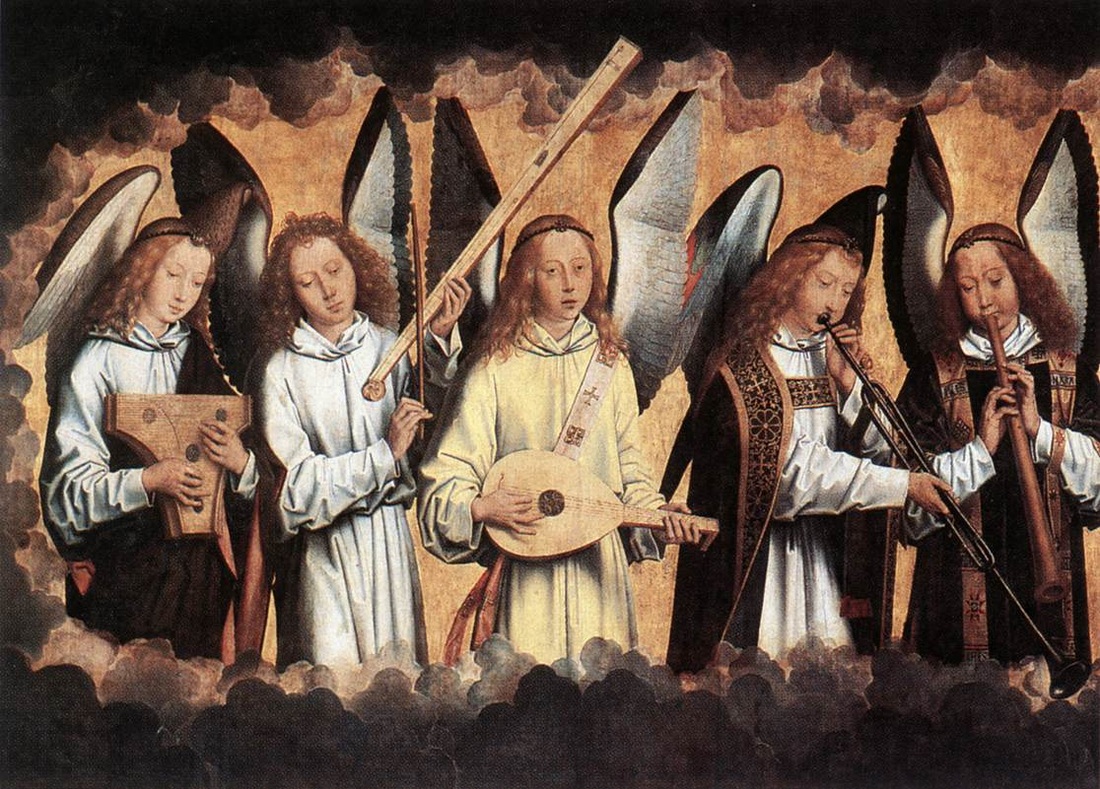
Note: If you wish to receive, via e-mail, (1) my weekly newsletter or (2) daily copies of these posts or (3) both, write to me at rrbates1951@gmail.com. Comments may also be sent to this addss. I promise not to share your e-mail with anyone. To unsubscribe or to change from daily to weekly, write here as well.
Sunday
A year and a half ago, when I was teaching at the University of Ljubljana, I learned that I had missed a Sewanee visit from Malcolm Guite, my favorite living religious poet. My friend John Gatta recently alerted me that a video is available on line, and I can report that it’s magnificent. In it Guite, who is an Anglican priest and a musician as well as a poet, looks at how the 17th century metaphysical poets John Donne and George Herbert use images of music in their poetry.
At one point in his talk, Guite enthuses about the opening stanza of Donne’s “Hymn to God, My God, in My Sickness.” He loves (1) how Donne sees himself tuning up for his encounter with God, much like an orchestra tuning its instruments prior to a concert; and (2) how Donne imagines himself not simply hearing but becoming God’s music:
Since I am coming to that holy room,
Where, with thy choir of saints for evermore,
I shall be made thy music; as I come
I tune the instrument here at the door,
And what I must do then, think here before.
Herbert refers to Donne’s poem in “Church Music,” today’s featured poem. Guite notes that when the speaker in Herbert’s poem is feeling melancholic, church music provides him with a refuge, reassigning him to “a dainty lodging” or “house of pleasure.”
Herbert finds a sublimated eroticism in what is essentially an out of body experience: “Now I in you without a body move, /Rising and falling with your wings.” Guite detects a possible allusion in line seven to Christopher Marlowe’s “The Passionate Shepherd to His Love” (“Come live with me and be my love,/ And we will all the pleasures prove”) and in the eighth line I pick up an allusion to Shakespeare’s “Sonnet 29” (“For thy sweet love remembered such wealth brings/ That then I scorn to change my state with kings”). Check it out to see if you agree:
Church Music
By George Herbert
Sweetest of sweets, I thank you: when displeasure
Did through my body wound my mind,
You took me thence, and in your house of pleasure
A dainty lodging me assigned.Now I in you without a body move,
Rising and falling with your wings:
We both together sweetly live and love,
Yet say sometimes, God help poor Kings.
Comfort, I’ll die; for if you post from me,
Sure I shall do so, and much more:
But if I travel in your company,
You know the way to heaven’s door.
Guite contends that the final two lines are among the most beautiful in English poetry. Herbert takes the image of heaven’s door from the Donne poem and then, centuries later, Bob Dylan takes it from Herbert. (Guite observes that Dylan is well acquainted with English poetry and points out that he borrowed the line “forever young” from John Keats’s “Ode on a Grecian Urn.) Although, without church music, the speaker will not be able to continue on, if he “travel[s] in your company”—he could be addressing either music or Donne—he will find his way to God.
As I was listening to the Guite talk, I thought of another Herbert poem that dwells on similar themes. In “Denial,” a poem about spiritual crisis, Herbert laments that he is like an out-of-tune or unstrung instrument. After voicing his despair, however, he imagines God stepping in to “mend my rhyme.” The poem ends with a graceful rhyming couplet:
Therefore my soul lay out of sight,
Untuned, unstrung:
My feeble spirit, unable to look right,
Like a nipped blossom, hung
Discontented.
O cheer and tune my heartless breast,
Defer no time;
That so thy favors granting my request,
They and my mind may chime,
And mend my rhyme.
Imagine your soul in tune with creation. “Sweetest of sweets” is one way of describing it.