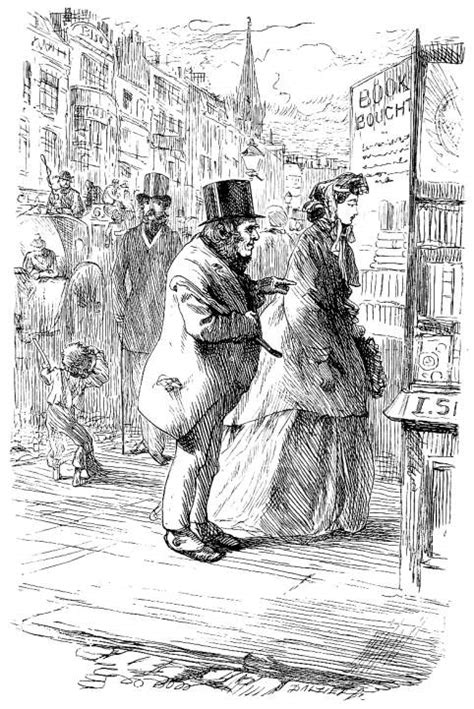
Marcus Stone, illus. from Our Mutual Friend (Mr. Boffin in search of books about misers)
Monday
I’ve just completed Charles Dickens’s Our Mutual Friend and find myself fantasizing that those American billionaires benefitting from GOP tax cuts would read it and undergo a magical transformation. Would they become ashamed at how they are pressuring Trump and Republicans to strip the rest of the country of much needed funds for education, healthcare, and basic living expenses? Would they recognize themselves in Mr. Boffin, whom we see being corrupted by undreamt of wealth?
The billionaires I have in mind are those who have been doing Trump’s bidding, including Peter Thiel, Mark Zuckerberg, Jeff Bezos, Tim Cook, Elon Musk, and David Ellison. While some of these (although not all) once had a more generous view of social welfare, they now appear willing to sacrifice the rest of us to their own narrow interests.
It so happens that, as I was finishing the novel, Trump was voicing their selfish views in a private Easter luncheon. In remarks utterly at odds with the spirit of Christ, Trump said that he had told Office of Management and Budget Director Russell Vought,
Don’t send any money for daycare, because the United States can’t take care of day care. That has to be up to a state. We can’t take care of day care. We’re a big country. We have 50 states. We have all these other people. We’re fighting wars. We can’t take care of day care. You got to let a state take care of day care, and they should pay for it too.”
A little later (I quote from an NBC News report here), the president added
that states would have to raise their taxes to pay for child care costs and that the federal government “could lower our taxes a little bit to them to make up” for it.
“It’s not possible for us to take care of day care, Medicaid, Medicare, all these individual things,” Trump said. “They can do it on a state basis. You can’t do it on a federal. We have to take care of one thing: military protection. We have to guard the country.”
In Mutual Friend we see Mr. Boffin, one of Dickens’s most engaging characters, turn unexpectedly ugly after inheriting a rich man’s money. Suddenly we see him immersing himself in the stories of famous misers:
A kind of illegibility, though a different kind, stole over Mr Boffin’s face. Its old simplicity of expression got masked by a certain craftiness that assimilated even his good humor to itself. His very smile was cunning, as if he had been studying smiles among the portraits of his misers. Saving an occasional burst of impatience, or coarse assertion of his mastery, his good humor remained to him, but it had now a sordid alloy of distrust; and though his eyes should twinkle and all his face should laugh, he would sit holding himself in his own arms, as if he had an inclination to hoard himself up, and must always grudgingly stand on the defensive.
Boffin becomes suspicious of everyone, surly with his personal assistant (who has been masterfully managing his finances), and transactional with Bella, a beautiful woman whom he initially supports out of his generous nature but whom he now expects to make a mercenary marriage. In fact, he becomes so ugly that Bella, who once thought that she must find a wealthy husband, is repelled and instead follows her heart, marrying the personal assistant.
As it turns out, Dickens is essentially writing a fairy tale in which wonderful reversals occur (as they do in many of his novels, most notably Christmas Carol). At the end we learn that Boffin has just been putting on an act in order to show Bella the ugliness of choosing wealth over love, integrity, generosity, and general humanity. In fact, Boffin has no problem surrendering his wealth when the rightful heir unexpectedly appears. Bella, grateful to him for awakening her to the danger of choosing money over love, thanks him for the success of his plan:
‘What?’ cried Bella, holding him prisoner by the coat with both hands. ‘When you saw what a greedy little wretch you were the patron of, you determined to show her how much misused and misprized riches could do, and often had done, to spoil people; did you? Not caring what she thought of you (and Goodness knows that was of no consequence!) you showed her, in yourself, the most detestable sides of wealth, saying in your own mind, “This shallow creature would never work the truth out of her own weak soul, if she had a hundred years to do it in; but a glaring instance kept before her may open even her eyes and set her thinking.” That was what you said to yourself, was it, sir?’
So as I turned the pages, I had this dream: that our billionaires—those greedy little wretches–would realize how spoiled they have become and how they have been misusing their wealth and influence. I imagined Dickens’s heartfelt novel opening their eyes and setting them to thinking. The happiness that is Bella’s could become theirs if they set about using their genius and wealth for the benefit of the nation.
Now that would be an awakening in the true spirit of Easter.