Note: If you wish to receive, via e-mail, (1) my weekly newsletter or (2) daily copies of these posts, write to me at rrbates1951@gmail.com. Comments may also be sent to this address. I promise not to share your e-mail with anyone. To unsubscribe, write here as well.
Friday
My great grandparents (father’s side) wrote informal autobiographies late in life, perhaps at prodding from their children, and my father did as well. It’s also a tradition amongst the Moravians, as I have learned from Julia Ruth Miksch, my Moravian wife, who has been uncovering personal Miksch narratives going back to the 18th century. Given how much these narratives mean to us, I’ve decided to write my own.
I haven’t done it earlier because doing so in addition to writing daily blog essays hasn’t seemed possible. If I were to devote my Friday entries to the project, however, I would kill two birds with one stone, so that’s what I’ve decided to do. And since my blog is devoted to literature, I’ll be telling my life story through the poems, stories, and plays I’ve encountered over my 74 years.
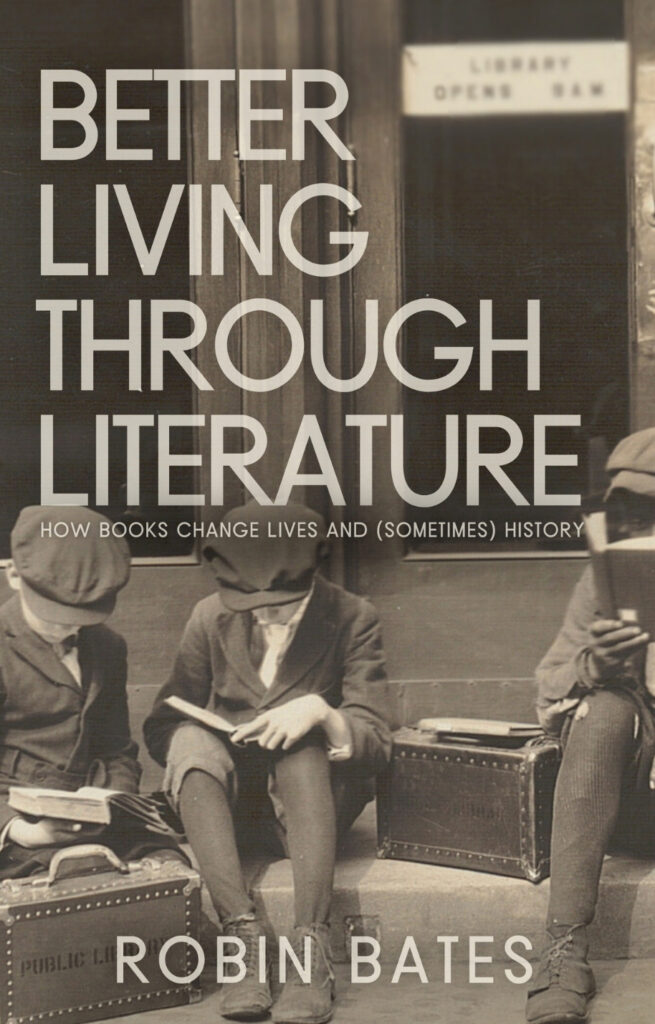
Literature has been important in the Scott-Fulcher-Bates side of the family. Eliza Scott Fulcher, as I’ve recounted in my book, used novels to process the big events in her life: her tomboyish youth (George Eliot’s Mill on the Floss),her mother’s final months (Susan Warren’s Wide, Wide World), her unhappiness with the housekeeper who was supposed to take her place (Charlotte Yonge’s The Daisy Chain and The Heir of Redcliffe), and her leaving home to become a governess (Jane Eyre). Meanwhile Eliza’s daughter Eleanor (my grandmother) was a reader like her mother and also married into a family of readers.
In fact, my father told me that, if the man she married had had his way, he might have become an English teacher rather than a lawyer. Thomas “Judge” Bates, however, was determined that his son would become a lawyer, and Alfred didn’t even go to college, getting his law education through the family firm. He made up for this, however, by extensive reading. I have many of my grandparents’ books—all of them in deteriorating leather—including the complete works of Robert Louis Stevenson, all of the Walter Scott Waverley novels, all of Shakespeare’s plays (in tiny little editions), the poetry of Robert Browning, and novels by James Barrie, Anthony Trollope, Charles Dickens, and many others. My father grew up in this household so it’s not surprising that he would end up as a literature professor.
I don’t remember the same focus on reading in my mother’s family but she herself was a voracious reader. As a child I read her tattered copies of the Oz books—she had a dozen or so—and she herself was a huge Anthony Trollope fan. I once showed her a list of Trollope’s 51 novels and we figured out that she had read 17 of them.
My parents met at Carleton College in the spring semester of January, 1946 in an English class (my mother was an English major). My father was just back from the war and my mother, not having seen many men in her college years, went and sat next to him. He was instantly smitten and they dated throughout the semester. Julia recently came across their love letters and discovered that they shared a love for Don Marquis’s Archie and Mehitabel, a newspaper poetry series featuring a cockroach and an alley cat. Mehitabel, who claims to be a reincarnation of Cleopatra, lives according to the philosophy, “Toujours gai” and “There’s life in the old girl yet.” “Toujours gai” became a recurring phrase for them, and it’s the line we put on my mother’s cemetery plaque.
My mother decided she wanted to date other men over the summer, breaking my father’s heart (and also leading to a number of poems about unrequited love), but by the end of the following semester they were back together. They wanted to get married after commencement (which Julia and I, also students at Carleton, did) but were persuaded to wait a year. My father was off to the University of Wisconsin to become a French professor.
My mother married him the following April and three years later they had me.
My father had just received a Fulbright to study either Arthur Rimbaud or Guillaume Apollinaire in France —in the end he chose Apollinaire—so my first language was French. My parents read to me regularly but I don’t remember any of the books, other than the adventures of the elephant Babar (at the time a French comic strip) and a book about a pair of cats. Pouf is white and well-behaved while Noiraud is black and mischievous. I recall one scene where they are skating their names into the ice and Noiraud goes around and around on the “O” in his name until he cuts a hole and falls through.
I’ve since gone back and reread these to see if they had an influence. I learned that I should be like Pouf and not like Noiraud, and the determination to be a good little boy was a major personal goal throughout my childhood. What I recall from Babar is the death of his mother—shot by a hunter—and his transition from wild elephant to civilized elephant as he flees to the city and is clothed. For a two-year-old realizing that he has an independent identity apart from his mother, the narrative teaches that the socialization process is positive. Chilean author Ariel Dorfman, who sees a colonialist agenda in the Babar story, disagrees, but for child looking to make sense of a difficult transition, the story is a comfort, capturing both the trauma and the reassurance. (The Old Lady functions as the replacement mother.)
That’s enough for this installment. More next Friday.
This entry was posted in Uncategorized. Bookmark the permalink. Both comments and trackbacks are currently closed.