Monday
Last week, when I was blogging on Fahrenheit 451 and those AI companies “scanning and destroying” books, I recognized something else in the firefighters: ICE agents.
While some people speculate that ICE agents are just in it for the money, I suspect a fair number of them are attracted to the license they are given to enact violence. Perhaps it is something comparable to the pleasure Bradbury’s firemen take in burning books:
It was a pleasure to burn. It was a special pleasure to see things eaten, to see things blackened and changed. With the brass nozzle in his fists, with this great python spitting its venomous kerosene upon the world, the blood pounded in his head, and his hands were the hands of some amazing conductor playing all the symphonies of blazing and burning to bring down the tatters and charcoal ruins of history. With his symbolic helmet numbered 451 on his stolid head, and his eyes all orange flame with the thought of what came next, he flicked the igniter and the house jumped up in a gorging fire that burned the evening sky red and yellow and black. He strode in a swarm of fireflies. He wanted above all, like the old joke, to shove a marshmallow on a stick in the furnace, while the flapping pigeon- winged books died on the porch and lawn of the house. While the books went up in sparkling whirls and blew away on a wind turned dark with burning.
One of the tactics that protesters have been attempting against ICE agents is shame. A similar tactic is used by Calrisse McClellan, fireman Guy Montag’s adolescent neighbor, although she doesn’t shout at him through a bullhorn. Instead, when she befriends him on a neighborhood walk, she starts asking such questions as “Are you happy?” and “Do you ever read any of the books you burn?” It would be like asking an ICE agent whether he has ever gotten to know any of the immigrants that he’s ordered to arrest.
In Montag’s case, the questions start getting under his skin and he starts rethinking his life
He felt his smile slide away, melt, fold over, and down on itself like a tallow skin, like the stuff of a fantastic candle burning too long and now collapsing and now blown out. Darkness. He was not happy.
He was not happy. He said the words to himself. He recognized this as the true state of affairs. He wore his happiness like a mask and the girl had run off across the lawn with the mask and there was no way of going to knock on her door and ask for it back.
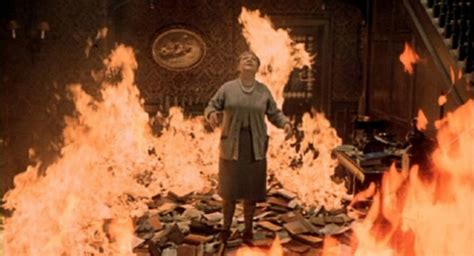
By the end of the novel, Montag is horrified at what he has been called on to do, especially after a woman chooses to be burned alive with her books. When he tries to process the experience with his wife, however, he gets only the party line:
“Aren’t you going to ask me about last night?” he said.
“What about it?”
“We burned a thousand books. We burned a woman.”
“Well?”…
“We burned copies of Dante and Swift and Marcus Aurelius.”
“Wasn’t he a European?”
“Something like that.”
“Wasn’t he a radical?”
“I never read him.”
“He was a radical.”
Unable to appreciate her husband’s distress, his wife continues to rationalize in way many MAGA fanatics rationalize the ICE killings and the brutal incarcerations:
“Mildred, how would it be if, well, maybe, I quit my job awhile?”
“You want to give up everything? After all these years of working, because, one night, some woman and her books —”
“You should have seen her, Millie!”
“She’s nothing to me; she shouldn’t have had books. It was her responsibility, she should have thought of that. I hate her. She’s got you going and next thing you know we’ll be out, no house, no job, nothing.”
“You weren’t there, you didn’t see,” he said. “There must be something in books, things we can’t imagine, to make a woman stay in a burning house; there must be something there. You don’t stay for nothing.”
“She was simple-minded.”
“She was as rational as you and I, more so perhaps, and we burned her.”
“That’s water under the bridge.”
“No, not water: fire. You ever seen a burned house? It smoulders for days. Well, this fire’ll last me the rest of my life. God! I’ve been trying to put it out, in my mind, all night. I’m crazy with trying.”
Bradbury was a Democrat in his early years and Fahrenheit 451, like Arthur Miller’s The Crucible—also written in 1953—were responses to the Joe McCarthy attacks on freedom of speech. In his later years, however, Bradbury became an ardent Republican. The real attacks on freedom of speech was affirmative action, and he was a big fan of both Ronald Reagan and George W. Bush. In 1994 he wrote that his novel was even more relevant now than it had been in the 1950s:
It works even better because we have political correctness now. Political correctness is the real enemy these days. The black groups want to control our thinking and you can’t say certain things. The homosexual groups don’t want you to criticize them. It’s thought control and freedom of speech control.
One wonders if he would have changed his thinking today when armed federal agents attack citizens for protesting and—even more to the book’s point—when librarians are fired for observing banned book week and teachers are fired for having libraries in their classrooms. This past year Luanne James, a head librarian in nearby Murfreesboro, Tennessee, was fired because she wouldn’t move LGBTQ+ themed/teen books into the adult section of the library.
In a sense, James is the woman burned with her books, whose last words are those of the Protestant martyr Hugh Latimer: “’Play the man, Master Ridley; we shall this day light such a candle, by God’s grace, in England, as I trust shall never be put out.’”
Latimer was burned by the Catholic Queen Mary I, along with Nicholas Ridley and Archbishop of Canterbury Thomas Cranmer.
While Alexandria Ocasio-Cortez recently acknowledged that aspects of “Woke 1.0,” were “crazy,” leftwing purity politics never led to the wholesale firings and the book suppressions that we are seeing today, including the attacks on libraries. Would Bradbury have changed his politics if he had witnessed MAGA? Or would he have offered the rationalizations of Montag’s wife?
We’ll never know since he died during the presidency of Barack Obama, who was a fan of Fahrenheit 451. Resistance to MAGA authoritarianism, however, is lighting a candle that we trust shall never be put out.