Note: If you wish to receive, via e-mail, (1) my weekly newsletter or (2) daily copies of these posts, write to me at rrbates1951@gmail.com. Comments may also be sent to this addss. I promise not to share your e-mail with anyone. To unsubscribe, write here as well.
Tuesday
Rosa Parks triggered the Montgomery Bus Boycott 70 years ago this past Friday. Two weeks after attending a workshop for activists at the Highlander Folk School, she refused to give up her seat to a white passenger and was arrested. The resulting collective action, which saw massive grassroot efforts (including a carpool operation that, at its peak, saw 15-20,000 rides a day), kickstarted the civil rights movement and changed history.
As a recent article in the Guardian explains, however, often we draw the wrong lessons from the boycott. There was every reason to believe it wouldn’t work. In other words, sometimes we have to dream the impossible and then continue acting as though it’s possible:
Today, as people see rising injustice, many get mired in the question: What will work? We search for the right legal case, the right tactic, the right leader. But the greatest lesson of the Montgomery bus boycott is that is the wrong question. If Rosa Parks had asked what will work on 1 December, she wouldn’t have refused to give up her seat. If Black Montgomery residents had worried about being too disruptive, if the Kings had listened to their parents, if Georgia Gilmore had thought about how much money they needed, they wouldn’t have acted. What worked was the ability to keep going, amid fear and uncertainty, amid job loss and police harassment, amid years of stands that produced nothing, amid the need to organize and maintain a massive carpool system no one had ever built before. “We can learn to play on locked pianos,” King’s friend Vincent Harding observed, “and to dream of worlds that do not yet exist.”
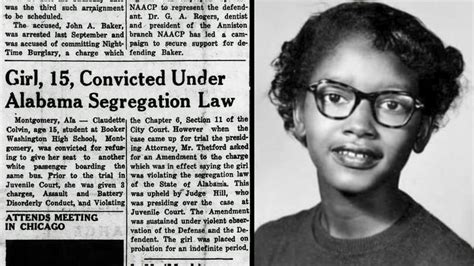
Among the stands that appeared to produce nothing was that of 15-year-old Claudette Colvin eight months prior to Rosa Parks. She too refused to give up her seat and, when the police dragged her off the bus, she was charged with assaulting an officer. Although there was some outrage in the Black community over the arrest, no mass movement followed. That’s because (according to the Guardian) “many adults saw Colvin as too young, poor and feisty to rally behind.” Yet without Colvin having done what she did,
it is unlikely Parks’s arrest would have galvanized people the way it did. Movements do not result from the first or second outrage but from an accumulation of injustice that brings people to a breaking point.
In 1998 Rita Dove honored Colvin—and by extension all those anonymous historical actors so critical to significant change–in “Claudette Colvin Goes to Work.” The poem captures Colvin when she was working in a Manhattan nursing home, having been forced to leave Montgomery because of her reputation. The poem focuses on her invisibility, having her remark, “Sometimes I wait until it’s dark enough for my body to disappear.” That her heroic action led to exile and abandonment prompts her to lament, “What do we have to do to make God love us?”
Colvin’s heroism did not end in 1955. As Dove has her say,
I help those who can’t help themselves,
I do what needs to be done . . . and I sleep
whenever sleep comes down on me.
Here’s the poem:
Claudette Colvin Goes to Work
By Rita Dove
Another Negro woman has been arrested and thrown into jail because she refused to get up out of her seat on the bus and give it to a white person. This is the second time since the Claudette Colbert [sic] case. . . . This must be stopped. — Montgomery Bus Boycott flierDecember 5, 1955
Menial twilight sweeps the storefronts along Lexington
as the shadows arrive to take their places
among the scourge of the earth. Here and there
a fickle brilliance — lightbulbs coming on
in each narrow residence, the golden wattage
of bleak interiors announcing Anyone home?
or I’m beat, bring me a beer.Mostly I say to myself Still here. Lay
my keys on the table, pack the perishables away
before flipping the switch. I like the sugary
look of things in bad light — one drop of sweat
is all it would take to dissolve an armchair pillow
into brocade residue. Sometimes I wait until
it’s dark enough for my body to disappear;then I know it’s time to start out for work.
Along the Avenue, the cabs start up, heading
toward midtown; neon stutters into ecstasy
as the male integers light up their smokes and let loose
a stream of brave talk: “Hey Mama” souring quickly to
“Your Mama” when there’s no answer — as if
the most injury they can do is insult the reasonyou’re here at all, walking in your whites
down to the stop so you can make a living.
So ugly, so fat, so dumb, so greasy —
What do we have to do to make God love us?
Mama was a maid; my daddy mowed lawns like a boy,
and I’m the crazy girl off the bus, the one
who wrote in class she was going to be President.I take the Number 6 bus to the Lex Ave train
and then I’m there all night, adjusting the sheets,
emptying the pans. And I don’t curse or spit
or kick and scratch like they say I did then.
I help those who can’t help themselves,
I do what needs to be done . . . and I sleep
whenever sleep comes down on me.