Note: If you wish to receive, via e-mail, (1) my weekly newsletter or (2) daily copies of these posts, write to me at rrbates1951@gmail.com. Comments may also be sent to this addss. I promise not to share your e-mail with anyone. To unsubscribe, write here as well.
Wednesday
In a classic example of how bad people can twist a good book to their own ends, ICE is calling its Charlotte deportation efforts “Operation Charlotte’s Web.” Leader Gregory Bovino has even had the effrontery to quote from the novel: “Wherever the wind takes us. High, low. Near, far. East, west, North, south. We take to the breeze, we go as we please.” To which he adds, “This time, the breeze hit Charlotte like a storm.”
On Monday the Charlotte Observer reported that the storm involved masked ICE agents in green uniforms detaining 130 people in public places, supermarkets, busy roadways and an east Charlotte church.
The estate of E.B. White has hit back, with White’s granddaughter and literary executor saying that the operation is “antithetical” to the author’s values. Martha White has stated that her grandfather “certainly didn’t believe in masked men, in unmarked cars, raiding people’s homes and workplaces without IDs or summons. He didn’t condone fearmongering.”
In an interview with the Observer, White pointed out that the novel “is all about compassion. It’s all about taking responsibility for those who are vulnerable and putting yourself in another person’s shoes.” She added that White, in his White Flag collection of essays (1943-46), wrote that the United States is regarded by people everywhere “as a dream come true, a sort of world-state in miniature. Here dwell the world’s emigrants under one law, and the law is: Thou shalt not push thy neighbor around.”
Further on he stated,
By some curious divinity which in him lies, Man, in this experiment of mixed races and mixed creeds, has turned out more good than bad, more right than wrong, more kind than cruel, and more sinned against than sinning. This is the world’s hope and its chance.
It is in this spirit that Charlotte, in her final conversation with Wilbur, explains why she has expended her remaining energy to save his life. When he asks, “Why did you do all this for me? I don’t deserve it. I’ve never done anything for you,” the spider replies,
You have been my friend. That in itself is a tremendous thing. I wove my webs for you because I liked you. After all, what’s a life, anyway? We’re born, we live a little while, we die. A spider’s life can’t help being something of a mess, with all this trapping and eating flies. By helping you, perhaps I was trying to lift up my life a trifle. Heaven knows anyone’s life can stand a little of that.
Yes, antithetical to everything that ICE and Trump and Trump’s minions stand for.
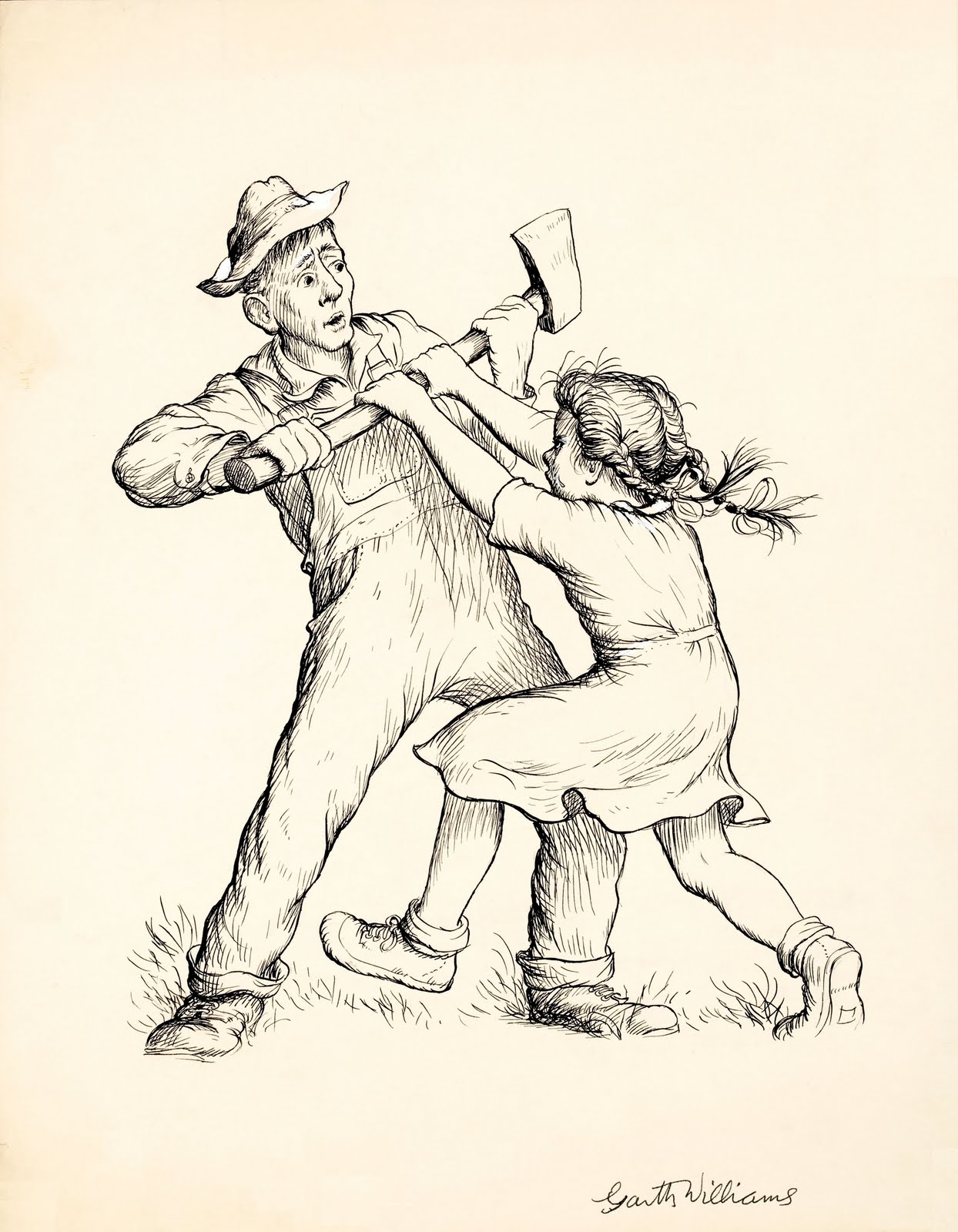
One Garth Williams illustration from Charlotte’s Web that was seared into my brain at six or so is Fern preventing her father from taking an axe to runt-of-the-litter Wilbur. Think of her as a Charlotte protester standing up against ICE. Of course, Mr. Arable is more justified than ICE in his rationale: farmers must kill animals to earn a living. This is the unwelcome news that the Old Sheep has for Wilbur: “Well, I don’t like to spread bad news but they’re fattening you up because they’re going to kill you…”
The only rationale that ICE has for going after most of those it is targeting is that they are people of color.
Bovino identifies ICE with the baby spiders who are about to be scattered to the wind. In actuality, there is nothing random about ICE, which is targeting blue cities. The passage he quotes more accurately describes our immigrants, who come down wherever circumstances allow. As the baby spiders put it, “We are aeronauts and we are going out into the world to make webs for ourselves.”
If Bovino wants to find a kindred soul in the novel, he should settle on Templeton the rat, who hoards rotten eggs and is described as having
no morals, no conscience, no scruples, no consideration, no decency, no milk of rodent kindness, no compunctions, no higher feeling, no friendliness, no anything. He would kill a gosling if he could get away with it – the goose knew that. Everybody knew it.
It is Templeton who, displaying a sadism characteristic of ICE, bursts Wilbur’s bubble at the fair, telling him, “I wouldn’t be surprised if Zuckerman changes his mind about you. Wait till he gets hankering for some fresh pork and smoked ham and crisp bacon! He’ll take the knife to you, my boy.”
Fortunately, Templeton doesn’t get the last word, and there’s a chance that Trumpism won’t either. The final message of Charlotte’s Web is one of renewal, which we all need at this moment. After Charlotte dies, breaking Wilbur’s heart, we are reminded that spring always follows winter:
The snows melted and ran away. The streams and ditches bubbled and chattered with rushing water. A sparrow with a streaky breast arrived and sang. The light strengthened, the mornings came sooner. Almost every morning there was another new lamb in the sheepfold. The goose was sitting on nine eggs. The sky seemed wider and a warm wind blew. The last remaining strands of Charlotte’s old web floated away and vanished.
A major reason why America has flourished is because immigrants, like baby spiders, have floated in, replenishing, rejuvenating and reinvigorating the nation. As E.B. White’s granddaughter notes, books like Charlotte’s Web have been vital in opening our hearts and minds to the vulnerable. In the novel, Charlotte stands in for the author—Wilbur regards her as “a true friend and a good writer”—one who devotes her life to helping a fellow creature. The final result is a world in which we can live in harmony with a diverse population, “a sort of world state in miniature.” This vision even includes a place for rats:
Life in the barn was very good—night and day, winter and summer, spring and fall, dull days and bright days. It was the best place to be, thought Wilbur, this warm delicious cellar, with the garrulous geese, the changing seasons, the heat of the sun, the passage of swallows, the nearness of rats, the sameness of sheep, the love of spiders, the smell of manure, and the glory of everything.
Hold on to this vision and don’t stop fighting.