Note: If you wish to receive, via e-mail, (1) my weekly newsletter or (2) daily copies of these posts, write to me at rrbates1951@gmail.com. Comments may also be sent to this address. I promise not to share your e-mail with anyone. To unsubscribe, write here as well.
Sunday
Today’s Gospel story, about the woman crippled by a spirit for 18 years, has me turning to Lory Hess’s book When Fragments Make a Whole: A Personal Journey through Healing Stories in the Bible. Lory and I share both a Carleton education and a passion for the Narnia Chronicles and the Oz books (check out her website, Entering the Enchanted Castle), and I’ve featured her work in the past. Fragments is a sensitive, intelligent, and moving exploration of the 18 episodes where we see Jesus healing people. For each Lory provides her own poetic version, along with a scholarly exploration of its meaning and an autobiographical account of the role it has played in her own healing.
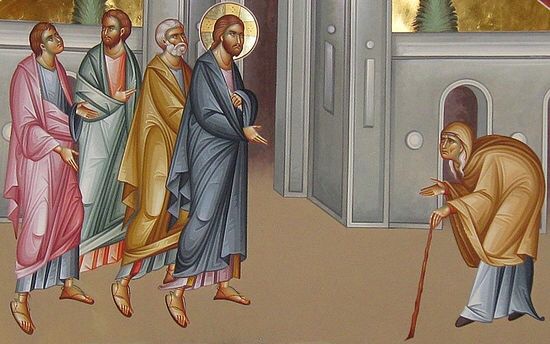
The incident occurs on a Sabbath when Jesus is preaching in a synagogue (Luke 13:10-17):
Just then there appeared a woman with a spirit that had crippled her for eighteen years. She was bent over and was quite unable to stand up straight. When Jesus saw her, he called her over and said, “Woman, you are set free from your ailment.” When he laid his hands on her, immediately she stood up straight and began praising God. But the leader of the synagogue, indignant because Jesus had cured on the sabbath, kept saying to the crowd, “There are six days on which work ought to be done; come on those days and be cured, and not on the sabbath day.” But the Lord answered him and said, “You hypocrites! Does not each of you on the sabbath untie his ox or his donkey from the manger, and lead it away to give it water? And ought not this woman, a daughter of Abraham whom Satan bound for eighteen long years, be set free from this bondage on the sabbath day?” When he said this, all his opponents were put to shame; and the entire crowd was rejoicing at all the wonderful things that he was doing.
Lory contends that the story can be read allegorically, with “daughter of Abraham” indicating that “the woman is a representative of her whole people, just as the ‘Son of Man’ is the representative of humanity.” Pointing out that the gospel account was probably written after the Romans brutally put down the final Jewish rebellion and destroyed the Second Temple, Lory equates the two: “The woman’s body cannot stand up straight, just as the ruined Temple in Jerusalem can no longer hold the religion of her people.”
In this light, the objection of the synagogue leader appears particularly petty while Jesus’s response points to a way forward in a time of despair. He essentially tells the congregation not to look for a brick and mortar rebuilding of the kingdom:
Christ restores humanity from within, not without. Old forms have fallen and cannot be repaired, but something can still arise when we reconnect to the lasting truth that built those forms in the first place and can continue to build ever-new structures for itself…Christ Jesus sees her, calls her over to him, and speaks the word of freedom from bondage (apoluo) that also means forgiveness of sins. He touches her with his hands and at once she is restored to uprightness (anorthoo).
Lory concludes,
Christ Jesus shows us, through his whole way of being, the rebuilt, rightly constructed human Temple. When we are seen by him, when we hear his call to freedom and feel his touch upon us, we become the people of God.
For her personal story, Lory recounts how, following disruption to her family and her own experience with a crippling ailment, she was finally able to find a way forward. In her poetic rendition of the story, she emphasizes the woman’s journey from “a tumbled wall that could no longer bear any weight” to a straightened spine and straightened spirit. The kingdom of God is made “not with hands/ but with unfettered hearts.”
Daughter of Abraham
By Lory Hess
It was eighteen years into Great Herod’s reign
when he took it in hand to restore our Temple,
to glorify God, or at least himself –
for him the difference was small.
My father was a mason, one of a thousand,
and a priest as well, as all must be
who worked on the holy restoration,
enlarging, repairing, making whole.
It soothed him to do this, as if our people,
shattered and scattered to the ends of the earth,
could as simply be brought back and rebuilt
as stones placed one on another.
But I did not think so. Though merely a girl,
not allowed to study or preach the scriptures,
I knew by heart the ones I’d heard,
I knew the words of the promise.
Our land had been stolen, our people betrayed.
The wicked reigned, and we had no king.
The faithful were parched fields waiting for rain.
Where was the one who would come in the clouds?
When my father collapsed one day beneath
his last load of bricks and mortar, I wept
for the waste of effort, the hopeless ruin
of Israel’s hope and Abraham’s seed.
There was a boy who loved me, and wanted
to speak for me, but I refused him.
My mother cried and called me insane,
but I stood firm. In these last days
I did not want to carry a babe
I’d only have to fear for, and run with
into the hills when the wrath of God
finally blasted us clean.
And so I fell back to this synagogue,
awaiting the word that would turn to flame
and fire the limp hearts of my sheepish folk
into something stronger than clay.
But I heard nothing, and as the years
piled into decades, I started to bend,
to shift, to collapse, like a tumbled wall
that could no longer bear any weight.
For eighteen years I’d been so bent,
eyeing the floor of the synagogue
and listening with only half an ear
to the usual moans, when I heard him.
‘Woman, you are free.’ Could it truly be
the one who had come to open our prison?
His word was not as I’d expected.
No flames of wrath, no furious blast,
but a gentle thrill that entered my spine
and straightened my spirit, so that I could see
my people again, standing like pillars,
bearing the weight of the world.
Let us be his temple. Let songs of praise
resound from the ones he lifts and straightens,
building a kingdom made not with hands
but with unfettered hearts.
Previous posts featuring Lory Hess
But the Light Will Come to Us Again
Excess and Deficiency in the Life Force
The Healing Power of Biblical Stories