Wednesday
Julia and I watched The Odyssey Monday and I had the most predictable reaction imaginable: “It’s not as good as the book.”
Someone, perhaps novelist and scriptwriter Gore Vidal, once said that you can make a great movie out of a mediocre book but not a great movie out of a great book. It was certainly hard for me to appreciate a film based on a poem I have taught at least twenty times because I made constant comparisons. When I last taught it (in Sewanee’s “Representative Masterpieces” class), I used the Emily Wilson translation that Christopher Nolan reportedly consulted.
Wilson caused a stir with her use of “complicated” in Homer’s opening invocation of Calliope, the muse of epic poetry:
Tell me about a complicated man.
Muse, tell me how he wandered and was lost
when he had wrecked the holy town of Troy,
and where he went, and who he met, the pain
he suffered on the sea, and how he worked
to save his life and bring his men back home….
Now goddess, child of Zeus,
tell the old story for our modern times.
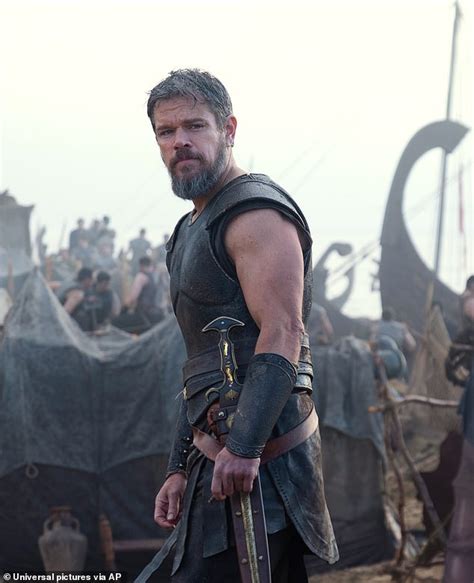
Matt Damon’s Odysseus is certainly complicated, but not in the way that Homer’s is. The original Odysseus does not appear to have qualms about sacking Troy, nor does he feel guilt over what happened to his men. In fact, he experiences a bloodlust when it comes to slaying his enemies: he kills every single suitor and is prepared to kill all those who show up to avenge them. He is stopped only by the intervention of Athena in the guise of Mentor (who, incidentally, is not poisoned, as he is in the movie). Here’s the passage in the Robert Fitzgerald translation:
Odysseus and his son now furiously
closed, laying on with broadswords, hand to hand,
and pikes: they would have cut the enemy down
to the last man, leaving not one survivor,
had not Athena raised a shout
that stopped all fighters in the tracks.
“Now hold!”
she cried, “Break off this bitter skirmish, Ithakans, and make peace.”
The poem then ends happily ever after:
[Odysseus] yielded to her, and his heart was glad.
Both parties later swore to terms of peace
set by their arbiter, Athena, daughter
of Zeus who bears the stormcloud as a shield—
though still she kept the form and voice of Mentor
When I taught the poem, I would tell my students that, more than one-eyed cyclopes and immortal island goddesses who turn men into swine, this is Homer’s most fantastical scene. All of us who have seen The Godfather (or read Beowulf or Huckleberry Finn) know how intractable family blood feuds are, how they can continue for generations.
I appreciate how Nolan acknowledges this. In his version, Odysseus must kill the suitors by himself so that Telemachus carries none of the blood guilt. Unlike the poem, where Telemachus fights side by side with his father, his only battle in the film is with Melanthius, the goatherd who is funneling weapons to the suitors.
[Side note: I found it improbable that Odysseus’s son, trained in weaponry, would have such difficulty dispatching someone untrained. In the poem, not-blind swineherd Eumaeus and the cowherd Philoetius have no difficulty subduing Melanthius, tying him up with “cutting cord” so that “his bones ground in their sockets,” and hoisting him “in agony up a pillar to the beams.” Later they will hack off his nose, ears hands, feet and genitals.]
By accepting exile for killing the suitors, Odysseus can end the feud and Telemachus can ascend to the throne with a clean slate. In ending his film this way, Nolan merges Homer’s Odysseus with Tennyson’s Ulysses in his famous poem by that name. Skipping Ulysses’s complaint about having an aging wife and a bureaucratic, non-adventurous son, Nolan turns to the following lines:
Yet all experience is an arch wherethro’
Gleams that untravell’d world whose margin fades
For ever and forever when I move.
…
Little remains: but every hour is saved
From that eternal silence, something more,
A bringer of new things; and vile it were
For some three suns to store and hoard myself,
And this gray spirit yearning in desire
To follow knowledge like a sinking star,
Beyond the utmost bound of human thought.
Nolan’s Odysseus doesn’t go into exile alone, however, but is accompanied by Penelope in what feels like a second honeymoon. Together they will sail “beyond the sunset, and the baths/ Of all the western stars, until [we] die.” Perhaps they’ll “touch the Happy Isles and see the great Achilles.”
But back to Homer’s Odysseus being a complicated man. His psychological states are conveyed through his interactions with the gods, as though forces greater than his own individual mind are driving him. The poem begins with a conclave on Mount Olympus in which Athena complains about Odysseus being stuck on Kalypso’s island and Zeus agreeing that Poseidon must allow Odysseus to return home. Put in terms of a dialogue inside Odysseus’s head, the call of duty is finally (after seven years!) triumphing over his fear of setting out on another sea voyage. It’s not an easy decision given that he must, in so doing, abandon the comfort of living with an immortal island goddess.
In the film, Nolan strips away this internal struggle. Combining an earlier adventure–Odysseus’s encounter with the Lotus Eaters–with the Kalypso episode, he has her using the drug’s memory-erasing qualities to treat his PTSD over having lost his crew. (Rather cleverly, Nolan has Odysseus gradually recall what has happened to him, thereby providing us with his backstory. There’s no reason now to include his journey to the Phaeacians, the islanders in Homer’s version to whom Odysseus tells his story.)
It’s not the first time in Homer’s poem that Odysseus has grappled with the decision whether to stay or whether to go. He remains with Circe and her “flawless bed of love” for a full year. (Only a day in Nolan’s version.) Indeed, I read the entire Hades visit, which occurs during his time with Circe, as Odysseus questioning whether he really wants to confront the rigors of the sea again. In addition to the men eaten by the cyclops, he has lost his other ships, along with their crews.
In Hades he encounters some compelling reasons to stay, beginning with Agamemnon telling him about his own fate upon returning home. “Indulge a woman never,” the king tells him, “and never tell her all you know.” Could Penelope be plotting something similar? Meanwhile, through Achilles Odysseus questions the concept of glory itself. When he observes that the warrior has been ranked with the immortals, Achilles responds,
Better, I say, to break sod as a farm hand
for some poor country man, on iron rations,
than lord it over all the exhausted dead.
Perhaps, then, the best option is to stay forever in obscurity on Circe’s island rather than die while seeking fame.
Achilles changes his tune when Odysseus tells him about his son, however. After hearing of Neoptólemos’s deeds in battle, Achilles goes off “striding the field of Asphodel, . . . glorying in what I told him of his son.” Maybe this is what convinces Odysseus to set off for home. He too has a son, so perhaps he realizes there is a kind of immortality in family and generation.
In other words, what gives life meaning is not only living. “As tho’ to breathe were life,” as Tennyson’s Ulysses puts it after having described the Ithakans as a savage race “that hoard, and sleep, and feed, and know not me.” This is another version of Circe turning men into swine, a point that Nolan’s Circe explicitly mentions, and one can see why Zeus/sense of duty would object.
All of which is to say that the gods function as a meaning system, with Odysseus’s interactions with them revealing his complicated nature. He’s just a different kind of complicated than Nolan’s Odysseus.
It’s not that I object to Nolan’s point. Although the movie was completed before Trump invaded Iran, America has a lot to be ashamed of when it comes to forever wars. Nolan’s Odysseus tells Penelope ahead of time that this will be an endless—or at least a very long—war, and he goes reluctantly. Then, in scenes which Nolan might have borrowed from Virgil’s Aeneid, he feels complicit in the atrocities visited upon the Trojans. Seeing the horrors of war through their eyes, it is as though he is seeing Gaza as experienced by the Palestinians or Iraq as experienced by the Iraqis.
When the Greek invaders kill a Trojan priestess in a temple dedicated to Athena, Nolan’s Odysseus internalizes the young woman. She becomes his Athena within, his conscience, and as such becomes his moral center. It’s a bit confusing, however, because it’s not clear that he lacked such a center before. At any rate, it’s Nolan’s way of acknowledging that divinity is part of our internal make-up.
This Athena is a far cry from Homer’s Athena, however. It’s true, as I’ve noted, that the ancient Greek goddess brings about peace at story’s end, just as she placates the vengeful furies at the end of Aeschylus’s Agamemnon trilogy. But when Odysseus is killing the suitors, she’s in the thick of it:
At this moment that unmanning thunder cloud,
the aegis, Athena’s shield,
took form aloft in the great hall.
And the suitors mad with fear
at her great sign stampeded like stung cattle by a river
when the dread shimmering gadfly strikes in summer,
in the flowering season, in the long-drawn days.
After them the attackers wheeled, as terrible as falcons
from eyries in the mountains veering over and diving down
with talons wide unsheathed on flights of birds,
who cower down the sky in chutes and bursts along the valley—
but the pouncing falcons grip their prey, no frantic wing avails…
Don’t show this passage to Defense Secretary Pete Hegseth, since it captures his fever dream.
Homer, however, doesn’t let his bloodthirsty hero off the hook. Simone Weil, the French philosopher and mystic, interprets The Iliad as an anti-war book because it exposes how force turns victimizer no less than victimized into a thing, and the same could be said of The Odyssey. Even more horrifying than the treatment of Melanthius could be Telemachus hanging the serving women who have slept with the suitors (and not necessarily because they wanted to, as Margaret Atwood points out in The Penelopiad). The horror lies in the tiny details:
“I would not give the clean death of a beast
to trulls who made a mockery of my mother
and of me too—you sluts, who lay with suitors.”
He tied one end of a hawser to a pillar
and passed the other about the roundhouse top,
taking the slack up, so that no one’s toes
could touch the ground. They would be hung like doves
or larks in springès triggered in a thicket,
where the birds think to rest—a cruel nesting.
So now in turn each woman thrust her head
into a noose and swung, yanked high in air,
to perish there more piteously.
Their feet danced for a little, but not long.
I’ve heard some of my elderly friends complaining about Nolan’s violence—the cyclops cannibalism scene echoes Goya’s horrific painting of Saturn eating his son—but imagine if the director had put bloodthirsty Odysseus and Telemachus into his film. When I say I prefer the book to the movie, it’s not that I like these passages but that they show me how complicated humans can be. Damon’s Odysseus and Tom Holland’s Telemachus, by contrast, seem shallow and sentimental.