Monday
One of the things that stood out to me as I was reading The Loneliness of Sonia and Sunny was how life in India—at least as described in Kiran Desai’s novel—is constantly interacting with nature. Bandicoots in Goa steal bars of soap, and when one is taking a shower, tree frogs whiz “from wall to ceiling all over the bathroom, joyous in the wet.” Sonia must check her night water glass before drinking because she never knows if a moth will be found therein, and a few mosquitoes always find their way through the netting. Meanwhile, mold blossoms on walls during the monsoon season and leaks in roofs ruin books. Accustomed as many Americans are to sealing themselves off from nature, the difference is noticeable.
Not that I myself have been feeling all that sealed. For a while we had woodpeckers attacking our house (they were after carpenter bees, we discovered), and squirrels were eating the siding. Periodically, there’s a power outage because squirrels have found a way into power boxes, and a rainy summer has meant that suddenly our kitchen is being invaded by tiny ants. In addition, twice a year hordes of Japanese ladybugs visit our house (I vacuum them up, sometimes forty or fifty at a time), which local farmers have imported to attack aphids.
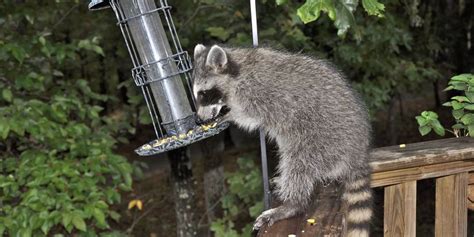
The animal that is most attracting my attention, however, is a raccoon that has found its way into our supposedly raccoon-proof bird feeders. For years we’ve been feeding nuthatches, titmice, chickadees, five different varieties of woodpeckers, purple finches, grosbeaks, goldfinches, cowbirds, and cardinals, and I was proud that I had found feeders that would frustrate squirrels. Racoons, however, are an entirely different matter.
Demonstrating a combination of cleverness and acrobatic agility, these critters have frustrated every attempt to fend them off. At one point, after I had used wires to keep the feeders out of reach, they broke the wires. It appears that I will have to leave off feeding the birds—all but the hummingbirds—because the raccoons will not be denied.
A recent Annie Lowrey article in The Atlantic helps me better understand the problem. The raccoons, she explains,
are intelligent, having long memories and a knack for problem-solving. “If you give them a puzzle and change the rules, they go with it,” Lauren Stanton, a cognitive ecologist at UC Berkeley, told me. “They have this creativity.” On top of that, they are dexterous enough to shuck oysters, unscrew jars, unlatch gates, and pick knots.
Unlike other animals, raccoons tolerate close proximity to humans (I’ve noticed this with our raccoon), and in addition to birdseed and suet they love human food. They are also, according to a raccoon biologist interviewed for the article, “incredibly destructive”:
“They’re so smart compared to cats and dogs—wildly, wildly intelligent—and because of that, they are very, very hard to keep entertained.” Captive raccoons require specially designed, large enclosures and “puzzle after puzzle” to work on, she said. “They like textures, they like to pick at things, they like to tear things apart, and it’s fun for them.”
The article notes that, while they are half-domesticated already, they can never be fully domesticated. The idea of a domesticated raccoon made me think of a passage in Antoine de Saint-Exupéry’s The Little Prince. The prince is looking for a friend and approaches a fox, who informs him that they can only be friends if it is tamed:
“What does that mean– ‘tame’?”
“It is an act too often neglected,” said the fox. It means to establish ties.”
“‘To establish ties’?”
“Just that,” said the fox. “To me, you are still nothing more than a little boy who is just like a hundred thousand other little boys. And I have no need of you. And you, on your part, have no need of me. To you, I am nothing more than a fox like a hundred thousand other foxes. But if you tame me, then we shall need each other. To me, you will be unique in all the world. To you, I shall be unique in all the world…”
The fox then explains how it will benefit from being tamed:
“My life is very monotonous,” the fox said. “I hunt chickens; men hunt me. All the chickens are just alike, and all the men are just alike. And, in consequence, I am a little bored. But if you tame me, it will be as if the sun came to shine on my life. I shall know the sound of a step that will be different from all the others. Other steps send me hurrying back underneath the ground. Yours will call me, like music, out of my burrow. And then look: you see the grain-fields down yonder? I do not eat bread. Wheat is of no use to me. The wheat fields have nothing to say to me. And that is sad. But you have hair that is the color of gold. Think how wonderful that will be when you have tamed me! The grain, which is also golden, will bring me back the thought of you. And I shall love to listen to the wind in the wheat…”
Now, I am not interested in taming or domesticating this raccoon—I just want it to leave our feeders alone—nor do I think that the relationship we have developed is helping it move on beyond boredom. I now wonder, however, if the elaborate mechanisms I have set up to keep it at bay are a source of entertainment. Maybe it’s not only after the food.