Kingsolver on Life-Changing Lit

Author Barbara Kingsolver

Note: If you wish to receive, via e-mail, (1) my weekly newsletter or (2) daily copies of these posts, write to me at rrbates1951@gmail.com. Comments may also be sent to this address. I promise not to share your e-mail with anyone. To unsubscribe, write here as well.

Tuesday

I’m revisiting an old Barbara Kingsolver interview because, in addition to providing insight into one of my favorite contemporary authors, it also has a series of questions that all literature lovers will benefit from answering. Along with Kingsolver’s responses, I’m providing some of my own. If any of you write back, I’ll share your answers as well. Here are the questions:

–Earliest reading memory
–Favorite book growing up
–The book that changed me as a teenager
–The writer who changed my mind
–The book that made me want to be a writer
–The book or author I came back to
–The book I reread 
–the book I enjoyed as a teenager but would never read again
 The book I discovered later in life
–The book I am currently reading
–My comfort read

My earliest reading memory

For Kingsolver, it was encountering the word “orange” when reading a newspaper over her father’s shoulder, at which point “my brain flooded with the thrills of colour and taste. I was hooked, forever.”

For myself, I remember being enchanted by the fact that, by simply changing the first letter of a word, you could change the word (as in “cat” to “hat”). I was four or five at the time and I can still remember where I was standing when, in my excitement, I explained this to a grown-up.

My favorite book growing up

For Kingsolver, it was Katharine Lee Bates’s fairytale collection Once Upon a Time, which scared her senseless. As she notes, 

This collection was no holds barred, with fully grotesque illustrations: two-headed giants, stolen babies. Toads and Diamonds, featuring a curse that made toads crawl out of a girl’s mouth instead of words. I credit this book with launching me into adult literature at the age of 12.

I’ve written numerous times about the book that saved my childhood was The Hobbit and Lord of the Rings, which I encountered in fourth or fifth grade. Tolkien’s vast “world building” fantasy taught me that the imagination has no limits.

The book that changed me as a teenager

Kingsolver says she was embarrassed to be cast as Juliet in 10th grade English and so clowned around. As a punishment, she had to “copy out sonnets until I was truly sorry,” which prompted her to fall for language, meter and Shakespeare. To this day she thanks her teacher.

I was really upset at having to attend a military high school (the only good school in the area), but having a teacher who had us read the entire Iliad aloud cushioned the blow. I had always loved Greek myths and, for the first time in my life, an English class was assigning reading I cared about.

The writer who changed my mind

For Kingsolver, this was Dorris Lessing, especially her Children of Violence novels. Kingsolver explains that she “suddenly had new eyes for racism, sexism, southern Africa and my own segregated town in Kentucky. Also, new eyes for what literary fiction can be and do in the world.” One sees in Kingsolver’s own novels a determination to make the world a better place.

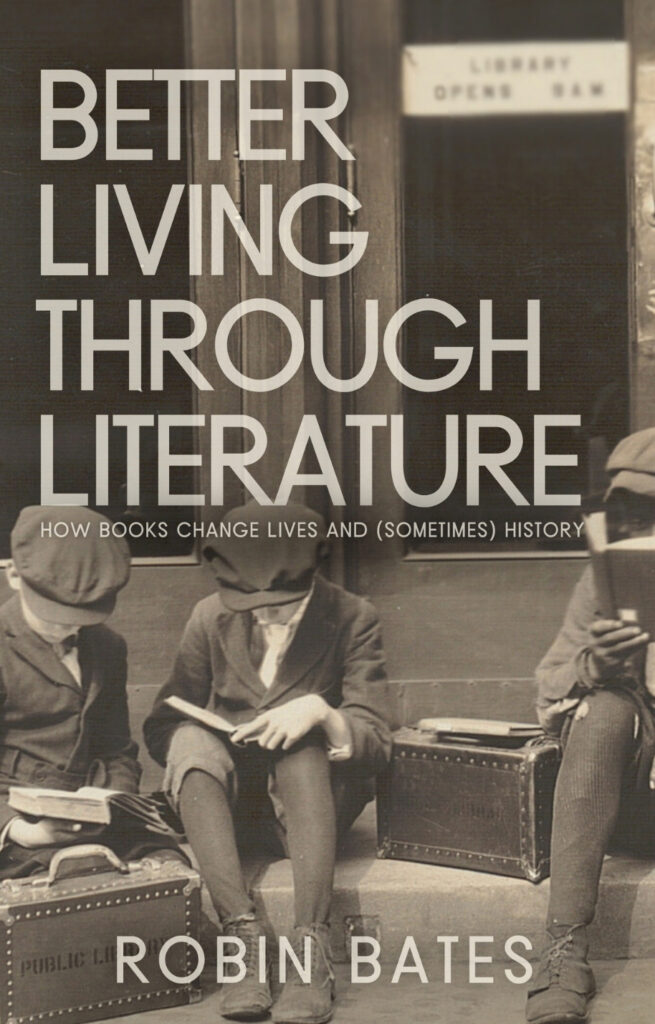
In my book Better Living through Literature I express gratitude to the two novels that gave 11-year-old me a firm foundation as my parents joined black parents to fight for integration in segregated Tennessee: Huckleberry Finn and To Kill a Mockingbird. While I saw racism all around me, these books let me know that good people did not think this way.

The book that made me want to be a writer

Kingsolver names John Steinbeck’s Cannery Row, which she describes as a funny, beautiful novel about an odd little scramble of not-important people.” She thought, “I could try to write a book like that,” and she went on to produce her first novel, The Bean Trees.

When I was in high school, the fiction writer I imitated was Albert Camus, especially his allegorical short stories. They seemed at once mysterious and filled with deep import. I stopped writing fiction when I got to college, however.

The book or author I came back to

Kingsolver names Charles Dickens, which comes as no surprise since Demon Copperhead owes its structure and many of its characters to David Copperfield. About Dickens Kingsolver writes,

I liked him well enough as a younger reader but didn’t appreciate his genius. The craft is so solid, you don’t see the director backstage manipulating plot and point of view. Now, as a novelist, I’m back there with him asking after every scene, “How the heck did you pull that off?”

I find myself choosing Dickens as well. I too found him pleasant enough but now am dazzled by his depth. Another work, which as a teenager I read in a French abridged version, is Victor Hugo’s Les Misérables. As with Dickens, I enjoyed it at the time but now, upon rereading, I now rank it up there with War and Peace in its sweeping portrayal of the human condition.

I’ll return to the rest of the questions in tomorrow’s post.

Posted in Uncategorized | Tagged , , , , , , , , , , , , , , , , , , , | Comments closed

Trump as Mrs. Elton and Ozymandias

Note: If you wish to receive, via e-mail, (1) my weekly newsletter or (2) daily copies of these posts, write to me at rrbates1951@gmail.com. Comments may also be sent to this address. I promise not to share your e-mail with anyone. To unsubscribe, write here as well.

Monday

Compared to how Donald Trump and his administration are dismantling American democracy, his turning the White House into a tacky version of Versailles, gilding with gold its classical white marble, seems a minor matter. Still, it reveals his dream of being a monarch, which is at the heart of his rot. When I see photographs of his restoration job, I can’t help but think of Mrs. Elton in Jane Austen’s Emma.

Mrs. Elton is the foil of Austen’s protagonista daughter of new money who marries the suitor that Emma has rejected. Determined to replace Emma as the head of Highbury society, she talks incessantly about the barouche-landau owned by her wealthy brother and sister, and she is determined to show this backwater hamlet how things ought to be run. Her criticisms in the following passage are delivered aloud so that everyone can hear them:

She was a little shocked at the want of two drawing rooms, at the poor attempt at rout-cakes, and there being no ice in the Highbury card-parties. Mrs. Bates, Mrs. Perry, Mrs. Goddard and others, were a good deal behind-hand in knowledge of the world, but she would soon show them how everything ought to be arranged. In the course of the spring she must return their civilities by one very superior party—in which her card-tables should be set out with their separate candles and unbroken packs in the true style—and more waiters engaged for the evening than their own establishment could furnish, to carry round the refreshments at exactly the proper hour, and in the proper order.

One can imagine Mrs. Elton looking at the White House and concluding, like Trump, that it needs an attached ballroom.

In many ways her relationship to Emma is like Trump’s relationship to Barack Obama, who has a natural class that Trump hungers for and thinks he can achieve by amassing money and power. Oh, and by tarting up the president’s residence. 

Emma, who represents old money, also has natural class. The drama of the novel, however, is whether Emma can live up to potential or whether she will descend to Mrs. Elton’s level. There are times when she is in danger of doing just that, whether by snobbishly rejecting Roger Martin as an appropriate partner for her protégé Harriet or by making a cheap joke at impoverished Miss Bates’s expense. In each case, neighboring squire John Knightley has to coach her into behavior expected of society’s leaders.

In the end, through honest self-reflection, Emma rises to the occasion, and the reward is marriage to Knightley. They have a classy and dignified wedding, and it is Mrs. Elton’s reaction to the ceremony that came to mind when I saw contrasting pictures of the White House Oval Office under Joe Biden and under Donald Trump (see picture above). Austen’s novel concludes with the following subtle and pitch perfect putdown: 

The wedding was very much like other weddings, where the parties have no taste for finery or parade; and Mrs. Elton, from the particulars detailed by her husband, thought it all extremely shabby, and very inferior to her own.—“Very little white satin, very few lace veils; a most pitiful business!—Selina [her sister] would stare when she heard of it.”

To which Austen adds,

But, in spite of these deficiencies, the wishes, the hopes, the confidence, the predictions of the small band of true friends who witnessed the ceremony, were fully answered in the perfect happiness of the union.

Chef’s kiss for “in spite of these deficiencies.”

Speaking of Trump’s Obama envy, he also can’t stand that his predecessor won the Nobel Peace Prize, so much so that he even threatened the Norwegian finance minister with tariffs if Norway doesn’t give him one. This made blogger Greg Olear at Prevail think of “Ozymandias,” the well-known Percy Shelley sonnet about Egyptian pharaoh Ramesses II. 

After noting that Trump has also taken over the Kennedy Center so that he can host the awards ceremony and name the recipients, Olear observes, “He wants the thing to be named after him, probably”:

This is a guy who basically spent his entire career putting his name on everything. He literally made money by licensing other people to put his name on things. So he’s big into this vainglory, right? This kind of “Me, me, me! I want to be the best. I want to be acknowledged as the greatest, as the genius, as the peacemaker, as the best supporting actor,” whatever. That’s what he wants.

Now for the poem:

I met a traveler from an antique land
Who said: “Two vast and trunkless legs of stone
Stand in the desert . . . Near them, on the sand,
Half sunk, a shattered visage lies, whose frown,
And wrinkled lip, and sneer of cold command,
Tell that its sculptor well those passions read
Which yet survive, stamped on these lifeless things,
The hand that mocked them, and the heart that fed:
And on the pedestal these words appear:
‘My name is Ozymandias, king of kings:
Look on my works, ye Mighty, and despair!’
Nothing beside remains. Round the decay
Of that colossal wreck, boundless and bare
The lone and level sands stretch far away.”

To be sure, Trump is no Ramesses II. “Lone and level sands” pretty much captures the barrenness of his interior landscape, however. And he shares Ozymandias’s ego.

Posted in Uncategorized | Tagged , , , , | Comments closed

Poetry – Music of the Sky and Heart

John Constable, Clouds (1822)

Note: If you wish to receive, via e-mail, (1) my weekly newsletter or (2) daily copies of these posts, write to me at rrbates1951@gmail.com. Comments may also be sent to this address. I promise not to share your e-mail with anyone. To unsubscribe, write here as well.

Sunday

Reprinted from Nov. 17, 2013

I’ve been thumbing through Music of the Sky, a wonderful collection of spiritual poetry from a wide range of faiths. The title comes from a poem by Frithjof Schuon, a 20th century German poet who, according to the book’s short blurb about him, wrote more than 300 short poems during the last three years of his life. This one was written in English:

The Song

A finite image of Infinity:
This is the purpose of all poetry.
All human work to its last limits tends;
Its Archetype in Heaven never ends.
What is the sense of Beauty and of Art?
To show the way into our inmost Heart–

To listen to the music of the Sky:
And then to realize: the Song was I. 

In their very interesting preface and introduction, editors Barry McDonald and Patrick Laude expound on how poetry is a “finite image of Infinity.” McDonald says that “the music of the sky” manifests itself through poetic rhyme and meter:

Apart from the content of the poem as such, the most important components of poetry are rhyme and meter. The “music” and the “rhythm” of the poem evoke what Frithjof Schuon has called “the metaphysical transparency of phenomena.” Just as it is the ordering principle of the Logos which enters into manifestation and allows us to realize that God is immanent, so it is the Logos, understood as Sound and Word, which is reflected in the prosodic norms of all authentic spiritual poetry. From the perspective of traditional metaphysic, only God is Real; and it is this Reality unfolding in all of creation which permits us to see that the world is a manifestation of the Sacred. It is this underlying aspect of the deep nature of things which points to the essential function of rhyme. If God is the fundamental unity allowing for all living things to exist in harmony, then, translated into the language of poetry, God is what makes all things rhyme. This is its most profound meaning, and it explains why, since time immemorial, the formal element of rhyme has been a part of the great poetic traditions of the world; without it, the world of the poem ceases to reflect the Logos; it ceases to reflect the deep, underlying homogeneity of creation.

McDonald says something comparable about rhythm:

Similarly, in union with rhyme, we note that the role of the rhythmic component of meter also possesses an essential meaning which we may associate with the contemplative life. Understanding the heart as a symbol of the logos in the human microcosm, we begin to realize the importance of the metrical norm in poetry: without the beating of the physical heart we cannot live; and without the prosodic “heartbeat” a poem is devoid of a rhythmic center—it loses its living pulse. The iamb, which is an unstressed followed by a stressed syllable, echoes the human heartbeat; it is one of the most ancient metrical forms, and it is as a result of the iambic meter that we are drawn into the spell of Shakespeare’s sonnets. Also, it is rhythm which largely contributes to the readers’ ability to interiorize the beauty of the poem; the rhythm of the poem, so to speak, allows the meaning to dance into the soul and to lodge in the memory.

Now, there are many spiritual poems that do not rhyme—those of Mary Oliver leap first of mind as I have just been teaching her—and of course many poems do not have an iambic rhythm. That being said, however, I would agree that there are musical dimensions of poetry that serve to put us in touch with the spiritual dimensions of life, which rhythm being essential.

Or as Schuon points out, we think we are listening to the music of the sky, only to discover that we have found the way to our inmost heart.

Posted in Uncategorized | Tagged , , | Comments closed

Discovering Parental Love Letters

Illus. of Don Marquis’s Archy and Mehitabel

Note: If you wish to receive, via e-mail, (1) my weekly newsletter or (2) daily copies of these posts, write to me at rrbates1951@gmail.com. Comments may also be sent to this address. I promise not to share your e-mail with anyone. To unsubscribe, write here as well.

Friday

Going through the many boxes of correspondence that my mother kept, Julia came across the love letters from my father in the summer of 1946. This was the summer when my mother, who had been going steady with my father for a semester, decided that she really should try out other options. What one sees in the letters is my father’s heart breaking, which he hides under a barrage of self-deprecating humor, thinly disguised jealousy, and poetry. I focus on the poetry in today’s post.

When Phoebe Strehlow from Peoria, Illinois attended the first day of her Carleton College English class in the spring of 1946, she noted a new male student—men had been in short supply during the war years—and went and sat next to him. Scott Bates from Evanston, Illinois fell in love instantly (my mother was a gorgeous woman) and they started dating. Scott, knowing instantly that she was the love of his life, started thinking marriage.

What did the two see in each other? Phoebe, I suspect, was impressed by my father’s life experiences—he was two years older and had been in Normandy, liberated Paris, and Munich—as well as by his poetry, his sense of humor, his lively intelligence, and (as she always said) his smile. He meanwhile was drawn to her beauty, her own considerable intelligence, and above all her innocence, which he clung to after witnessing the horrors of Dachau.

But I imagine that my mother, who had had an upper-class upbringing in Peoria, was also somewhat overwhelmed by this restless and imaginative man, which is why she retreated to more conventional dates over the summer and following fall, including the heir of a major watch company and someone who would later ascend to the upper echelons of the American Boy Scouts administration. These men looked like the kind of man she was supposed to marry once she got what was often called the M.R.S. degree.

She discovered, however, that no one fascinated her anywhere near as much as this poet. So when my father told her at the end of their senior fall semester that he was finally over her—and she, realizing she was in danger of losing him and his wonderful smile, responded by inviting him to a smorgasbord in Minneapolis—and he accepted—the relationship was on again. They wanted to get married following graduation, as Julia and I did, but her parents persuaded her to wait a year. 

Their marriage involved a very different life than the one Peoria would have given her. After all, professors didn’t make much in those days. Rather than being a Peoria socialite, she found herself first scraping by as a grad school wife, then becoming fluent in French thanks to a two-year Fulbright, then plunged into the civil rights movement, and all the while having a front row seat to my father’s battles with the Sewanee administration over integration, the admission of women, LGBTQ+ rights, and his erotic film series. Their marriage lasted 65 years, with my father dying at 90. My mother died eight years later at 96.

As I go through their letters, I’m struck by the role poetry played in their relationship. They were big fans of Don Marquis’s Archy and Mehitabel, a poetic series that appeared in the Baltimore Sun. It featured cockroach Archie, who writes in lower case letters since he can’t work the shift key on the typewriter, and alleycat Mehitabel, who claims that she is Cleopatra reincarnated and whose watchword is “toujours gai” (always joyous).

 “Toujours gai” became their motto that first semester, and my father would use it in his desperate letters to her over the summer as he tried to win her back. “Laugh, be merry, be gay, raise hell” he wrote her in August of that summer, along with some cutting remarks about that “old soak” Bill, whom she was dating at the time. (If he knew about Bill, then my mother must have been telling her about him, perhaps using my father as “a friend.” Years later she would confide to me that Bill, whom she corresponded with into their nineties—her exploration of a road not taken?–was one of the most boring men she had ever known. My father, who was always stirring things up, could be unpredictable and unsettling and exasperating but he was never boring.)

I note in passing that “toujours gai” is the epitaph my brothers and I inscribed on my mother’s plaque in the Sewanee cemetery.

In my father’s letters to her that summer, my father also channeled the great humorist and cartoonist Milt Gross, whose characters deliver a mixture of English and Yiddish. In the following paragraph, he hints that he could have come to see her return from visiting “Jim” at the airport, Jim being the watch guy who had also been in the navy [“da gobs,” “da middies,” “da fleet”]. He imagines Jim being carried off in a stretcher and being hit by a train. Or maybe it’s he who feels like he’s been run over by this train:

Almost came down to the airport Thursday to see you in but thought you might have changed your plans or something’.  Sorry now I didn’t.  Mama, that woulda been delicious! I can see myself leaping into your waiting arms (joke!) while they carried Jim off in a stretcher.  “hi, kids, meet Bates, your daughter’s latest! What goes wit da gobs? Ha. Ha. What makes wit da’ middies? Ha, Ha. Bin flirtin’ wit’ da fleet, baby? Oh, ha. Ha, Ha. The lifeless, shattered remains found under the caboose of the Peoria Rocket have been identified as formerly belonging to a Miss Phoebe Strehlow, late of ….” Sorry, honey I would have liked to have seen you though.

I’m struck by my father’s use of jazz age lingo, here and in the next paragraph. Notice the agony in his tone as he describes a knife being twisted by all her “extra-curricular activities” (which, again, indicates that she must have been telling him about them):

Darling, if you missed me for a day, that’ wonderful, and I will always remember it, but Jesus, Phoebe, I’ve been like that ever since, strictly laughin’ on the outside, crying on the inside, and your letters usually have so much penicillin in them.  Baby, they vibrate and sing! I guess you must be pretty shot, tho’ from all the extra-curricular activities. It’s swell that you had a bang-up time on your trip and God knows I want you to be livin’ on a rainbow toujours, but please don’ twist the blade. I’m too young to be an alcoholic! Jeez, I’m sorry honey, I shall now commence kicking myself around the block for being so dodard (surprise!) jealous; you must think I’m a damn’ fool sometimes, Phoebe.

So now to one of the poems that he wrote during this time, perhaps in the fall in a creative writing class. He knew well the tradition of unrequited love poetry and about poets lamenting their broken hearts. Perhaps the following poignant but bitter poem provided some comfort. I think “crashing chords” is a reference to wedding music:

Orpheus, you played and overplayed your hand.
Your mystic ripples lapped on shifting sand
Ahead: instead of crashing chords you planned
You touched raw, clanging dissonances, and
Found magic nothing more than sleight-of-hand.

What most strikes me about these letters is how my parents’ relationship foreshadowed my own with Julia, albeit without the heartbreak. We too met at Carleton our junior year and we too were brought together by poetry: Julia had started a poetry group and I wowed her by showing up and reciting the opening lines of a Gerard Manley Hopkins poem (“The Leaden Echo”)—and then disappointed her by not joining the group because I was so busy with my duties on the Carletonian, which I would go on to edit. 

We didn’t start dating right away but, later that school year, we started talking in more depth and found each other endlessly fascinating. I too sent her poetry over the following summer and would go on to sprinkle poetry liberally into our commencement day wedding ceremony (including a sexually explicit D. H. Lawrence poem). 

I imagine that my sons will someday discover the letters I wrote to Julia over that summer, which are stored somewhere. Unfortunately, like my father, I didn’t hold on to Julia’s letters to me.

We think we are different from our parents until we discover that, in many ways, we are not.

Posted in Uncategorized | Tagged , , , | Comments closed

Dachau and Hiroshima Remembered

Dachau when liberated by allied troops

Note: If you wish to receive, via e-mail, (1) my weekly newsletter or (2) daily copies of these posts, write to me at rrbates1951@gmail.com. Comments may also be sent to this address. I promise not to share your e-mail with anyone. To unsubscribe, write here as well.

Thursday

Last week, when marking the 80th anniversary of the bombing of Hiroshima and Nagasaki, I recounted how my father was in Munich taking German citizens through required tours of Dachau when he heard the news. Julia and I have been looking through old papers of my parents, including old love letters, and came across this account. I already knew the story but hadn’t realized—or perhaps just didn’t remember—that he had written it down. 

Imagine being 22 years old and encountering first the Holocaust and then the atom bomb. It helps explain my father’s fatalistic determinism, which he and I used to argue about. How can you have devoted your entire life to fighting for social justice, I would ask him, while declaring that we’re all going to end up wiping ourselves out? In response, he would just shrug and say that one does what one can. 

Even though he died at 90 during Barack Obama’s second term—which is to say, he saw the reward for having worked tirelessly for civil rights and racial justice—I imagine that would not have been at all surprised at Donald Trump’s ascendency. If someone had told him that, a little more than a decade later, masked storm troopers would be grabbing people off the streets and the national guard would be occupying Democratic cities, he would have felt affirmed in his view of the world.

Perhaps his pessimism served to insulate him against the kind of disappointment that causes people to withdraw from politics. Expecting nothing, he kept fighting. When I think of him organizing against segregation and homophobia and climate destruction, I am put in mind of a song that I remember singing in a civil rights workshop we attended in Charleston, South Carolina in 1967. Present there were Fanny Lou Hamer, Septima Clark, Stokely Carmichael and others activists who would go on to become legends. The following stanza stands out:

My mother, she was a soldier
She had her hands on the gospel plow
One day she got old, she couldn’t fight anymore
She said, “I’ll stand here and I’ll fight anyhow.”

Here my father’s war story:

A Memoir
By Scott Bates

We passed by the gate
In the back of ten-ton trucks and couldn’t see much
But the smell was terrible.
          They had piled up the bodies
In long symmetrical stacks like cord wood
Next to fright cars hoping to ship them out before we came.
But they hadn’t had time to get rid of them.
We drove on by into Munich with the Seventh Army
          And set up shop in the City Hall.
But we found out later that
The infantry men who took the camp were so sick at
What they found that they rounded up all the guards
And shot them on the spot.
          They also killed the SS officers.
It was our job to show to the German public
The movies we took and the ones we captured
Which pictured graphically the horrors of the camp.
We required the people to watch them. They didn’t like it.
          They didn’t believe them either.
It was just a lot of war propaganda to them.
But still after a couple of months we were
Making some headway in breaking through all that Nazi propaganda when we read in
The Stars and Stripes about the bomb dropped at Hiroshima.

We couldn’t believe it. Had the Air Force lost its mind?
How could they be so dumb as to do a stupid thing like that!
          Here we were
Trying to get the idea through to the Germans about what their government had done
And with one single bomb we had made a dozen Dachaus.
We also realized with terrible foreboding
That we had started a new and potentially fatal arms race.

Julia and I have also come across my father’s old war letters. They’re actually pretty boring—perhaps intentionally so as he didn’t want to disturb his parents—and only twice does this kind man express anger. Once was at the Merchant Marines for delaying deployment of the troops back to the States but the other, more significant, was at the Germans for refusing to take responsibility for what they had done. 

This, however, meant that Hiroshima and Nagasaki hit him doubly hard. As he puts it in his memoir, “with one single bomb we had made a dozen Dachaus.”

Posted in Uncategorized | Tagged , , | Comments closed

Travel to Innisfree—in Your Mind

The lake isle of Innisfree in Sligo, Ireland

Note: If you wish to receive, via e-mail, (1) my weekly newsletter or (2) daily copies of these posts, write to me at rrbates1951@gmail.com. Comments may also be sent to this address. I promise not to share your e-mail with anyone. To unsubscribe, write here as well.

Wednesday

These hot and humid August days are the time when (to cite three cities I know something about) New Yorkers head to Maine, Parisians sets out for southern countryside, and the citizens of Ljubljana head for the Alps or the Dalmatia coast. For his part, W. B. Yeats dreams of “The Lake Isle of Innisfree.”

When I revisited this well-loved poem, I was startled to discover something that I’m sure many have noted but that I was only seeing for the first time. Yeats appears to be responding directly to William Wordsworth’s Romantic classic “Lines Written a Few Miles above Tintern Abbey.” 

Wordsworth is revisiting a site he remembers from five years before. In the intervening time, he says, memories of the place have come back to him so that he sees them as though they are actually there, not just there as a blind man would remember a landscape from the days when he could still see. When the poet is feeling weary and depressed, he returns to this memory  and is restored:

These beauteous forms,
Through a long absence, have not been to me
As is a landscape to a blind man’s eye:
But oft, in lonely rooms, and ‘mid the din
Of towns and cities, I have owed to them,
In hours of weariness, sensations sweet,
Felt in the blood, and felt along the heart;
And passing even into my purer mind
With tranquil restoration

The reference to “din of towns and cities” came to mind as I was reading “Innisfree,” with Yeats standing “on the roadway, or on the pavements grey” as he imagines the sanctuary. Here’s the poem: 

The Lake Isle of Innisfree
By William Butler Yeats

I will arise and go now, and go to Innisfree,
And a small cabin build there, of clay and wattles made:
Nine bean-rows will I have there, a hive for the honey-bee;
And live alone in the bee-loud glade.

And I shall have some peace there, for peace comes dropping slow,
Dropping from the veils of the morning to where the cricket sings;
There midnight’s all a glimmer, and noon a purple glow,
And evening full of the linnet’s wings.

I will arise and go now, for always night and day
I hear lake water lapping with low sounds by the shore;
While I stand on the roadway, or on the pavements grey,
I hear it in the deep heart’s core.

In “Tintern Abbey,” at the end of the stanza about beauteous mental forms Wordsworth talks about becoming “a living soul” that can “see into the life of things. This, I think, is what Yeats is expressing as he talks about always hearing, in his deep heart’s core, the lake water lapping. Here’s Wordsworth describing where the feelings generated by the memory take him:

Nor less, I trust,
To them I may have owed another gift,
Of aspect more sublime; that blessed mood,
In which the burthen of the mystery,
In which the heavy and the weary weight
Of all this unintelligible world,
Is lightened:—that serene and blessed mood,
In which the affections gently lead us on,—
Until, the breath of this corporeal frame
And even the motion of our human blood
Almost suspended, we are laid asleep
In body, and become a living soul:
While with an eye made quiet by the power
Of harmony, and the deep power of joy,
We see into the life of things.

Both poets are telling us that, even if you’re stuck in the city, you’re not really stuck. You can travel to Innisfree in your mind.

Posted in Uncategorized | Tagged , , , , | Comments closed

Is Vance Cassius to Trump’s Caesar?

Gielgud, Mason as Cassius, Brutus in Julius Caesar

Note: If you wish to receive, via e-mail, (1) my weekly newsletter or (2) daily copies of these posts, write to me at rrbates1951@gmail.com. Comments may also be sent to this address. I promise not to share your e-mail with anyone. To unsubscribe, write here as well.

Tuesday

Normally I wouldn’t pay attention to speculation on whether tiny cracks are opening up between Donald Trump and J.D. Vance, any more than I pay attention to distinctions between Kim Jong Il and Kim Jong Un. What point is there in such Kremlinology given that both men are bent on dismantling our democracy? 

When Shakespeare is brought into the conversation, however, I take note, if only to highlight the issues at stake. Thus I read with interest William Kristol contending that Vance is attempting to play Brutus to Trump’s Caesar in the Epstein affair. At a time when Trump has been praying for his friendship with the child rapist to disappear, Vance (so Kristol argues) has stabbed him in the back by deliberately drawing attention to it. “Et tu, Brute?” Kristol imagines Trump saying to his supposedly trusted lieutenant.

Kristol then shifts, however, to seeing Vance not as Brutus but as his co-conspirator Cassius. He imagines Trump viewing his vice-president as Caesar views the senator:

Yon Cassius has a lean and hungry look.
He thinks too much. Such men are dangerous . . .
Such men as he be never at heart’s ease
Whiles they behold a greater than themselves,
And therefore are they very dangerous.

Kristol believes that Vance has deliberately blown fresh life into the Epstein scandal. First, he leaked news of a special meeting he was setting up on how to handle the affair and then he said on Fox News that “a lot of Americans want answers. I certainly want answers.” Kristol points out that the leak and the interview reminded everyone that Trump is hiding something: 

Perhaps Vance was simply being clumsy. But if one had a suspicious mind, one might think Vance knows what he’s doing. Perhaps he doesn’t mind seeing Trump embroiled in the Epstein scandal. Vance presumably had no connection to Epstein, so he’s at no risk if the files are released. And to the degree Trump gets damaged by the Epstein matter, it would make it harder for Trump to run again in 2028—something Trump obviously wants to do, something Vance is intelligent enough to see that Trump wants to do, and something Vance presumably doesn’t want Trump to do.

Running again in 2028 really would be Trump crossing the Rubicon given that it is blatantly unconstitutional. Recall that it is Caesar threatening the Roman republic that galvanizes Brutus into action. “What means this shouting? I do fear, the people choose Caesar for their king,” he says when he hears that Marc Antony is angling for exactly that. 

Cassius further goads Brutus by pointing out that Rome is in danger of being ruled by “one man” rather than a “breed of noble bloods” (i.e., the Senate). The words resonate with us today given that our own Republican-run Congress has surrendered its power to Trump: 

Upon what meat doth this our Caesar feed,
That he is grown so great? Age, thou art shamed!
Rome, thou hast lost the breed of noble bloods!
When went there by an age, since the great flood,
But it was famed with more than with one man?
When could they say till now, that talk’d of Rome,
That her wide walls encompass’d but one man?
Now is it Rome indeed and room enough,
When there is in it but one only man.

Yes, America was once famous for being ruled by more than one man. It used to have wider walls. 

If Vance is indeed attempting to stab Trump in the back, however, it is not because he is a Brutus desiring to save the American republic. Think instead Cassius, who for all his talk of Senate rule would set himself up as a dictator if he had the chance. Caesar reads him right when he says that “such men as he be never at heart’s ease/ Whiles they behold a greater than themselves.” Vance is willing to sell out every principle he once professed for power. 

Our historical moment calls for our own Senate, along with the House, to stand up for the ideals of the Republic. I’m obviously not asking them to assassinate their head, as Brutus and Cassius do, but they could hold fast to cherished American ideals. If they did so, we could indeed call them (echoing Marc Antony on a dead Brutus) the noblest Republicans of them all. We have done so already with Adam Kinzinger and Liz Cheney.

Instead, panicked at how they hear the MAGA faithful cheering their idol, GOP members of Congress have abandoned all they professed to believe, starting with fealty to the Constitution. Trump strides amongst them like a colossus and they, as “petty men,”

Walk under his huge legs and peep about
To find [themselves] dishonorable graves.

Posted in Uncategorized | Tagged , , , , , | Comments closed

Carter Foresaw Algorithm Manipulation

Note: If you wish to receive, via e-mail, (1) my weekly newsletter or (2) daily copies of these posts, write to me at rrbates1951@gmail.com. Comments may also be sent to this address. I promise not to share your e-mail with anyone. To unsubscribe, write here as well.

Monday

Today I return to a post I wrote on Angela Carter’s The Infernal Desire Machines of  Doctor Hoffman a year and a half ago—which itself was a repost from the first Trump presidency—because it’s becoming increasingly applicable with every passing day. A Substack post by Caroline Orr Bueno, a behavioral science researcher at the University of Maryland, warns that the Trump administration is manipulating the algorithms used by social media.

Since many Americans get their news and opinions from social media, and since controlling the narrative is a key part of politics (which is why students need to study literature), this is a significant development. Orr Bueno calls such manipulation “reverse algorithmic capture,” which she describes as 

a process through which government pressure reshapes the architecture of digital platforms, not by direct control, but by engineering incentives that guide algorithms to amplify preferred narratives and suppress dissent. Put differently, it’s the state using soft power to realign platforms’ invisible gates toward ideological conformity—but never giving up that element of distance and plausible deniability.

Orr Bueno notes that this strategy “does not need to issue censorship orders or serve warrants to Silicon Valley tycoons.” That’s because it works “by shifting the terrain on which digital gatekeeping occurs.”

Reverse algorithmic capture is a far more subtle form of control than the example I discussed back in January of 2024, when we saw a Democratic rival to Biden use Artificial Intelligence to create fake robo-calls. That appears child’s play compared with this.

I predicted in my 2024 post that, if Trump were reelected, Carter’s account of a “downward-dropping convoluted spiral of unreality from which we could never escape” would continue to, well, spiral downward. And so, to our horror, it has.

Carter wrote her novel in 1973, when the left-leaning counterculture was engaged in its own assault on norms and conventions. It’s darkly ironic that the anarchy that certain leftists embraced back then is now besieging us from the right.

Reprinted from January 24, 2024

Of the many potential dangers posed by Artificial Intelligence, it appears that one may involve messing with elections. During the recently completed New Hampshire primary, a Boston University professor of Journalism and Emerging Media Studies reports AI being used to fake a Joe Biden robo-call to potential voters. Joan Donovan writes that the call urged Democrats not to participate in the GOP’s January 23 primary election.

New Hampshire is one of those states where voters have opportunities to cross party lines to vote, and Trump was worried about liberals voting for Trump’s opponent Nikki Haley to keep him from getting his party’s nomination. Donovan explains, “In a media ecosystem full of noise, scrambled signals such as deep fake robocalls make it virtually impossible to tell facts from fakes.”

Apparently, all one need to in creating a fake robocall is

selecting a politician, celebrity or executive like Joe Biden, Donald Trump or Elon Musk from a menu and typing a script of what you want them to appear to say, and the website creates the deepfake automatically. Though the audio and video output is usually choppy and stilted, when the audio is delivered via a robocall it’s very believable. You could easily think you are hearing a recording of Joe Biden, but really it’s machine-made misinformation.

Three years ago, as we saw Trump use his stolen election lie to regain control over his party, I noted that Angela Carter has written a novel in which fake reality sweeps aside all resistance. Since the situation has gotten even worse as close to 70% of Republicans now think that Joe Biden was illegitimately elected.

I once taught The Infernal Desire Machines of Doctor Hoffman (1973) in a British fantasy class and found it so unpleasant that I vowed never to assign it again. Now, however, it has the ring of truth. The villain is the 19th century German author E.T.A. Hoffman, who wrote The Nutcracker and the Mouse King and other works of fantasy and gothic horror. In Carter’s novel, Hoffman is the creator of city-wide illusions. Once he gets to work, no one can tell what is real and what is fake.

The changes start imperceptibly, just as Trumpian reality did. Narrator Desiderio, who believes in Reason, is one of the first people to notice

how the shadows began to fall subtly awry and a curious sense of strangeness invaded everything….And the Doctor started his activities in very small ways. Sugar tasted a little salty, sometimes. A door one had always seen to be blue modulated by scarcely perceptible stages until, suddenly, it was a green door.

When the unreality plague is at its height, anything is possible. Here’s a small sampling:

The sense of space was powerfully affected so that sometimes the proportions of buildings and townscapes swelled to enormous, ominous sizes or repeated themselves over and over again in a fretting infinity. But this was much less disturbing than the actual objects which filled these gigantesque perspectives. Often in vaulted architraves of railway stations, women in states of pearly, heroic nudity, their hair elaborately coiffed in the stately chignons of the fin de siècle, might be seen parading beneath their parasols as serenely as if they had been in the Bois de Boulogne…Sometimes the river ran backwards and crazy fish jumped out to flop upon the sidewalks and wriggle around on their bellies for a while until they died…It was, too, the heyday of trompe l’oeil for painted forms took advantage of the liveliness they mimicked. Horses from the pictures of Stubbs in the Municipal Art Gallery neighed, tossed their manes and stepped delicately off their canvases to go crop the grass in public parks. A plump Bacchus wearing only a few grapes strayed from a Titian into a bar and there instituted Dionysiac revelry.

Will this doesn’t sound too bad, there are darker illusions as well:

Frequently, imaginary massacres filled the gutters with blood and, besides, the cumulative psychological effect of all these distortions, combined with the dislocation of everyday life and the hardship of privations we began to suffer, created a deep-seated anxiety and a sense of profound melancholy. It seemed each one of us was trapped in some downward-dropping convoluted spiral of unreality from which we could never escape. Many committed suicide.

“Downward-dropping convoluted spiral of unreality from which we could never escape” pretty much describes what presidency under Trump felt like and what we could expect again were he to be reelected.

At one point in the battle to hold on to a determined reality, the city’s Minister of Determination worries that illusions of past mistresses will lure real people into impregnating them, thereby creating “a generation of half-breed ghosts [that] would befoul the city even more.” I think of those once reasonable Republicans who have interbred with Trump’s fantasies, thereby rendering themselves unrecognizable.

The narrator, like many of us gazing in horror at what Trump’s grotesque lying has done to America, describes reacting with a mixture of fascination and dread:

Then, we—that is, those of us who retained some notion of what was real and what was not—felt the vertigo of those teetering on the edge of a magic precipice. We found ourselves holding our breath almost in expectancy, as though we might stand on the threshold of a great event, transfixed in the portentous moment of waiting, although inwardly we were perturbed since this new, awesome, orchestration of time and space which surrounded us might be only the overture to something else, to some most profoundly audacious of all these assaults against the things we had always known.

Hoffman’s infernal desire machines, it turns out, operate by mechanistically tapping into our inexhaustible “eroto-energy,” thereby creating images that we cannot resist. While this means that, on one level, our dreams come true, it’s also the case that we are no more than Pavlovian dogs. Hoffman has but to mix some sights, sounds and colors, ring a bell, and we salivate. In fact, he (unlike Trump) becomes weary of his project, even though it brings him immense power. The narrator observes, “I would have hated him less if he had been less bored with his inventions.”

Conservative Never Trumper Tom Nichols has described America as “an unserious nation threatened by millions of spoiled, stupid adult children,” and I wonder if Carter’s novel gets at this reality. (Being English, she could also be getting at the fantasies that prompted large numbers of Brits to vote against their well-being and for Brexit.) Desiring their fantasies, large portions of the American electorate thrill to Trump tickling their pleasure centers, and even though he resorts to the same tired act over and over, for some it works every time.

Maybe this is a rich country problem, where bored people (some of whom flew their planes to Washington to participate in the January 6 insurrection) seek thrills to give their lives meaning. Why settle for mere technocratic competence when you can get a show every day? Whereas Joe Biden listens to scientists and tries to get everyone vaccinated, Trump and his cult tout bleach and ivermectin and conspiracy theories and the thrill of flaunting death.

These spoiled, stupid adult children, unlike actual children, have a fully developed frontal lobe and prefrontal cortex (responsible for the executive function), which means they have no excuse. Sadly, it appears that you only have to tell them what they want to hear and they’ll follow you anywhere.

In the novel, there are only two characters who have a fighting chance against Hoffman—Desiderio, whose imagination is balanced with his love of Reason, and the Minister of Determination, who has no imagination at all, being a colorless bureaucrat who believes in order. While Trump riled up those with vivid imaginations, his coup attempt was thwarted by a number of Republicans who were no more than good bureaucrats. It was secretaries of state and election supervisors that saved our democracy by simply running a matter-of-fact election.

Unfortunately, Trump and his followers are trying to unseat them, replacing them with people who are susceptible to the former president’s infernal desire machines. Trump’s eroto-energy has enough of a hold over enough Republicans that future elections are in doubt.

In the novel, Desiderio triumphs, although only barely, and we should all hope that, between Enlightenment Reason and bureaucratic competence, we will defeat Trumpism. But I worry that, because a technocrat like Joe Biden can’t put on a Trump-like show, maybe some of his drop in popularity is attributable to nostalgia for the circus of the last administration. As I look back at 2016-20, I relate to Desiderio looking back at the days when Hoffman’s desire machines ran unchecked:

In those tumultuous and kinetic times, the time of actualized desire, I myself had only the one desire. And that was, for everything to stop.

I became a hero only because I survived. I survived because I could not surrender to the flux of mirages. I could not merge and blend with them; I could not abnegate my reality and lose myself forever as others did, blasted to non-being by the ferocious artillery of unreason.

We’ve been bombarded by this ferocious artillery for some time, and now, with AI entering the scene, it appears that it will get even worse. Professor Donovan, like Desiderio, is hoping that Reason and our version of the Ministry of Determination will prevail. We must, he says, “learn to venerate what I call TALK: timely, accurate, local knowledge. I believe that it’s important to design social media systems that value timely, accurate, local knowledge over disruption and divisiveness.” He also wants federal and state law enforcement authorities to vigorously investigate any use of technology to suppress voter turnout.

 As an Enlightenment project, America has always found itself besieged by the forces of unreason. Educators everywhere must be on high alert.

Posted in Uncategorized | Tagged , , , , | Comments closed

How Shelley Helps Me Envision God

Percy Bysshe Shelley

Note: If you wish to receive, via e-mail, (1) my weekly newsletter or (2) daily copies of these posts, write to me at rrbates1951@gmail.com. Comments may also be sent to this address. I promise not to share your e-mail with anyone. To unsubscribe, write here as well.

Sunday

I am no theologian and so can’t speak systematically about what God is, but that doesn’t mean that my mind doesn’t grapple with the question. Carl Sagan once observed that there are more stars in the universe than there are grains of sand on earth, and while that couldn’t possibly be true, it does help get at the immensity of what we are talking about. Just as the universe is not only bigger than we think but bigger than we can think, so God is bigger than even that. 

But if this is so, how can we imagine that God cares about us? After all, compared to the universe, we are so infinitesimally tiny as to practically not exist. “Not one sparrow will fall to earth without your father’s care,” Jesus assures us in Matthew 10:29, which means that the impossibly large and the impossibly small are somehow bound together. How can this be?

Percy Bysshe Shelley comes as close to resolving this conundrum for me as anyone. Although Shelley was famously kicked out of Oxford for co-authoring a pamphlet entitled “The Necessity Atheism,” in his poem Adonais he talks of “the One Spirit,” which could just as well be called God. In Shelley’s eyes, the One Spirit

Sweeps through the dull dense world; compelling there
All new successions to the forms they wear;
Torturing th’ unwilling dross, that checks its flight,
To its own likeness, as each mass may bear;
And bursting in its beauty and its might
From trees and beasts and men into the heaven’s light.

If one sees creation as the process of the One Spirit blowing through matter—“torturing th’ unwilling dross”—so that new forms are created, then one has an image of how large and small interact. Shelley says that this Power “wields the world with never wearied love,/ Sustains it from beneath, and kindles it above.”

Dante articulates a version of this vision in the Divine Comedy, beginning with humans who are locked in the hell of self but ending with the celestial rose of Paradiso, where the poet is able to envision, through specially granted insight, the whole universe being driven by “the love that moves the sun and the stars.”

I had a vision of the One Spirit at work during our church’s Adult Forum this past year, which had nature as its focus. As different experts talked about different dimensions of the natural world and our natural bodies, each astounding in its creative complexity, I thought of the God of Genesis looking at creation and seeing that it was good. I felt the same as one of my reading groups discussed Richard Power’s The Overstory and then, this past week, Zoë Schlanger’s The Light Eaters: How the Unseen World of Plant Intelligence Offers a New Understanding of Life on Earth. What formerly I had seen as a “green smudge” (Schlanger’s phrase) now seems infused with, well, the One Spirit.

Since Adonais is a poem about the death of a great poet, Shelley focuses on how the One Spirit produces beauty. In lines that we had engraved on our eldest son’s grave, Shelley writes,

He is made one with Nature. There is heard
His voice in all her music, from the moan
Of thunder to the song of night’s sweet bird.
He is a presence to be felt and known
In darkness and in light, from herb and stone…

In other words, Keats is a particular sensitive receiver of the One Spirit; he is dross that comes as close as dross ever can to capturing the beauty and enchantment of that Spirit. Our interactions with nature are heightened by his poems like “Ode to a Nightinggale,” just as they are by, say, the Hudson Valley painters or Beethoven in his Pastoral Symphony. 

As he mourns Keats, Shelley is somewhat consoled by the idea that his friend is being reunited with this energy source: “He is a portion of the loveliness/ Which once he made more lovely.” If this is true, then there is no final death because we are all part of the eternal Spirit. “The One remains, the many change and pass;/ Heaven’s light forever shines, earth’s shadows fly,” Shelley writes, and then elsewhere,

The splendors of the firmament of time
May be eclipsed, but are extinguished not;
Like stars to their appointed height they climb,
And death is a low mist which cannot blot
The brightness it may veil. 

Shelley, in short, comes close to answering the question that has triggered this post. So does the Book of Job, in which the suffering Job expresses his anguished sense that he has been abandoned by God. God responds with a version of Shelley’s One Spirit: while not catering specifically to the individual tragedies of infinitesimally small beings, God is nevertheless present in our lives. Somewhat sarcastically God asks Job,

“Where were you when I laid the foundation of the earth?
    Tell me, if you have understanding.
Who determined its measurements—surely you know!
    Or who stretched the line upon it?
On what were its bases sunk,
    or who laid its cornerstone,
when the morning stars sang together
    and all the sons of God shouted for joy?

While I didn’t think of either Shelley or Job when we lost Justin, I remember thinking of God in these terms. I didn’t blame God because I didn’t think that God interacted with us in this particular way. Rather, I saw God as presenting me with a way out of perpetual gloom. I could embrace the One Spirit and open myself to its light, even at the darkest of times.

I couldn’t do this all at once, nor does Shelley. The early parts of Adonais are filled with with his despair at Keats’s death. But he has faith that a greater force is at work in our lives, and that faith gave me something to rally around. 

Posted in Uncategorized | Comments closed

  • Sign up for my weekly newsletter