MAGA News Too Much? Be Mithridates

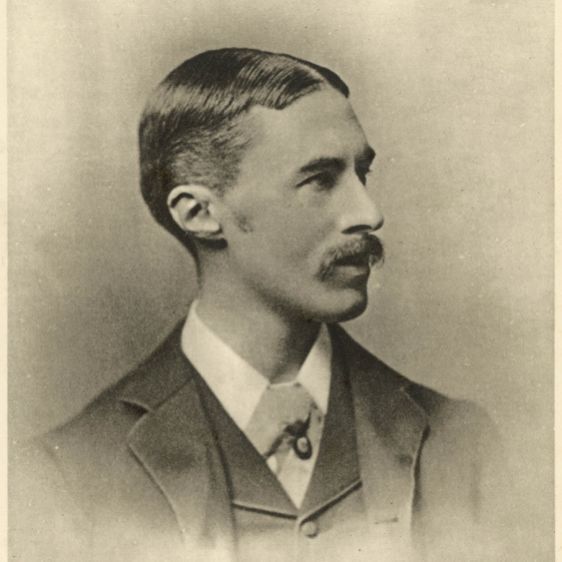
A. E. Housman

Note: If you wish to receive, via e-mail, (1) my weekly newsletter or (2) daily copies of these posts, write to me at rrbates1951@gmail.com. Comments may also be sent to this address. I promise not to share your e-mail with anyone. To unsubscribe, write here as well.

Thursday

Greg O’Lear, one of my favorite bloggers because of his wonderfully rambling essays about literature and politics, has posted another gem. The subject is a poem I loved as an adolescent, albeit one that I’ve never fully understood until now. Taking his cue from A.E. Housman’s “Terence, This Is Stupid Stuff,” Olear contends that the poet offers us important advice for surviving the Trump presidency.

Better yet, poetry is part of the answer.

The poem is a debate between a poet who writes depressing poems and one of his drinking mates. This mate wants something livelier that Terence’s usual fare. He begins by denigrating the poet’s melancholy poetry, seeing it at odds with the gusto with which he eats and drinks. The reference to the cow, Olear notes, is to a popular song from the time:

Terence, this is stupid stuff:
You eat your victuals fast enough;
There can’t be much amiss, ‘tis clear,
To see the rate you drink your beer.
But oh, good Lord, the verse you make,
It gives a chap the belly-ache.
The cow, the old cow, she is dead;
It sleeps well, the horned head:
We poor lads, ‘tis our turn now
To hear such tunes as killed the cow.

Perhaps this friend isn’t averse to all poetry, but he wants something more upbeat that the melancholy poetry that was characteristic of Housman, such as “To an Athlete Dying Young,” “Into my heart an air that kills,” and “Here dead we lie” :

Pretty friendship ‘tis to rhyme
Your friends to death before their time
Moping melancholy mad:
Come, pipe a tune to dance to, lad.’

Terence begins his counter argument by conceding that, yes, there are indeed more uplifting things than depressing poetry. Guinness, for instance:

Why, if ‘tis dancing you would be,
There’s brisker pipes than poetry.
Say, for what were hop-yards meant,
Or why was Burton built on Trent?
Oh many a peer of England brews
Livelier liquor than the Muse…

Then comes the most famous couplet from the poem:

And malt does more than Milton can
To justify God’s ways to man.

The reference, of course, is to the opening invocation of Paradise Lost, where Milton, blind and in jail following the collapse of the Commonwealth and restoration of the the monarchy—is trying to figure out God’s plan in all this. Imagining the Holy Spirit as his epic muse, Milton says that he writes his poem to restore his faith in “Eternal Providence,” which he has begun to doubt:

                                   What in me is dark
Illumine, what is low raise and support;
That to the height of this great Argument [the poem]
I may assert Eternal Providence,
And justify the ways of God to men.

Terence isn’t done acknowledging that beer has its virtues, but he begins to land some subtle jabs: beer works best with fellows “whom it hurts to think” and who would rather “see the world as the world’s not”:

Ale, man, ale’s the stuff to drink
For fellows whom it hurts to think:
Look into the pewter pot
To see the world as the world’s not.
And faith, ‘tis pleasant till ‘tis past:
The mischief is that ‘twill not last.
Oh I have been to Ludlow fair
And left my necktie God knows where,
And carried half way home, or near,
Pints and quarts of Ludlow beer:
Then the world seemed none so bad,
And I myself a sterling lad;
And down in lovely muck I’ve lain,
Happy till I woke again.

Now comes the counterargument, beginning with the inevitable hangover:

Then I saw the morning sky:
Heigho, the tale was all a lie;
The world, it was the old world yet,
I was I, my things were wet,
And nothing now remained to do
But begin the game anew.

Many use the internet, algorithmically programmed to confirm their fantasies, as Housman’s lads use beer. Because the tale that Trump tells is indeed “a lie,” sooner or later we wake up with wet clothes and a splitting headache. And while some do indeed “begin the game anew”—it’s how addiction works, after all—we all know where that leads.

Depressing poems provide a more substantive response to bad times. While Terence makes one last concession—”’Tis true, the stuff I bring for sale/ Is not so brisk a brew as ale”—he points out that he speaks from experience: the poetry “has been rung out in a weary land.” Although “the smack is sour,” all the better “for the embittered hour”:

Therefore, since the world has still
Much good, but much less good than ill,
And while the sun and moon endure
Luck’s a chance, but trouble’s sure,
I’d face it as a wise man would,
And train for ill and not for good.
‘Tis true, the stuff I bring for sale
Is not so brisk a brew as ale:
Out of a stem that scored the hand
I wrung it in a weary land.
But take it: if the smack is sour,
The better for the embittered hour;
It should do good to heart and head
When your soul is in my soul’s stead;
And I will friend you, if I may,
In the dark and cloudy day.

The poem ends with how to prepare for “the dark and cloudy day” that is sure to come. We should read poetry that alerts us to our condition because it can build up our immune systems. Terence’s example is King Mithridates, who rendered himself immune to poison by ingesting small amounts over time:

There was a king reigned in the East:
There, when kings will sit to feast,
They get their fill before they think
With poisoned meat and poisoned drink.
He gathered all the springs to birth
From the many-venomed earth;
First a little, thence to more,
He sampled all her killing store;
And easy, smiling, seasoned sound,
Sate the king when healths went round.
They put arsenic in his meat
And stared aghast to watch him eat;
They poured strychnine in his cup
And shook to see him drink it up:
They shook, they stared as white’s their shirt:
Them it was their poison hurt.

Terence ends his case with a climactic couplet:

I tell the tale that I heard told.
Mithridates, he died old.

From a poetic point of view, there are some problems here. First of all, do we really want to compare poetry to poison? Also, should we only read poetry in small amounts?

Obviously Terence—or at least Housman—is being humorous here, making what he knows to be an outlandish case for poetry. There’s real wisdom here as well, however. In the many ways I’ve explored over the years, literature provides us a powerful means for negotiating the slings and arrows of outrageous fortune, from the death of loved ones to shattering world events. It certainly provides deeper comfort and deeper understanding than a pint.

Back to Olear since he’s using Housman’s poem to provide ways, not just poetry, to handle Trumpism’s daily assaults. Terence offers us two important reminders. First, we can’t live in ignorance, eating, drinking, and being merry while Trumpism is wreaking havoc, because we’ll all end up in the muck. At the same time, however, we must get through these times “emotionally intact.” And to do that, we must find ways to “inure ourselves to bitterness, injustice, heartache, and woe—to steel ourselves to those inevitable negative outcomes.”

You can see where the Mithridates solution comes in. Because the newsfeed “is so toxic that we risk succumbing to its fascist poison,” we must, like the Persian king, “take it all in small doses.”

The goal, for us and for our democracy, is to die old. In order to keep fighting the good fight, limit the amount of time you spend tracking the latest outrages.

Also, keep reading poetry.  
Posted in Uncategorized | Tagged , , , , | Comments closed

Finn, the Woke King in Beowulf

King Finn of Frisia

Note: If you wish to receive, via e-mail, (1) my weekly newsletter or (2) daily copies of these posts, write to me at rrbates1951@gmail.com. Comments may also be sent to this address. I promise not to share your e-mail with anyone. To unsubscribe, write here as well.

Wednesday

I’ve been teaching Beowulf as part of our church’s reading program and was struck, as I reread it, by the applicability of the Finn saga to America’s battles over “wokeism.” The woke character is Frisian king Finn in one of the stories within Beowulf that audiences would have known from elsewhere. It’s an episode that, in the past, I have applied to battles between Israelis and Palestinians, but unfortunately it fits our own internecine quarrels only too well.

The story is a little confusing to modern readers because it has gaps that the original audience could have filled in. Princess Hildeburh of the Danes has been married to the Frisian king in a diplomatic effort to patch up old quarrels. Unfortunately, these quarrels break out again when Hildeburh’s brother is visiting Finn, perhaps as part of continuing diplomatic efforts. Somehow some of the warriors in Finn’s court start taunting the Danes–or something along these lines–and a fight breaks out. In the end, both Hildeburh’s Danish brother on one side and her Frisian son on the other are killed.

Finn, who never wanted the fight in the first place—his desire for peace is the reason he married Hildeburh in the first place—now has a new problem on his hands. Neither side has prevailed and so, while a truce has been declared, he has on his hands angry Frisians and angry Danes. Furthermore, because it’s winter, the Danes can’t sail home, which means they all have to find a way to coexist peacefully. In other words, he’s ruling over fractious factions who, at the least provocation, are prepared to renew fighting. Is this beginning to sound familiar?

Finn’s solution is to go woke. Everyone will receive the same number of gold-wrought rings and no provocation, either by word (taunts or insults) or deed (punches thrown) will be permitted:

So a truce was offered
                                     as follows: first
separate quarters
                              to be cleared for the Danes,
hall and throne
                          to be shared with the Frisians.
Then, second:
                       every day
at the dole-out of gifts
                                      Finn, son of Focwald,
should honor the Danes,
                                          bestow with an even
hand to Hengest
                             and Hengest’s men
the wrought-gold rings
                                      bounty to match
the measure he gave
                                   his own Frisians—
to keep morale
                          in the beer-hall high.
Both sides then
                          the Danish
sealed their agreement
                                       with Oaths to Hengest       t
Finn swore
                  openly, solemnly,
that the battle survivors
                                         would be guaranteed
honor and status.
                              No infringement
by word or deed,
                             no provocation
would be permitted.

To back this up, Finn promises to execute his own warriors if they are at fault:

So if any Frisian
                           stirred up bad blood
with insinuations
                             or taunts about this,
the blade of the sword
                                       would arbitrate it.

As I noted in my previous post, the stranded Danish warriors are spread through Friesland in a situation not unlike Jewish settlements on the West bank. And both Israelis and Palestinians, the Danes are harboring grievances:

Warriors scattered
                               to homes and forts
all over Friesland
                               fewer now, feeling
loss of friends.

Meanwhile, Hengest, who has taken command of the Danes after the death of Hildebuhr’s brother, must live in Finn’s hall. He too broods:

Hengest stayed,
lived out that
                       resentful, blood-sullen
winter with Finn,
                             homesick and helpless.

We are told that he longs for vengeance and “to bring things to a head.” All it takes is for one of his men to drop a sword in his lap and for a couple of others to remind him of old grievances:

    So he did not balk
once Hunlafing
                         placed on his lap
Dazzle-the-Duel,
                           the best sword of all,
whose edges Jutes
                               knew only too well

And:

after Guthlaf and Oslaf
back from their voyage
                                        made old accusation:
the brutal ambush,
                                 the fate they had suffered,
all blamed on Finn.

It doesn’t take much for old rivalries to blaze into a conflagration, and that’s what happens:

                              The wildness in them
had to brim over.
                             The hall ran red
with blood of enemies.
                                       Finn was cut down,
the queen brought away
                                         and everything
the Shieldings could find
                                          inside Finn’s walls —
the Frisian king’s
                              gold collars and gemstones —
swept off to the ship.

This, to be sure, is Danish wish fulfillment, a fantasy of totally annihilating your enemy. The real lesson here, however, is that a diplomatic marriage has failed to work, which means that violence will continue on unabated. The Frisians may be down but they’re not out, and the Danes can expect reprisals.

Later on in the poem, Beowulf notes the tenuousness of diplomatic marriage, observing,

But generally the spear
is prompt to retaliate when a prince is killed,
no matter how admirable the bride may be.

He goes on to describe a scenario very much like the one Finn is banning hate speech to avoid: formerly warring parties, supposedly brought together by such an alliance, will be unable to forget past animosities. As I read the following passage, I think of bar talk where, say, racial grievances—whether real or imagined—inflame imaginations. (Perhaps a person of color has landed a job a white speaker thought was rightfully his.) Today, people reach for keyboards—or occasionally guns—rather than swords, but the effect is to keep the wounds ever fresh:

Then an old spearman will speak while they are drinking,
having glimpsed some heirloom that brings alive
memories of the massacre; his mood will darken
and heart-stricken, in the stress of his emotion,
he will begin to test a young man’s temper
and stir up trouble, starting like this:
“Now, my friend, don’t you recognize
your father’s sword, his favorite weapon,
the one he wore when he went out in his war-mask
to face the Danes on that final day?
After Withergeld died and his men were doomed,
the Shieldings quickly claimed the field;
and now here’s a son of one or other
of those same killers coming through our hall
overbearing us, mouthing boasts,
and rigged in armor that by right is yours.”
And so he keeps on, recalling and accusing,
working things up with bitter words
until one of the lady’s retainers lies
spattered in blood, split open
on his father’s account. 

So what would Beowulf do? At the very least, he provides his warrior society with a different model: he does not hold grudges, he shares what he gains freely, and he follows orderly procedure, awaiting his turn to be king rather than jumping the line. As the poet reports,

Thus Beowulf bore himself with valor;
he was formidable in battle yet behaved with honor
and took no advantage; never cut down
a comrade who was drunk, kept his temper
and, warrior that he was, watched and controlled
his God-sent strength and his outstanding
natural powers.

Once upon a time, Americans valued such qualities in a leader, although we might substitute “never cut down a comrade who was drunk” with “never used his office to unfairly enrich himself” or “never handed out corrupt pardons.”

The question is whether we will live into a modern version of the Beowulf model or whether we will suffer the fate of a Finn, who is unable to prevent the Danish-Frisian feud from killing everyone–brother, son, husband–that Hildeburgh loves. No one wins in the latter scenario.

Posted in Uncategorized | Tagged , , , | Comments closed

No Kings Day, Callooh, Callay!

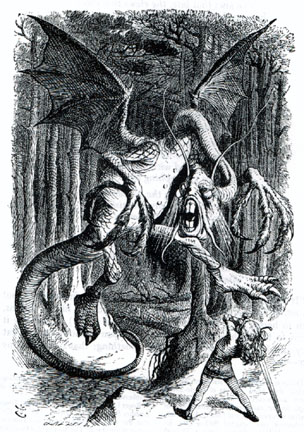
John Tenniel, the Jabberwock from Alice through the Looking Glass

Note: If you wish to receive, via e-mail, (1) my weekly newsletter or (2) daily copies of these posts, write to me at rrbates1951@gmail.com. Comments may also be sent to this address. I promise not to share your e-mail with anyone. To unsubscribe, write here as well.

Tuesday

Where does one find a word to describe one’s joy at over seven million Americans turning out for Sunday’s No Kings marches? (The seven million included 225 that gathered here in ruby red Winchester, Tennessee.) William Kristol, editor of the conservative Never-Trump Bulwark, turned to a nonsense classic for a work that would capture his elation: frabjous.

Revealing that he didn’t initially think he would be moved by the protests, he was caught off balance by them. As he found himself surrounded by prancing inflatable characters, witty signs, and honking horns, he thought of Lewis Carroll’s “Jabberwocky.”

The poem, which is stuffed full of nonsense words—more on these in a moment—describes a heroic quest in which a youth goes in search of the fearsome Jabberwock, which features eyes that flame, “jaws that bite,” and “claws that catch.” Fortunately he is carrying a “vorpal blade,” which he uses to good effect. Here’s the poem:

’Twas brillig, and the slithy toves
      Did gyre and gimble in the wabe:
All mimsy were the borogoves,
      And the mome raths outgrabe.

“Beware the Jabberwock, my son!
      The jaws that bite, the claws that catch!
Beware the Jubjub bird, and shun
      The frumious Bandersnatch!”

He took his vorpal sword in hand;
      Long time the manxome foe he sought—
So rested he by the Tumtum tree
      And stood awhile in thought.

And, as in uffish thought he stood,
      The Jabberwock, with eyes of flame,
Came whiffling through the tulgey wood,
      And burbled as it came!

One, two! One, two! And through and through
      The vorpal blade went snicker-snack!
He left it dead, and with its head
      He went galumphing back.

“And hast thou slain the Jabberwock?
      Come to my arms, my beamish boy!
O frabjous day! Callooh! Callay!”
      He chortled in his joy.

’Twas brillig, and the slithy toves
      Did gyre and gimble in the wabe:
All mimsy were the borogoves,
      And the mome raths outgrabe.

Alice comes across the poem in Looking Glass World but it takes Humpty Dumpty to explain the language. Many of the nonsense words, he says, are like a portmanteau, where “there are two meanings packed up into one word.” Unpacking “frabjous,” Kristol says that it’s a combination of “fabulous” and “joyous.” (Maybe “ferocious” can fit in that portmanteau as well.) The mood  in Maclean and around the country, he reports, “was certainly joyous. And it was fabulous that some seven million people assembled peacefully and patriotically to protest Donald Trump and reaffirm their allegiance to the American idea.”

“On Saturday,” he continues,

the American people assembled lawfully on behalf of the rule of law. On Saturday, the American people demonstrated their commitment to keeping this a free country. Mike Johnson and all his fellow pro-Kings propagandists hoped for violence, extremism, and evidence of hate for America. But instead they saw peace, patriotism, and loyalty to America.

It was a frabjous day.

For all of Saturday’s optimism, Kristol acknowledges that “there’s a long struggle ahead against the sustained attack on our freedom by those in charge.” The quest to defeat our jabberwock requires courage and determination. And venturing into the tulgey wood.

The first step, however, involves overcoming fatalism and lassitude. Saturday’s march helped with that. So far, anti-dictator marches have drawn three million, then five million, now over seven million. As MSNBC’s Rachel Maddow observed last night, at this rate we may reach the 12 million mark, which would be 3.5 % of the population. According to Erica Chenoweth of Harvard’s Kennedy School, who studies social movements, “Nonviolent protests are twice as likely to succeed as armed conflicts – and those engaging a threshold of 3.5% of the population have never failed to bring about change.”

Callooh! Callay!

Posted in Uncategorized | Tagged , , , | Comments closed

My Granddaughter and a Banned Book


Note: If you wish to receive, via e-mail, (1) my weekly newsletter or (2) daily copies of these posts, write to me at rrbates1951@gmail.com. Comments may also be sent to this address. I promise not to share your e-mail with anyone. To unsubscribe, write here as well.

Monday

Okay, schools banning books has just become personal for me. Not on account of a book that has been banned but on a book that could have been banned had my nine-year-old granddaughter Eve (not her real name) resided in a different school district. Here’s the story.

My four grandchildren are biracial, with a Trinidadian American mother. They live in Buford, Georgia, and while Gwinnett County was once Newt Gingrich’s congressional district, it is now wonderfully multicultural and regularly votes blue. Therefore it’s no surprise that the school library would carry Sharon Draper’s Blended, about a mixed-race 11-year-old dealing with various family and social issues.

My own biracial granddaughter is a precocious fourth grader who loves reading, math, tennis, and piano playing. I’m not surprised that she would be drawn to Blended when she saw it in the library because the girl on the cover sports an Afro puff, which Eve often does as well. When we video chat with our grandchildren on Sundays, we always ask them what they’re reading, which is how we learned about Eve’s excitement about Draper’s novel.

Goodreads describes Blended as follows:

“You’re so exotic!” “You look so unusual.” “But what are you really?”

Eleven-year-old Isabella is used to these kinds of comments – her father is black, her mother is white – but that doesn’t mean she likes them. And now that her parents are divorced (and getting along WORSE than ever), Isabella feels more like a push-me-pull-me toy. One week she’s Isabella with her dad, his girlfriend Anastasia, and her son Darren living in a fancy house where they are one of the only black families in the neighborhood. The next week she’s Izzy with her mom and her boyfriend John-Mark in a small, not-so-fancy house that she loves.

The description notes that the novel grapples with identity issues. “If you’re only seen as half of this and half of that,” it asks, “how can you ever feel whole?”

Eve was stimulated by Blended because she felt seen. I don’t know if she’s ever been asked, “But what are you really?”, although I know one of her older sisters was once informed (this by an African American kid who lives next door) that she wasn’t really Black. In any event, Eve, like her two older sisters, is very thoughtful, and the plot gave her a framework for thinking about her own life. The issues raised by the novel seemed familiar.

This goes also for police violence, which Eve has heard about. (The family marched around the neighborhood declaring “Black Lives Matter!” after the murder of George Floyd.) Protagonist Isabella is winged by a police bullet at one point, which momentarily brings the estranged parents together. Eve was riveted.

Had Eve, however, been attending school in Hamilton County, Tennessee; Indian River County or Clay County, Florida; Goddard County, Kansas; Eanes County or Clear Creek County, Texas; Cumberland County, North Carolina; or  Elkhorn Area School District, Wisconsin, she would not have come across the book. And while her parents are both professors, they wouldn’t necessarily have known about it. Thanks to a school library, she picked it up and read it.

In a library challenge to the book brought by a Wrightsboro, North Carolina parent, we get some sense of objections.  As reported by WHQR,

They wrote that this is “intentionally creating highly controversial topics and embedding them into the life events of a small child,” adding that the content is too mature and that while the book is written for children ages 8-12, “authors write and sell books, our job is to look out for kids.”

To its credit, the Wrightboro Public Library overrode the parental challenge, declaring that Blended has “an engaging storyline for young readers, relatable issues, covers issues our students experience such as the impact of divorce, racism, blended families, and positive role model characters who demonstrate resilience and empathy (something our students can benefit from).”

Given our conversation with nine-year-old Eve, I can testify that the librarians know what they are talking about.

In the recent Friends of the Library event we had at Sewanee on book banning, author Christina Soontornvat and librarian Keri Lambert repeatedly pointed out that libraries are not against parents supervising what their own children read; the parents just shouldn’t be able to deny books to other people’s children. In the question-and-answer period that followed, one young person talked about how John Green’s much banned Looking for Alaska “saved my life.” Another said the same about Green’s The Fault in Our Stars.

In other words, certain parents are against other people’s children having their lives saved.

While Blended hasn’t saved Eve’s life, it has spurred her to question and explore the world around her, along with her own developing self. What more can you hope for from a book?

Posted in Uncategorized | Tagged , , , , , | Comments closed

Now I Wrestle with Myself

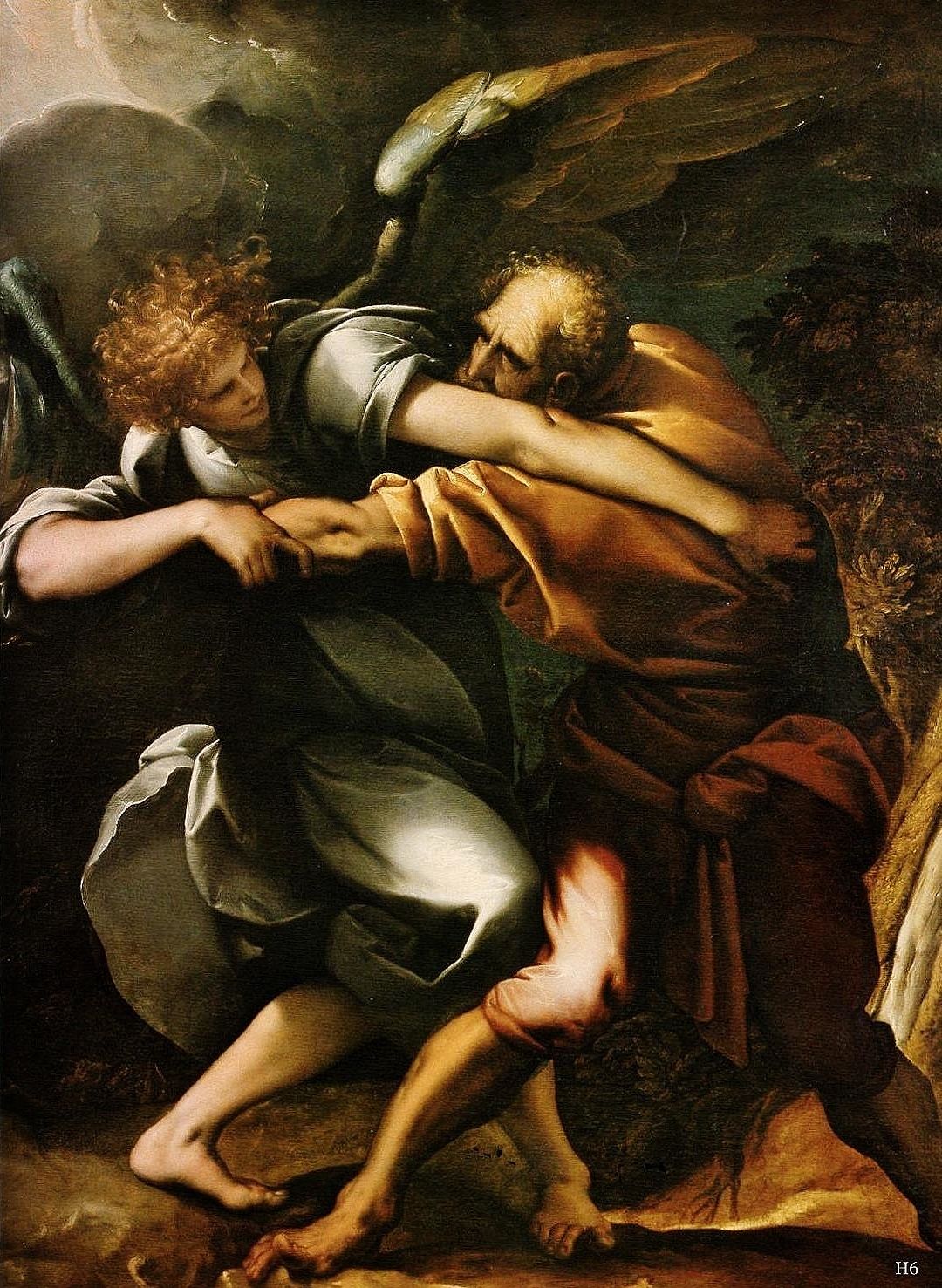
Cristofori Roncalli, Jacob Wrestling with the Angel

Note: If you wish to receive, via e-mail, (1) my weekly newsletter or (2) daily copies of these posts, write to me at rrbates1951@gmail.com. Comments may also be sent to this address. I promise not to share your e-mail with anyone. To unsubscribe, write here as well.

Sunday

Today’s Old Testament reading is the wonderfully mysterious account of Jacob wrestling with…well, we never know for sure? An angel? His brother Esau? Someone else? In Michael Dickel’s “Jacob Wrestling,” his adversary is “myself, this messenger, this something of nothingness.” Here’s the Genesis story (32:22-31):

The same night Jacob got up and took his two wives, his two maids, and his eleven children, and crossed the ford of the Jabbok. He took them and sent them across the stream, and likewise everything that he had. Jacob was left alone; and a man wrestled with him until daybreak. When the man saw that he did not prevail against Jacob, he struck him on the hip socket; and Jacob’s hip was put out of joint as he wrestled with him. Then he said, “Let me go, for the day is breaking.” But Jacob said, “I will not let you go, unless you bless me.” So he said to him, “What is your name?” And he said, “Jacob.” Then the man said, “You shall no longer be called Jacob, but Israel, for you have striven with God and with humans, and have prevailed.” Then Jacob asked him, “Please tell me your name.” But he said, “Why is it that you ask my name?” And there he blessed him. So Jacob called the place Peniel, saying, “For I have seen God face to face, and yet my life is preserved.” The sun rose upon him as he passed Penuel, limping because of his hip.

In Dickel’s poem, sending his loved ones ahead as he backtracks, suggests that he must deal with unfinished business or unresolved doubts before he moves on. In the hero’s quest narrative, crossing a river is often the first step in the journey to selfhood.

The step is often taken reluctantly, however. Even though one’s life is tangled in “deception and counter-deception,” in losses, deaths, and uncertainty, it is still familiar, whereas stepping into an existence where “nothing will be the same” requires real courage.

That’s what happens when one grapples with life’s deepest questions. Or putting it another way, when one wrestles with God.

Jacob Wrestling
By Michael Dickel

They’ve all gone ahead, those I loved,
those I cared for but did not love—
arrayed and ranked, walking toward doom

or reunion. This bank, this river I have crossed before—
this creek, this life, this wreck on this shore—
all too familiar, all too fresh, all too unknown, all too new.

Now a shadow over the moon, or
perhaps my own doubt
forms as I ford the stream.

Now I wrestle with myself,
with this messenger,
this something of nothingness.

Now the moon fades—
darkness less dark—
what is my name?

Now I limp away
from this tangled life
of deception and counter-deception—

to losses, deaths, uncertainty,
a favorite son sold to the gypsies—
Who will redeem us?

Soon my brother and I will embrace
but keep our defended distance.
Soon nothing will be the same.

Now, I wrestle with God.

Posted in Uncategorized | Tagged , , | Comments closed

Childhood in Paris

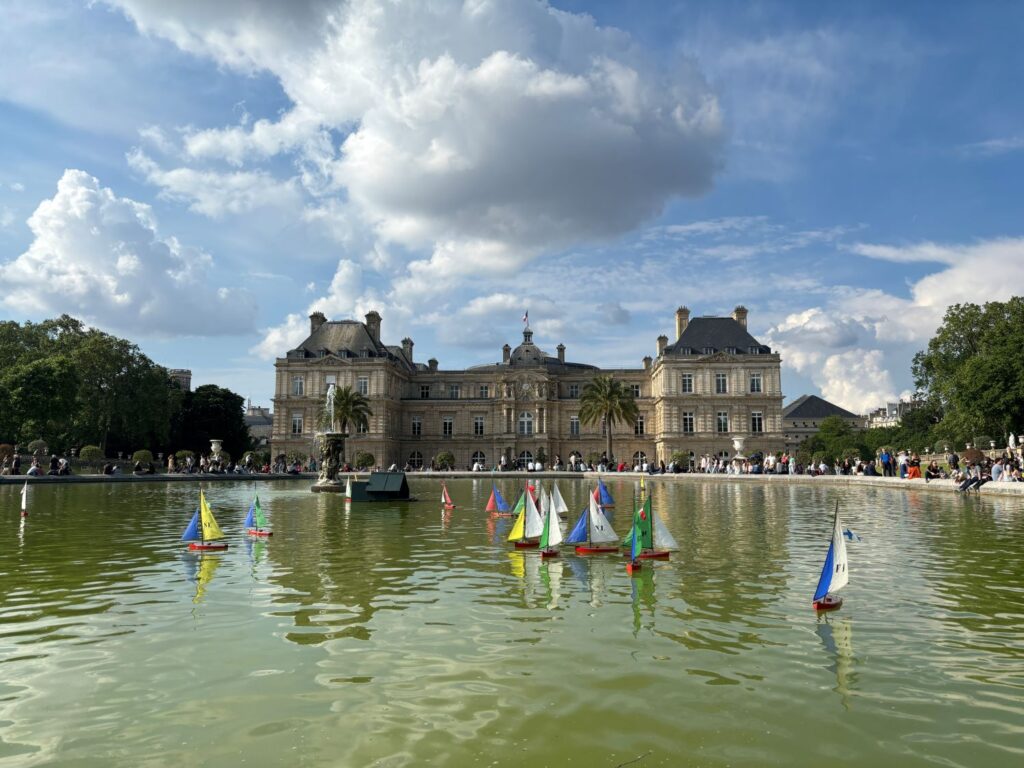
The Luxembourg Gardens

Note: If you wish to receive, via e-mail, (1) my weekly newsletter or (2) daily copies of these posts, write to me at rrbates1951@gmail.com. Comments may also be sent to this address. I promise not to share your e-mail with anyone. To unsubscribe, write here as well.

Friday

This is the latest post in my on-going series on “My Life in Literature,” which appears every Friday. Because an informal autobiography written by my great grandmother Eliza Scott means so much to me—she discusses the novels that were important to her as she grew up in Victorian England—I figured that I should do something similar for family members who come after me. Of course, the subject is also consistent with the mission of this blog, which is to explore the many ways that literature enhances and sometimes changes our lives.

One of the happiest years of my life was the one spent in France at age 13. As I mentioned in last Friday’s post, I was desperately unhappy in seventh grade, so France gave me the opportunity to break from that. While my father was spending all his time in the Bibliothèque Nationale researching the poet Guillaume Apollinaire and my mother was at home taking care of my four-year-old brother Sam, David (8), Jonathan (10) and I attended a small, one-room, private French school named after the poet Alfred de Musset (Cours d’Alfred de Musset).

We lived at 10 Rue de Docteur-Finlay in an apartment building a block from the Seine and near the Bir Hakeim Bridge. This meant that, to get to school, we walked under the Eiffel Tower. In fact, we walked under it four times a day since there was a lunch break of two hours. The school session was 9-12 and 2-5 Monday-Friday (with Thursdays off, as was customary in France) and a half day on Saturday.

We sat in different rows, with each row a different grade level, and spent our time learning French grammar; filling out French maps with the rivers, mountain ranges, and major cities (which we also had to memorize); doing math problems; and memorizing the “resumé” paragraphs that came at the end of the chapters in our science and history textbooks. This wasn’t as onerous as it sounds because, for the first time since I was two, I became fluent in the language. This was fortunate as the teacher knew little English. A moment of pride came when, in a remark that I now recognize as somewhat classist, she told me my French was better than that of many working people.

I fell in love with French history that year—it would become my focus in college—but my favorite part of the day was the final half hour of both the morning and afternoon session. That time—a sixth of the school day—was spent memorizing poetry. To this day I can still recite poems by Apollinaire (“L’Adieu”), Paul Verlaine (“Chanson d’automne,” “Il pleut dan mon coeur”), and Jean de La Fontaine (“Le Corbeau et le Renard,” “La Cigale and la Fourmi”). I also remember solo singing the French version of “O Tannenbaum” and the class looking at me in wonder (perhaps because I was putting myself out there, perhaps because of my American accent).

Through a stroke of fortune, the American Library of Paris, originally near the Champs Elysée, moved to a location directly on our path to school. They had a wonderful children’s collection and we went through everything they had. We read the entire Freddy the Pig series, by Walter Brooks, along with Robert McCloskey’s Homer Price books, Margery Sharp’s Rescuers, and various swashbuckling adventure stories set in Medieval and Renaissance times whose titles I no longer remember. My brother Jonathan, meanwhile, was working his way through all the library’s science fiction collection, so much so that they dropped protocol for him and allowed him to roam the adult stacks. Not infrequently we would check out our books during one lunch hour and return them the following day or sometimes the same day.

Other high points included seeing the Royal Shakespeare Theatre performing Love’s Labours’ Lost and (one of the highlights of the year) a performance of Cyrano de Bergerac in La Comédie Française, France’s most famous playhouse. My father had given me a translation of the play before attending and I fell in love with Cyrano. As I recall, the actor received at least seven curtain calls.

We also went to London for spring vacation, where I remember us attending a performance of Thomas Dekker’s Shoemaker’s Holiday (1599). In short, I was in my element.

Of course, we didn’t only read. Every Saturday my father would give David, Jonathan, and me money to see a film anywhere in the city (we had the Metro system memorized), and thanks to that we saw movies starring the Marx Brothers, Cary Grant (Arsenic and Old Lace), John Wayne (a French favorite), Gary Cooper, Jean Paul Belmondo, Jean Marais, Cary Grant, and others. I remember us once mistakenly walking into the wrong theater (in the Latin Quarter sometimes theaters were squeezed together), and instead of watching the British comedy Tight Little Island, we instead watched Fellini’s 8 ½. Although this autobiographical film is today considered Fellini’s masterpiece, we were American kids watching a film about a film-maker’s midlife crisis (there’s a rocket ship in the film within the film that never takes off—Fellini is never subtle with his symbolism). But even though the film was in Italian with French subtitles, we had paid our way in and so I felt obligated to watch it all the way through. And Jonathan, at least, was excited about the rocket. The carnivalesque film score still haunts my memories.

Of particular pleasure was the newly opened Cinémathèque, which at the time housed the world’s largest international film collection. There we watched old silent films starring Charlie Chaplin, Buster Keaton, Harry Langdon, Harold Lloyd, Ben Turpin, Fatty Arbuckle, and Douglas Fairbanks, as well as movies directed by Jean Cocteau and Jean Vigo. We would sit in the front row, sometimes down on the carpeting, and marvel. I remember once seeing a Buster Keaton film with Czech subtitles since curator Henri Langlois was gathering prints from all over the world.

At home we collected toy warriors from Roman and medieval times; acquired every one of the Tintin books (all in French, of course); purchased magical tricks from a magic store; purchased a foosball table from the large department store Galeries LaFayette (we loved visiting it during the Christmas season); and visited museums, including the Louvre, the Nautical Museum, Notre Dame, the Chateau de Vincennes, the Cluny Museum (with the unicorn tapestries), the Luxembourg Gardens (where we watched children sailing toy sailboats in the garden and where we ourselves played boules). Most of these we visited on our own, without parents.

We also, for the first time in our lives, had a television, which riveted us. We watched British shows, dubbed in French, featuring Ivanhoe, Robin Hood, and Sir Francis Drake (who fights the Spanish, never the French). There were also two French shows we liked: Thierry la Fronde (a French Robin Hood) and Rocambole (an underground adventurer). Oh, and there was also the American series Mr. Ed, which seemed so much better in French than in English since, after all, whoever knew that a horse could speak French?

Every morning for breakfast we would go out and buy hot croissants from the local bakery, along with the Herald Tribune, in which we would read the comics. (I especially remember Dick Tracy and The Phantom.) For lunch I always had camembert and a baguette, along with strawberry yoplait. Oh, and we also drank hard cider, not knowing that it was alcoholic. The French back then (and perhaps still?) were more relaxed about alcohol, and I know that during a later sabbatical trip to France, my brother David’s school celebrated his 15th birthday with champagne.

The only downside we country boys saw to Paris is that it could sometimes feel a bit confined. Only the Bois de Boulogne had open spaces where one could run freely. This drawback felt minor compared to everything the city offered, however.

As I look back, I realize that, even at the time, I sensed my childhood was drawing to a close. I knew, even though I didn’t openly acknowledge it to myself, that when I returned to the States I would be attending the Sewanee Military Academy, the best education the mountain had to offer. In France I felt no pressure to grow up  or to impress peers (there were none), but I knew that couldn’t last. One way I tried to hold on to my childhood was wearing the short pants of the school uniform the entire year, even though we had the option of switching to long pants when it got cold. I’ve talked in past posts how, for my father’s sake, I tried to hold on to childhood innocence, and this was another variant of that. Once again, I was playing to what I sensed was his Peter Pan fantasy.

Ten years later, after I graduated from college, I came across a description of a related longing. In John Knowles’s A Separate Peace, we learn about a magical summer (or so it appears in the narrator’s mind) when time seems to be held in suspension. The school masters know that, when the boys graduate, they could well end up in the World War I trenches, so they loosen the reins. As the narrator describes it,

This was the way the Masters tended to treat us that summer. They seemed to be modifying their usual attitude of floating, chronic disapproval. During the winter most of them regarded anything unexpected in a student with suspicion, seeming to feel that anything we said or did was potentially illegal. Now on these clear June days in New Hampshire they appeared to uncoil…A streak of tolerance was detectable…

The narrator reflects,

I think we reminded them of what peace was like, we boys of sixteen. We were registered with no draft board, we had taken no physical examinations. No one had ever tested us for hernia or color blindness. Trick knees and punctured eardrums were minor complaints and not yet disabilities which would separate a few from the fate of the rest. We were careless and wild, and I suppose we could be thought of as a sign of the life the war was being fought to preserve. Anyway, they were more indulgent toward us than at any other time; they snapped at the heels of the seniors, driving and molding and arming them for the war. They noticed our games tolerantly. We reminded them of what peace was like, of lives which were not bound up with destruction.

In my case, it was not an indulgent faculty that allowed me to remain a child but an indulgent setting. I felt a kind of freedom and peace that I sensed I would lose once I entered my own military experience. I know I was in denial because, when I took the high school placement test, I didn’t put down where I would be attending high school (SMA got hold of it anyway).

Nor was I entirely wrong in my foreboding as the military academy proved to be a painful shock. More on that next week.

Posted in Uncategorized | Tagged , , , | Comments closed

The Most Dangerous Game: Wild Pigs

Note: If you wish to receive, via e-mail, (1) my weekly newsletter or (2) daily copies of these posts, write to me at rrbates1951@gmail.com. Comments may also be sent to this address. I promise not to share your e-mail with anyone. To unsubscribe, write here as well.

Thursday

Somehow I stumbled across an Outdoor Life article, posted by the author on Bluesky, that brought to mind the 15th century Arthurian romance Sir Gawain and the Green Knight. I use it to take a break from the dispiriting political news that pounds us day after day.

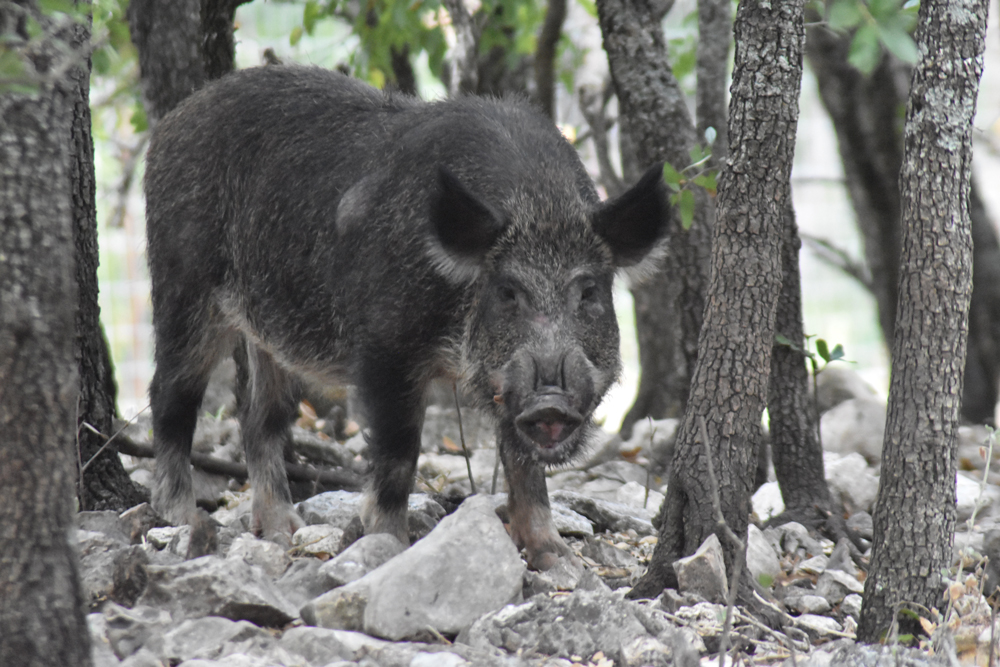
The headline that caught my eye was, “I’ve Been Charged by Bears and Moose. Wild Hogs Are Much, Much Worse.” The subtitle reads, “Over the years I’ve had my fair share of run-ins with big game. The only critters that seem to have no sense of fear are feral pigs.”

Hunter and photographer Charles Elliott elaborates:

Over the years, my contacts with big game have led me to believe that the only tribe that has no sense of fear is the one to which pigs belong. This includes the European wild boar, introduced into our Eastern mountains and Southern coastal islands in the early part of the century, and feral hogs that have escaped civilization and made it on their own in the swamps and mountains. They have noses and ears as sensitive as deer. Most of the time, when a lone hunter ap­proaches, they are wise enough to vanish into the brush or to run before a dog pack. But, cornered or in sudden confrontation, they are most likely to charge or put on a hair-raising demonstration of their ferocity.

The author goes on to report stories of otherwise fearless hunters shimmying up trees to escape the wild boar charges.

Among the many reasons why Green Knight is among my top five favorite works of literature is how, in Part III, the poet crosscuts between men hunting game in the forest and a woman “hunting” Gawain in the castle. The use of this technique, which D. W. Griffith rediscovered in Birth of a Nation 550 years later, serves to heighten both the suspense and the intensity of both chases. Here’s the hunt:

Then they [the hounds] rile the creature with their rowdy ruckus
and suddenly he breaks the barrier of beaters,
–the biggest of wild boards has bolted from his cover–
ancient in years and estranged from the herd,
savage and strong, a most massive swine,
truly grim when he grunted. And the group were aggrieved,
for three were thrown down by the first of his thrusts;
then he fled away fast without further damage.
The Other huntsmen bawled “hi” and “hay, hay,”
blasted on their bugles, blew to regroup,
so the dogs and the men made a merry din,
tracking him noisily, testing him time and time
                         and
         The board would stand at bay
         and aim to maul and maim
         the thronging dogs, and they
         would yelp and yowl in pain.

The next stanza is more of the same, only note the dramatic but also comic shift at the end, where the Lady of the Castle advances on a sleeping Sir Gawain:

Then the archers advanced with their bows and took aim,
shooting arrows at him which were often on target,
but their points could not pierce his impenetrable shoulders
and bounced away from his bristly brow.
The smooth, slender shafts splintered into pieces,
and the heads glanced away from wherever they hit.
Battered and baited by such bombardment,
in frenzied fury he flies at the men,
hurts them horribly as he hurtles past
so that many grew timid and retreated a tad.
But the master of the manor gave chase on his mount,
the boldest of beast hunters, his bugle blaring,
grumpeting the tally-ho and tearing through thickets
till the setting sun slipped from the western sky.
So the day was spent in pursuits of this style,
while our lovable young lord had not left his bed,
and, cosseted in costly quilted covers, there he
                    remained
         The lady, at first light,
         did not neglect Gawain,
         but went to wake the knight
         and meant to change his mind.

We watch the lady relentlessly tempting and teasing Gawain, who is simultaneously working to remain chaste without striving to remain chivalrous and accommodating. (A Groucho Marx line from Duck Soup comes to mind:“We’re fighting for this lady’s honor, which is more than she ever did.”) Then it’s back to the boar.

Then [Gawain] loitered with the ladies the length of the day
while the lord of the land ranged left and right
in pursuit of that pig which stampeded through the uplands,
breaking his best hounds with its back-snapping bit
when it stood embattled…then bowmen would strike
goading it to gallop into open ground
where the air was alive with the huntsman’s arrows.
That boar made the best men flinch and bolt,
till at last his legs were like lead beneath him,
and he hobbled away to hunker in a hole
by a stony rise at the side of a stream.
With the bank at his back he scrapes and burrows,
frothing and foaming foully at the mouth,
whetting his white tusks. The hunters waited,
irked by the effort of aiming from afar
but daunted by the danger of daring to venture
                         too near.
         So many men before
         had fallen prey. They feared
         that fierce and frenzied boar
         whose tusks could slash and tear.

Following much commotion, the hunt finally comes to an end:

Till his lordship hacks up, urging on his horse,
spots the swine at standstill encircled by men,
then handsomely dismounts and unhands his horse,
brandishes a bright sword and goes bounding onwards,
wades through the water to where the beast waits.
Aware that the man was wafting a weapon
the hog’s hairs stood on end, and its howling grunt
made the fellows there fear for their master’s fate.
Then the boar burst forward, bounded at the lord,
so that beast and hunter both went bundling
into white water, and the swine came off worst,
because the moment they clashed the man found his mark
knifing the boar’s neck, nailing his prey,
hammering it to the hilt, bursting the hog’s heart.
Screaming, it was swept downstream, almost slipping
                         beneath.
         At least a hundred hounds
         latch on with tearing teeth.
         Then, dragged to drier ground,
         the dogs complete its death.

As I interpret the poem, it is about humans learning to appreciate and love life in the decades following the great plague, which wiped out half of Europe’s population. Gawain looks with contempt at life, perhaps as a psychological coping mechanism in an age of death (he sees self-denial as a Christian and knightly virtue), and so has to be taught to value it as the gift that it is. This is the lesson the Green Knight has for him. In the hunt we see the creatures fighting for life while in the castle hunt we see the sweetness of sexuality. The Lord of Death and the Lady of Life divide creation between them.

In the end, Gawain is forced to concede that he cares for his life after all. This admission comes reluctantly and with a fair amount of shame attached but it does come. We, meanwhile, can see in the lord’s quarry—the deer, the boar, and the fox—the three ways we respond to death: we deny it (like the deer, who are caught unawares), we fight it (like the boar), or we seek to escape it (like the fox). And just as the Lord of Death always gets its prey, so does the Lady of Life, who persuades Gawain to accept from her a life-saving belt.

But back to boar hunting. Thanks to rifles, hunters now have an unfair advantage. Still, boars themselves haven’t changed.

They still refuse to go gently into that good night.

Posted in Uncategorized | Tagged , , , , | Comments closed

On Clifton, Columbus, and Indians

Miniconjou Lakota Chief Big Foot, killed at Wounded Knee

Note: If you wish to receive, via e-mail, (1) my weekly newsletter or (2) daily copies of these posts, write to me at rrbates1951@gmail.com. Comments may also be sent to this address. I promise not to share your e-mail with anyone. To unsubscribe, write here as well.

Wednesday

On Monday Sewanee observed Indigenous People’s Day with a walk along that section of the Trail of Tears—the Bell Route—that goes through our area. In 1838 John Bell led a detachment of 650-700 Cherokees on the 1000 mile trek to present day Oklahoma. They arrived in January, 1839, suffering from hunger, sickness, and cold along the way. The Sewanee walk honoring their memory was interspersed with readings of recorded accounts of those who were relocated and their descendants.

While this was going on, the Trump White House was issuing a proclamation praising Christopher Columbus. As Heather Cox Richardson reports

The proclamation says that the day is one on which “our Nation honors the legendary Christopher Columbus—the original American hero, a giant of Western civilization, and one of the most gallant and visionary men to ever walk the face of the earth. This Columbus Day, we honor his life with reverence and gratitude, and we pledge to reclaim his extraordinary legacy of faith, courage, perseverance, and virtue from the left-wing arsonists who have sought to destroy his name and dishonor his memory.”

The proclamation goes on to announce that, upon Columbus’s arrival, “he planted a majestic cross in a mighty act of devotion, dedicating the land to God and setting in motion America’s proud birthright of faith.” And that, “guided by steadfast prayer and unwavering fortitude and resolve, Columbus’s journey carried thousands of years of wisdom, philosophy, reason, and culture across the Atlantic into the Americas—paving the way for the ultimate triumph of Western civilization less than three centuries later on July 4, 1776.”

In response, and at the risk of sounding like a left-wing arsonist, I share this Lucille Clifton poem, written after she watched a neighbor bulldoze down all the trees in his yard so he wouldn’t have to worry about raking leaves. Watching the trees go down, Clifton thought of the famous Wounded Knee photo of Chief Big Foot. “Pahuska” means long hair and is the Lakota name for General Custer:

the killing of the trees
By Lucille Clifton

the third went down
with a sound almost like flaking,
a soft swish as the left leaves
fluttered themselves and died.
three of them, four, then five
stiffening in the snow
as if this hill were Wounded Knee
as if the slim feathered branches
were bonnets of war
as if the pale man seated
high in the bulldozer nest
his blonde mustache ice-matted
was Pahushka come again but stronger now,
his long hair wild and unrelenting.

remember the photograph
the old warrior, his stiffened arm
raised as if in blessing,
his frozen eyes open,
his bark skin brown and not so much
wrinkled as circled with age,
and the snow everywhere still falling,
covering his one good leg.
remember his name was Spotted Tail
or Hump or Red Cloud or Geronimo
or none of these or all of these.
he was a chief. he was a tree
falling the way a chief falls,
straight, eyes open, arms reaching
for his mother ground.

so i have come to live
among the men who kill the trees
a subdivision, new,
in southern Maryland.
I have brought my witness eye with me
and my two wild hands,
the left one sister to the fists
pushing the bulldozer against the old oak,
the angry right, brown and hard and spotted
as bark. we come in peace,
but this morning
ponies circle what is left of life
and whales and continents and children and ozone
and trees huddle in a camp weeping
outside my window and i can see it all
with that one good eye.

“There is no document of civilization which is not at the same time a document of barbarism,” the German thinker Walter Benjamin once wrote, and Heather Cox Richardson follows this up by observing, “Rejecting an honest account of the past makes it impossible to see accurate patterns.” She adds, “What is arson, though, is the attempt to skew history to serve a modern-day political narrative.” Trump’s whitewashing to Columbus is matched by his whitewashing of Andrew Jackson, one of his favorite presidents and the individual most responsible for the Trail of Tears.

Trump, of course, is not only going after history. Since he came to power, the cavalry has only stepped up its assault on “what is left of life,” whether it’s clear water, clean air, clean energy, the national forests, children, civil rights, or American democracy generally.

Clifton doesn’t altogether absolve herself. After all, she has moved into a subdivision that required the felling of trees. One of her hands, she says, is “sister to the fists” that pushes the bulldozer against the oak. Her angry right hand, however, is as “brown and hard and spotted” as a felled tree or a felled warrior.

Her eyes are similarly split. While her left eye prefers not to see things, her witness eye insists on testifying.

Which, by Trump standards, makes her a left-wing arsonist.

Posted in Uncategorized | Tagged , , , , , | Comments closed

A Browning Poem and MAGA America

Andrea del Sarto


Note: If you wish to receive, via e-mail, (1) my weekly newsletter or (2) daily copies of these posts, write to me at rrbates1951@gmail.com. Comments may also be sent to this address. I promise not to share your e-mail with anyone. To unsubscribe, write here as well.

Thursday

I was pleasantly surprised recently to see Mary Trump, Donald Trump’s niece and vocal critic, using a Robert Browning poem to understand our current turmoil. She also uses it to understand her own father since, like the Italian painter Andrea del Sarto, he never lived up to his potential. In Mary’s case, her dysfunctional family and the current state of the nation are connected: while her father had more substance, the parents preferred their flashier but less talented younger son.

Mary draws a parallel between her father, who died a disappointed alcoholic, and her country, which she sees as failing to live up to the challenges of the present moment. Like del Sarto, both are trapped in a “common greyness” that “silvers everything.”

Using the dramatic monologue form for which he was famous, Browning captures the lament of a painter who is good but not great. While the del Sarto in the poem has perfect technique, he lacks that special something—inspiration, soul—that marks his contemporaries Raphael and Michelangelo. The poem shows him whining to his wife about how (to borrow from Marlon Brando) he could have been a contender. For his failures, del Sarto blames everything from Lucrezia to his own lack of effort to external circumstances to inner limitations. “Important to Browning’s project,” Mary writes,

is del Sarto’s grappling with recognition—and his unwillingness to accept—that the extraordinary talents he possesses are not enough, have never been enough, in and of themselves to elevate his art to the level of the sublime. His dawning awareness that he is ultimately the only one responsible for having squandered his potential, and the reasons for his having squandered, remains beyond his ability to acknowledge.

Mary recognizes Fred Trump II in the monologue, especially the lines

I do what many dream of, all their lives,
—Dream? strive to do, and agonize to do,
And fail in doing.

She writes,

Those lines, and the tone of resignation that runs throughout the poem, reminded me of my father and the fact that his extraordinary accomplishments ended up being for naught. As he floundered, his unaccomplished and unworthy younger brother usurped his position and his fortune.

“One of the diseases that ravaged my family,” she elaborates, “was the delusion that Donald of all people was great, while somebody like my father was a loser. When families operate in service to perpetuating such delusions, you get a thin-skinned, constantly aggrieved bully.”

Of more interest to most of us is how Mary applies the poem to our present moment. Just as Andrea del Sarto is in the twilight of a disappointing career—his sober landscape paintings are pleasant enough—so this 250-year-old democracy is dwindling from great to something merely good:

A common greyness silvers everything,—
All in a twilight, you and I alike
—You, at the point of your first pride in me
(That’s gone you know),—but I, at every point;
My youth, my hope, my art, being all toned down
To yonder sober pleasant Fiesole.

The poem, Mary notes, is in part a meditation on the idea that greatness without effort is unsustainable. “If you believe you possess a greatness that is immanent,” she writes, “there is no need to strive to be good.” This is our situation:

American exceptionalism is based on the belief that this country is de facto superior to other countries, that our way of being—our culture, our beliefs—should never be challenged and changed. This has led to complacency and a failure to challenge the status quo. Worse, it has led to an insupportable arrogance and a steady degradation of the things upon which our ideas of being exceptional are based.

Browning’s poem concludes with Lucrezia leaving del Sarto for her lover. As America withdraws into isolation, the rest of the world is looking elsewhere for leadership, with economist Paul Krugman recently observing that Trump is managing “to make China great again.”

Can this trend be reversed? The most famous passage from “Andrea del Sarto” is “a man’s reach should exceed his grasp or what’s a heaven for?” What’s important is the striving. But as Mary points out, the lines that follow reveal what happens once the striving ends:

All is silver-grey,
Placid and perfect with my art: the worse!

Make America Great Again is a longing for the past, not a striving toward a future. “Placid and perfect” describes the Mayfield of Leave It to Beaver, not a country capable of rising to the challenges of the 21st century.

“We might have risen to Rafael, I and you!” del Sarto says to his wife at one point. We can relate only too well to his sorrow over what could have been.

Posted in Uncategorized | Tagged , , , , , | Comments closed

  • Sign up for my weekly newsletter