Tuesday
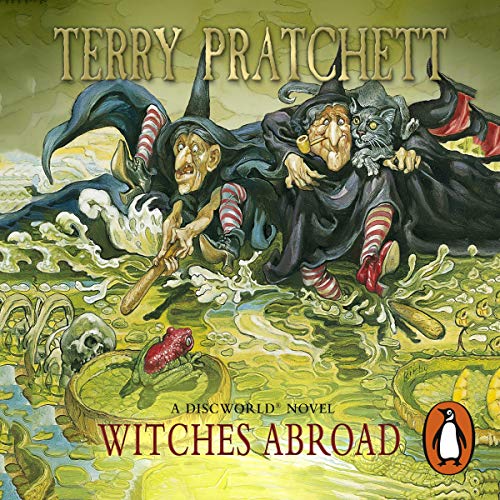
In recent years I’ve written a lot about Terry Pratchett, an author whom I think is underappreciated by people who take comedy less seriously than melodrama or tragedy. I find that he has profound things to say about the nature of authority, our dark impulses, and (my subject today) the power of narrative. In Witches Abroad he explores the tyranny that can arise from attempting to force reality into a predetermined story.
Yale scholar Peter Brooks opens his book Seduced by Story: The Use and Abuse of Narrative (2022) with a quotation from Game of Thrones: “There’s nothing in the world more powerful than a good story. Nothing can stop it. No enemy can defeat it.” The heroic witches in Pratchett’s novel, however, are out to defeat the archetypal story of “happy ever after.”
In the opening chapter the author spells out what they are up against:
People think that stories are shaped by people. In fact, it’s the other way around.
Stories exist independently of their players. If you know that, the knowledge is power.
Stories, great flapping ribbons of shaped space-time, have been blowing and uncoiling around the universe since the beginning of time. And they have evolved. The weakest have died and the strongest have survived and they have grown fat on the retelling…stories, twisting and blowing through the darkness.
In Leslie Marmon Silko’s novel Ceremony, an evil Pueblo witch tells a dark story and, when the other witches beg her quash it, she informs them that “it can’t be called back.” Pratchett recounts how a story picks up steam as it goes along:
And their very existence overlays a faint but insistent pattern on the chaos that is history. Stories etch grooves deep enough for people to follow in the same way that water follows certain paths down a mountainside. And every time fresh actors tread the path of the story, the groove runs deeper.
This is called the theory of narrative causality and it means that a story, once started, takes a shape. It picks up all the vibrations of all the other works of that story that have ever been.
This is why history keeps on repeating all the time.
Pratchett then gives examples that are reminiscent of Carl Jung’s collective unconscious and Joseph Campbell’s Hero with a Thousand Faces:
So a thousand heroes have stolen fire from the gods. A thousand wolves have eaten grandmother, a thousand princesses have been kissed. A million unknown actors have moved, unknowing, through the pathways of story.
It is now impossible for the third and youngest son of any king, if he should embark on a quest which has do far claimed his older brothers, not to succeed.
Stories don’t care who takes part in them. All that matters is that the story gets told, that the story repeats. Or, if you prefer to think of it like this: stories are a parasitical life form, warping lives in the service only of the story itself.
To fight this life form, Pratchett gives us Granny Weatherwax and Nanny Ogg, two witches who provide essential services to the citizens of the tiny kingdom of Lancre. “It takes a special kind of person to fight back,” the author tells us, “and become the bicarbonate of history.”
As a specialist in fairy tale fantasy, Pratchett is intimately acquainted with the power of traditional stories, and in much of his fiction he simply turns them upside down. For him, elves are bad and witches (most witches anyway) are good, as are (also with exceptions) werewolves, vampires, goblins, and trolls. Pratchett is well aware how, throughout history, some of these figures have served as stand-ins for scapegoated marginalized groups. Old women living in rural solitude have long been vulnerable to bouts of witch hysteria, and in Lord of the Rings Tolkien uses goblins to articulate his anxieties about the industrial working class. In those Pratchett novels featuring the sprawling urban jungle of Ankh Morepork, the author uses a variety of traditional monsters to explore the exciting potential of multicultural society. Trolls and dwarfs, werewolves and humans learn to overcome their differences and work together.
In Witches Abroad, Weatherwax, Ogg, and newly minted witch Magrat must go up against a fairy godmother (Lilith) who is determined to transform the populace Genoa into her own happily-ever-after reality. She turns mice into coachmen, rats into horses, and frogs into princes while the population is pressured into behaving like Disneyland props. Woe be to the tavern keeper who is not fat and jolly!
The Lancre witches must rescue Embererella (“Ella”), the rightful ruler of Genoa, from marriage to a frog prince. In so doing, they act as counter-godmothers, there to assist Ella to escape the marriage plot and become her own individuated self. As Weatherwax explains it, “We’re the kind [of godmother] that gives people what they know they really need, not what we think they ought to want.”
To which Pratchett adds, “Among the fascinated crowd several pairs of lips moved as people worked this out.”
Weatherwax is more clear in a subsequent statement, declaring that Ella “might be quite good at ruling. She might be bad at it. But she’s got to find out for herself. With no interference from anyone.”
This means no interference from a predetermined story.
Mirrors play a significant role in Witches Abroad, especially mirrors set up against each other so that an infinite number of worlds appear. Pratchett’s point, I think, is that we can lose sight of who we really are as we imagine (thanks to stories) all those selves we think we ought to be. In a final showdown between Weatherwax and Lilith, where each finds herself in a limbo world, Weatherwax triumphs because she knows who she is:
Granny Weatherwax looked out at the multi-layered silvery world.
“Where am I?”
INSIDE THE MIRROR…“When can I get out?”
WHEN YOU FIND THE ONE THAT’S REAL.
“is this a trick question?”NO.
Granny looked down at herself.
“This one,” she said.
At which point she returns to reality. Lilith, by contrast, never escapes but simply runs on, forever, “through the endless reflections.”
While Pratchett isn’t writing about America today, his book nevertheless speaks to us. We are living at a time where our president lies non-stop while he and his minions systematically attack the arbiters of truth, whether they be journalists, scientists, doctors, judges, lawyers, professors, economists, or civil servants. Increasingly MAGA Republicans spin outlandish fables—lies—for which they are never held to account, whether it be about the climate or vaccines or immigrants. They see what they want to see in an endless hall of mirrors.
Is there a limit? The great literary Marxist theorist Fredric Jameson, debating the post-structuralists, used to say that history wasn’t subject to endless deconstruction. In the end, he asserted, “history is what hurts.” We are seeing this to be increasingly the case as temperatures, measle cases, and gas prices all soar. Even some of those most committed to Trump’s fables are beginning to have doubts.
In such discussions, I always quote Salman Rushdie, who has written that, “as far as writers are concerned, we need to rebuild our readers’ belief in argument from factual evidence, and to do what fiction has always been good at doing—to construct, between the writer and the reader, an understanding about what is real.” Pratchett uses fantasy to enhance this understanding.