Note: If you wish to receive, via e-mail, (1) my weekly newsletter or (2) daily copies of these posts, write to me at rrbates1951@gmail.com. Comments may also be sent to this addss. I promise not to share your e-mail with anyone. To unsubscribe, write here as well.
Tuesday
My father’s favorite holiday was Christmas—he felt it kept the child in him alive—and every year he would write a poem for the occasion. This my parents sent out as a Christmas card and also published in the town newspaper (which my mother founded before she passed it on). Here’s a mystical villanelle he wrote about the quest that the Christmas tree represents. ’Tis the season for such poems.
For the record, a villanelle is a 19-line verse form consisting of five three-line stanzas and a final four-line stanza, with various lines repeated. The best-known villanelle is Dylan Thomas’s “Do Not Go Gentle.”
My father insisted that, on Christmas day, we follow various rituals. The youngest members of the family would go down and retrieve the stockings, beautifully knitted for us by my mother and each carrying our name. We would empty these at the dining room table while eating a braided coffee cake, with icing and pecans, that my mother had made and frozen a few days before. My father had spent the previous year keeping his eye open for things to put in the stockings.
Breakfast eaten, we would go into the living room, gazing at the presents that had miraculously appeared around the tree. We would sit in a circle while the youngest would again bring us our gifts, one at a time for each of us. The predominant gifts, especially as we grew older, were books and videos/dvds. We’d spend the rest of the day reading, watching films, and phoning relatives. When I had my own family, we would drive the twelve hours from Maryland and spend a week. Now Julia and I live in this same house, and our two sons and five grandchildren will be traveling here to join us.
Our book-heavy Christmases provide insight into the poem. First of all, the marvelous tree is not only a reference to the evergreen symbolism of northern European solstice traditions, although it is partly that. It also points to how the season is about miraculous transformation. Imagination is the key to the magical cave, an “open sesame” password that “only the children know.” Well, children and those adults in touch with their inner child.
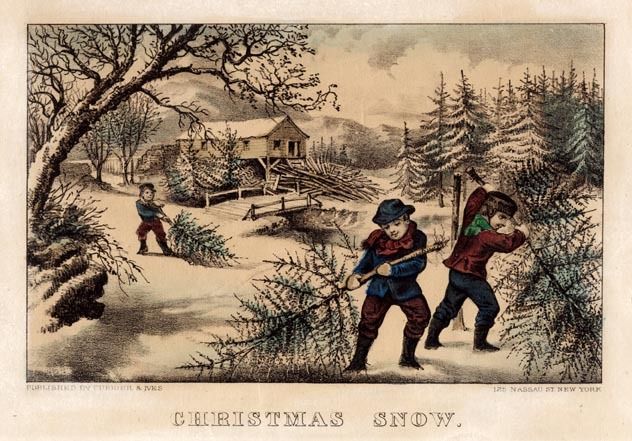
To capture this journey, my father echoes poems and stories about journeys to magical lands. I catch allusions to Cavafy’s “Ithaka,” Edward Lear’s “The Jumblies” and “The Owl and the Pussycat,” poems by Charles Baudelaire and Derek Walcott, and Arabian Nights. The sailors are like children—or children are like sailors–with the skiing over the snow recalling Currier and Ives paintings. This is Christmas seen through a child’s eyes.
Quentin Hope, to whom the poem is dedicated, was a French professor at Indiana University and a close friend of my father’s. They spent many hours “in lybrarye” (Chaucer’s spelling) searching for literary treasures. For my father, library archive work was like an Easter egg hunt, so it makes sense to me that he groups himself with children entering a cave portal by means of a magical key and with sailors discovering exotic new worlds. He and Quentin are carried on the wings of poetry, which include songs/poems like this one.
Here’s the poem:
The Quest of the Marvelous Tree
By Scott Bates
On the quest of the marvelous tree
The children ski over the snow
As sailors sail out to seaPast islands of ginger and tea
Over dolphin hills they go
On the quest of the marvelous treeSo scholars in lybrarye
On greening mastheads flow
As sailors sail out to seaPast the Islands of Cybele
And the Hills of the Cat and the Crow
On the quest of the marvelous tree
In the Cave with the Wonderful Key
Which only the children know
And sailors who sail out to sea
And scholars like Quentin and me
Who sail on our songs through the snow
On the quest of the marvelous tree
As sailors sail out to seaFurther thought: When my father mentions children skiing in the snow, I suspect he has partly in mind the boy Charles Foster Kane in Orson Welles’s Citizen Kane, sailing down seemingly endless snowbanks on his rosebud sled before he is brutally wrenched out of his childhood. The loss of innocence, which was one of my father’s defining themes, leaves a hole in Charlie that is never filled. Citizen Kane was my father’s favorite film, articulating as it did his own shock at “the desecration of innocence” (a favorite phrase of his). Through Christmas rituals he reconnected with lost innocence.