Note: If you wish to receive, via e-mail, (1) my weekly newsletter or (2) daily copies of these posts, write to me at rrbates1951@gmail.com. Comments may also be sent to this addss. I promise not to share your e-mail with anyone. To unsubscribe, write here as well.
Thursday
In the classic crime story, the prevailing social order is first disrupted and then reaffirmed as truth and the law defeat the forces of evil. Miss Prism in The Importance of Being Earnest could be describing the genre when she says of her own novel, “The good ended happily, and the bad unhappily. That is what Fiction means.”
Even though good people in some stories end not so happily, the one non-negotiable aspect of the genre is accountability. The murderer cannot be allowed to escape some form of justice. If he or she were to do so, the world would become (to borrow from Heart of Darkness) “too dark altogether.”
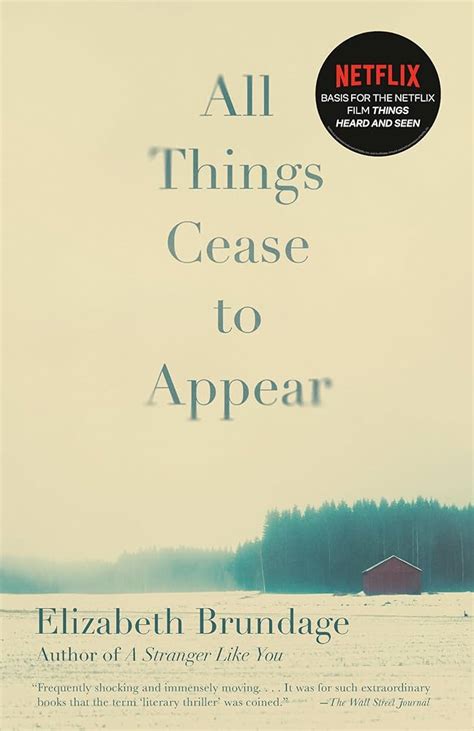
Which is sometimes how our own world feels as our felon-in-chief appears able to break laws with impunity. Perhaps we need Elizabeth Brundage’s splendid crime novel All Things Cease to Appear to capture our reality. (Caution: major spoilers ahead.) While it was published in 2016, meaning that the author probably had other things than Donald Trump on her mind, this beautifully written work reveals how much a charming sociopath can get away with. When people assume that the world operates according to certain civilized rules, they are vulnerable to sick minds.
We learn from the early pages that Catherine Clare has been murdered with an axe. Although (as we are told) in nine out of ten such cases the culprit is the husband, as first we don’t suspect George Clare. That is because the book takes us into his point of view. We later get an explanation for what may seem at first a shabby authorial trick, however. As a seasoned defense attorney points out,
A sociopath has the ability to convince himself that he’s innocent. So everything that comes out of his mouth rings true to him, and usually to everyone else. They separate themselves from the event. Like they’d never been there. Like it never even happened.
The suspense in Cease to Appear is like the suspense that has been gripping America for the past decade: will the guilty party ever be brought to justice? The answer appears to be no. In addition to Catherine’s murder, George gets away with a fraudulent PhD (he has forged a letter from his PhD advisor); with killing his department chair; and with running a colleague off the road after she sees the double game that he’s playing. One reason he kills his wife is because she has just figured out he drowned his boss.
While there are a couple of people who could expose the crime—a woman with whom he is having sex, the teenage boy who comes by the house to babysit their daughter while Catherine is lying dead upstairs—for various reasons they don’t reveal what they know. In today’s essay I focus on the reasons that George escapes accountability because they provide insight into how Trump does the same. Different individuals enable his crimes in the following ways:
—Submitting to and closing one’s eyes to the sociopath lurking just beneath the surface
This is the path taken by Catherine, who gives up her art career and attempts to be a model wife in the 1950s mold, even though the year is 1978. This requires living in denial:
She chose to deny his true nature, just as his own mother did, contriving logical excuses for illogical acts, or reasonable grounds for unreasonable behavior, sometimes even blaming themselves for his failures. Poor George! He was overtired, overworked, overpressured – he just needs rest, to be left alone! and George never failed to exploit their misunderstanding.
MAGA rationalizations for Trump’s behavior have an abused spouse quality to them.
—Underestimating the lengths to which a sociopath will go
George’s department chair can’t imagine that an applicant for a position would forge a letter from his dissertation advisor and falsely claim to have received special awards. Then, when he learns the truth, he thinks allowing George to accompany him on a boat ride will be a chance to console him for the fact that he is about fire him. His humanity dooms him.
Similarly, when George’s colleague Justine, who is his wife’s best friend, reveals to him that she has learned of his adultery, she thinks she is safe in doing so. She has no idea that he will chase her down in his car and run her off the road. When she finally sees his psychotic streak, it’s too late.
Many people who voted for Trump had no idea the lengths to which he would go if given unbridled power, starting with the rightwing justices on the Supreme Court but including many more. Even Jeffrey Epstein, monstrous though he himself was, never suspected that Trump would backstab him, exposing him to the law in order to shaft him on a real estate deal.
—Thinking that, by running away, the problem will go away
This is the case of Willis, the masochistic woman with whom George is having an adulterous affair. As their sex becomes increasingly perverse, she realizes that he is fully capable of having killed his wife and flees to the other coast. She learns, however, that she can’t escape so easily. George hires her defense attorney father, famous for successfully defending the worst of the worst, and then blackmails her by sending her pictures of the two of them having sex. Reveal what she knows, he lets her know, and daddy learns all.
Anyone who has had dealings with Trump and then attempted to break off the relationship learns that there is no easy escape. Many in the GOP think there’s no way free.
—Pretending that nothing is amiss
The one piece of evidence that would definitively implicate George is in the hands of Cole, the babysitter: George’s kitchen table note informing Cole not to bother his wife, who he says is upstairs sick, would prove that George is attempting to cover up the murder. But Cole figures that denying that he was in the house that day will make any unpleasantness disappear.
A significant percentage of the country is hiding out in similar willful ignorance.
I suppose there is accountability of a sort for George: he spends the rest of his life terrified that he will be found out, and his restless moving from one place to another is a sign that he is never at peace. While he claims to love his daughter, she too comes to understand that there is something deeply wrong in the way he has never talked to her about her mother. She tells him that she will never forgive him or talk to him again, and he learns of her wedding (to Cole) only through a newspaper article. In the end, he is a cranky old man living in retirement center isolation. When, on the verge of growing blind (because of diabetes), he learns that the case has been reopened and that he is a suspect, he commits suicide.
I can’t imagine that Trump will ever find peace, even with bootlickers constantly around him who tell him whatever he wants to hear. To truly get in his head, I must leave Brundage’s novel and turn to Shakespeare. If the aging King Lear needs declarations of love from his daughters, it is because he realizes, in his final years, that a life without love is a living hell. His mistake is thinking that he can engineer such love—just as George thinks he can manipulate his daughter into loving only him by erasing the memory of her mother—and he goes crazy when his scheming doesn’t get him what he wants.
Will all those who have suffered under Trump consider justice to have been done when he descends into his miserable final years? And there’s no doubt about it, they will be as miserable as Lear’s, even if they are not spent wandering on the heath. We may not get the crime novel ending we desire: Trump, no more than George, will end up behind bars. But despite the adulation of fans and the millions the president has gained from monetizing the presidency, no sane person would want to change places with him.