Note: If you wish to receive, via e-mail, (1) my weekly newsletter or (2) daily copies of these posts, write to me at rrbates1951@gmail.com. Comments may also be sent to this address. I promise not to share your e-mail with anyone. To unsubscribe, write here as well.
Tuesday
In July, political commentator Robert Hubbell wrote about the Democrats’ “Failure of Imagination.” The post was triggered by the Supreme Court allowing the Trump administration to dismantle the Department of Education—even though, according to the Constitution, only Congress can undo what Congress has established—with Hubbell observed that this is only the latest in a long string of imagination breakdowns:
The collective failure of imagination of Democrats to foresee the overruling of Roe v. Wade at the first opportunity, the grant of criminal immunity to the nation’s first convicted felon president, the tacit approval of kidnapping of immigrants and sending them to war-torn countries not their home, the injection of prayer into public schools, the erosion of voting rights, and the denial of the right of parents of transgender youth to make medical decisions about their children—and more.
We knew this was coming. We didn’t know the details, but we lacked the imagination to anticipate the worst.
So what resources are available to spur us to imagine better? Hmm, I wonder.
At the very least, literature is able to help us recognize what is happening, even if before catastrophe strikes we treat it like Cassandra. Sometimes it’s only when all hell breaks loose that we realize we should have been listening to our poets all along. Last week I encountered three cases of commentators turning to literature to make sense of the news.
First of all, there was political consultant and blogger Jay Kuo turning to Margaret Atwood to frame frightening new developments in Texas’s on-going assault on reproductive rights:
Texas Goes Full Handmaid’s Tale
A new bill would empower private parties to sue out-of-state abortion medication providers.
Then there was former federal attorney and co-host of the #SistersInLaw podcast Joyce Vance, whose summer book group discussed George Orwell’s 1984. Vance drew on the book to see the sinister implications of the following news item:
The Federal Communications Commission’s approval of CBS owner Paramount’s $8 billion merger with Skydance came with a condition to install an ombudsman, which FCC Chairman Brendan Carr has described as a “bias monitor.”
Finally, there was fascism expert Timothy Snyder turning to Percy Shelley’s “Ozymandias” (see my own post on the poem) to call out the latest ceces of Trump cultism.
There are two ways that literature gets used in these discussions. In some instances, as with Kuo’s use of Atwood, it works as shorthand to make a point. If one has read Handmaid’s Tale or seen the television series, one has a gut sense of the lengths to which religious fanatics will go to control and suppress women. Other works often employed as shorthand are Mary Shelley’s Frankenstein (creating a monster one can’t control), Lewis Carroll’s Alice in Wonderland (disappearing down a rabbit hole), Marlowe’s Doctor Faustus (selling one’s soul), Kafka’s The Trial (getting destroyed by the machinations of bureaucratic state power), and of course 1984 (the same only with flesh-eating rats).
E.D. Hirsch, former literature professor and founder of the Core Knowledge Foundation, talks about how societies need these common cultural referent points—this shorthand—to operate communally. Cultural literacy, he writes, is
the network of information that all competent readers possess. It is the background information, stored in their minds, that enables them to take up a newspaper and read it with an adequate level of comprehension, getting the point, grasping the implications, relating what they read to the unstated context which alone gives meaning to what they read.
Without cultural literacy we risk becoming a siloed Tower of Babel.
One can also use literature to glean further insight into issues, which of course is how I use it on this blog and what Joyce Vance has been doing with 1984. Orwell’s novel, she notes, is not only about the dangers of fascism but also “the vital role of open, truthful dialogues, like the ones we have here and take out into our communities. It’s about the protection of democratic institutions against the corrosive effects of misinformation and attempts to rewrite history.”
The comment from the FCC chair about installing a “bias monitor” to police CBS, Vance points out,
follows Trump’s ridiculous lawsuit about how a 60 Minutes interview with Kamala Harris was edited. That’s the lawsuit CBS’s parent company, Paramount, agreed to pay Trump $16 million to resolve, despite the fact that most legal experts who had assessed it thought it was a loser.
Of course, Orwell’s “Ministry of Truth,” “Newspeak,” “double think” and other ways of distorting language come to mind. “When the fourth branch of government, the free press, bends the knee like that,” Vance declares, “it’s time to reread 1984.“
For his part, Snyder quotes the final six lines of Shelley’s famous sonnet “Ozymandias” to begin his meditation on the current plight of the United States. A traveler reports to the speaker about having seen the gigantic head of a statue lying on the ground, “half buried by the sand,” alongside the pedestal upon which the statue once stood:
And on the pedestal these words appear:
“My name is Ozymandias, King of Kings:
Look on my works, ye Mighty, and despair!”
No thing beside remains. Round the decay
Of that colossal wreck, boundless and bare
The lone and level sands stretch far away.
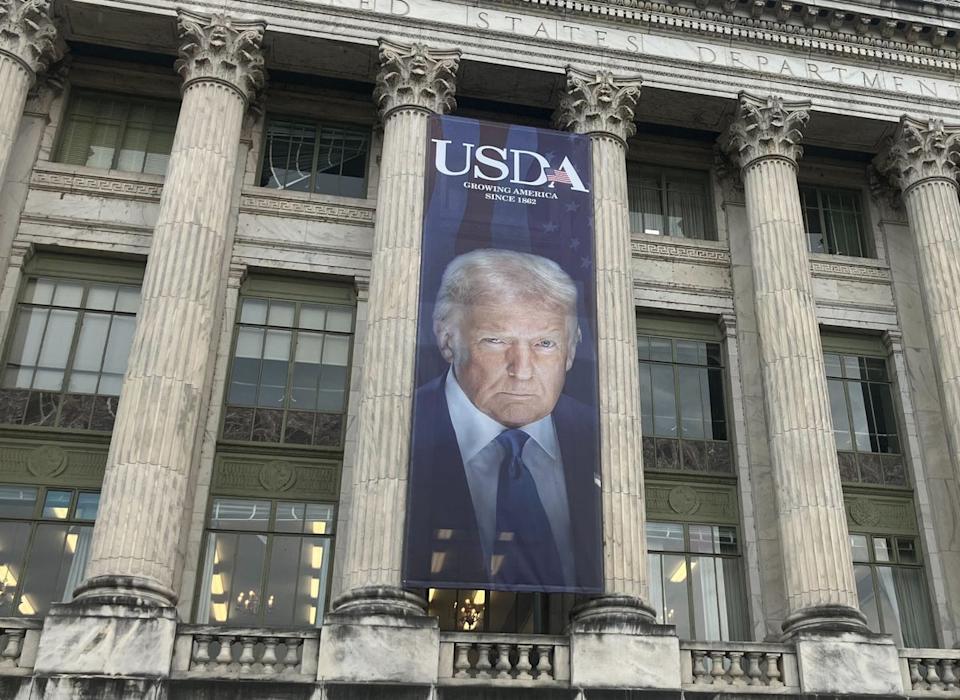
Snyder was led to think of the poem after seeing the gigantic banner of Trump that currently adorns the Department of Agriculture, and this in turn led to a rumination about “the labors of creation and of destruction.” For all the similarities between Trump and Ozymandias (Ramses II), however, the pharaoh at least had accomplishments to boast of. After all, he “won battles, built temples, and ruled for decades. He led a state that lasted for millennia, of such fame that Percy Shelley and his friends could write poems about it millennia after its end.”
All Trump has done, by contrast, is tear things apart. Snyder points out,
We are living through a regime in which there is no creativity between the boasting and the vanity. It is not that Trump is building great things and boasting about them, and that only time will reveal the inherent tragedy of human achievement. He is bragging about destroying what others have created.
Even the kingdoms of great rulers come to an end, however. Shelley reminds us that this final, unavoidable reality “is what makes vanity of every boast.” Snyder applies this insight to our own predicament. Trump and J.D. Vance, he notes, “seem to believe that the United States will go on forever, regardless of what they do,” not realizing that
no political order is eternal. It is one thing to build things and imagine that all must bow before them indefinitely – the mistake of the poetical Oyzmandias. But it is a less forgivable mistake to believe the destruction can go on forever.
At this point Snyder, spurred by the poem, engages in the kind of imaginative speculation to Robert Hubbell calls for:
In the present circumstances, the future of the United States cannot be taken for granted. The negative scenario in On Tyranny, and I think the negative scenario most often imagined, is that the entirety of the United States will undergo a regime change towards an authoritarian order, without the rule of law, without checks and balances, with permanent repression of dissidents, with informational control via technology, with programmed ignorance through decimated and humbled schools and universities, with an economy controlled such that social advancement is impossible and wealth remains with the regime-friendly oligarchs. That is the goal of those in power, and we are right to fear it, and right to work against it – more right, I think, than we realize.
But if we need to imagine the worst that can happen, we also need to imagine what we can do in response. Snyder does so at the end of his essay. Progressive, liberals, and principled conservatives can take heart that, in Trump and Vance thinking that they can continue to plunder the country to their heart’s content, they are setting themselves up for a fall. As Snyder puts it, “Believing in forever, acting as if forever belongs to you, is a certain way to summon doom. Trump and Vance will not learn from Ozymandias or from history.”
This means that patriotic resistance will not be in vain. Cracks will open in Trumpism, leading to its eventual collapse, and although we don’t know which particular acts will bring that about, we do know that a better America “can rest only on the labor that we perform now, on the good that we do now.”
To be sure, the resistance at the moment seems more against than for. With the GOP currently controlling the presidency, the Congress, the Supreme Court, and many governorships and state legislatures, the politics of freedom will often take the form of digging in one’s heels. But Snyder adds that, by their very nature, “every strike, every protest, every act of organization, every act of kindness and solidarity are also actions for, for a future in which the United States continues to exist.”
I sometimes wonder if the rightwing craze for literature banning arises from its fear of people thinking and imagining. Handmaid’s Tale, both the novel and the graphic novel version, is among the most banned books at the moment, and 1984 shows up on a number of lists.
So think of librarians and language arts teachers as key members of the resistance. Democrats of the world, imagine!