Note: If you wish to receive, via e-mail, (1) my weekly newsletter or (2) daily copies of these posts or (3) both, write to me at rrbates1951@gmail.com. Comments may also be sent to this addss. I promise not to share your e-mail with anyone. To unsubscribe or to change from daily to weekly, write here as well.
Monday
Time after time, when there has been a mass shooting such as we just witnessed in Sydney, Australia and Providence, Rhode Island, I have turned to Beowulf. The Anglo-Saxon epic is one of the world’s great literary works about violence, composed by a poet who lived at a time of violent tribal rivalries and knew his subject well. The trolls, who embody resentful rage (Grendel) and grieving rage (his mother), help us understand what drives mass killers.
I want to focus today on the dragon, however, because, as I see it, the monster embodies the grief and depression we experience when faced with death. Or put another way, when we are feeling beaten down and world weary, we can become dragons.
Think about it. Dragons withdraw from the world, hunkering down in caves. Although they are encased in scaly hard exteriors, however, deep within they nurse angry fire, and poison runs in their veins. Although they can remain in this state for extended periods of time, if anyone intrudes on their solitude they may erupt in fury and burn down everything and everyone around them. Often their fellow human beings give them a wide berth.
Before Beowulf, the first poem that came to mind following the Sydney shooting was the 13th psalm since the shooters were targeting people celebrating Hanukkah. Legend has it that King David composed the psalm following the death of his son Absalom:
How long, O Lord? Will you forget me forever?
How long will you hide your face from me?
How long must I take counsel in my soul
and have sorrow in my heart all the day?
How long shall my enemy be exalted over me?
Repeatedly in Beowulf one encounters kings who are essentially calling out, “How long, O Lord?” First there’s Hrothgar, who spirals into depression after his best friend Aeschere is killed by Grendel’s mother:
Rest, what is rest, sorrow has returned.
Then there is the last veteran, who retreats into a funeral barrow after all his friends have died:
He mourned as he moved about the world,
deserted and alone, lamenting his unhappiness
day and night, until death’s flood
brimmed up in his heart.
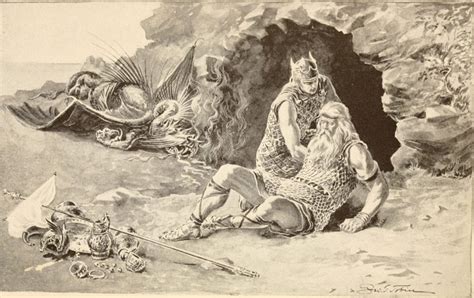
It is in this barrow that the dragon finds a home. Or as I read the incident, the last veteran becomes a human dragon.
Then there is Beowulf at the end of his life. Although he has been an exemplary king, all he can see as he looks back is one damn death after another. There’s no mention at this point in the poem of his victories. He thinks first of his beloved grandfather and mentor, King Hrethel, who falls into depression after his second son accidentally kills his first. Hrethel takes to his bed and never gets up again:
He gazes sorrowfully at his son’s dwelling,
the banquet hall bereft of all delight,
the windswept hearthstone; the horsemen are sleeping,
the warriors under ground; what was is no more.
No tunes from the harp, no cheer raised in the yard.
Alone with his longing, he lies down on his bed
and sings a lament; everything seems too large,
the steadings and the fields.
Then Beowulf remembers his uncle Hygelac, king at the time of the Grendel slayings:
One of his cruellest
hand-to-hand encounters had happened
when Hygelac, king of the Geats, was killed…
Then he recalls how Hygelac’s son and successor, Heardred, was killed by the Swedes:
That marked the end
for Hygelac’s son: his hospitality
was mortally rewarded with wounds from a sword.
It is in recalling this history that Beowulf encounters dragon depression:
And so the son of Ecgtheow had survived
every extreme, excelling himself
in daring and in danger, until the day arrived
when he had to come face to face with the dragon…
The poem is a gift because it articulates the funk into which we can sink. Fortunately, it also offers us a counter response. Since Beowulf’s desire to fight the dragon alone is itself a dragon trait, at moments of sorrow it is important to reach out to friends and loved ones. Beowulf would be swallowed up were it not for his nephew Wiglaf, who braves dragon fire and comes to his aid. Working together, the two of them defeat the monster, allowing Beowulf to go out a hero, not a dragon.
Too often our landscape can resemble the world that the aging Beowulf sees, with one damn death following another. When a mass shooting occurs, we pay special attention. Family, friendship groups, and community are vital at such moments.