Monday
As the Guardian wrote about one of my favorite contemporary novelists recently, the headline provides the prompt for today’s post, even though it made little sense to me: “Haruki Murakami to publish first novel to feature woman as lead character.”
It made little sense since 1Q84, my favorite Murakami novel, has a female protagonist.
To be strictly factual, Aoame, a massage therapist and secret assassin (she assassinates men who abuse women and little girls), is a co-protagonist since she shares the stage with math instructor and novelist Tengo, also a wonderful character. Still, I bonded so deeply with Aoame that I blinked twice when I read in the article that Murakami “has faced criticism for portrayal of women.”
Aoame isn’t an exception. Many of Murakami’s female characters live in my imagination, even when they don’t command center stage. If I look at my three favorite Murakami novels, there’s a dowager who runs a house for battered women in 1Q84 and the psychic Creta Kano and the mixed-up teenager May Kasahara in Wind-Up Bird Chronicle. To be sure, Kafka on the Shore doesn’t have any female characters that grab my mind, but there’s the wondrous transgender man Oshima, who calls traditional gendering into question. In fact, all these characters are more interesting than male protagonists Kafka and Wind-Up Bird’s Toru Okada. So no, I don’t think it’s a stretch for Murakami’s latest novel to have a female lead.
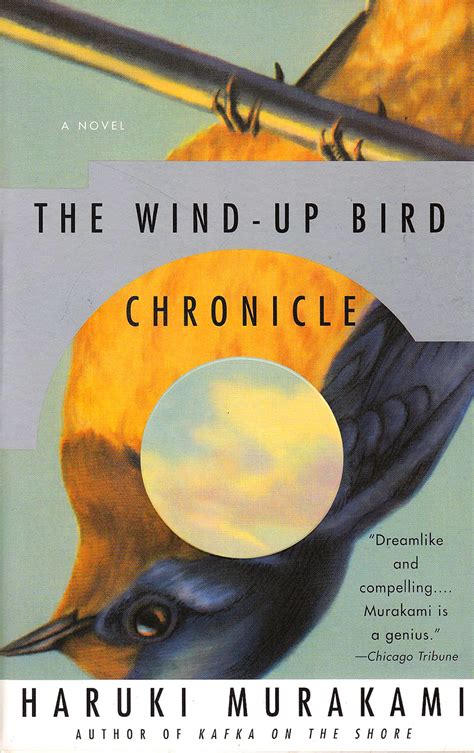
I’ve been thinking of Wind-Up Bird Chronicle recently because we have our own wind-up bird in southern Appalachia. The pileated woodpecker has a distinctive call (you can listen to it here) that seems a bit like the bird that Toru describes in the early pages:
There was a small stand of trees nearby, and from it you could hear the mechanical cry of a bird that sounded as if it were winding a spring. We called it the wind-up bird. Kumiko [Toru’s wife] gave it the name. We didn’t know what it was really called or what it looked like, but that didn’t bother the wind-up bird. Every day it would come to the stand of trees in our neighborhood and wind the spring of our quiet little world.
Later, when Kumiko has run away, Toru meets a teenage neighbor. When she challenges him to come up with a nickname for himself—she considers his name boring—“wind-up bird” pops into his head:
“Wind-up bird?” she asked, looking at me with her mouth open. “What is that?”
“The bird that winds the spring,” I said. “Every morning. In the treetops. It winds the world’s spring. Creeak.”
She went on staring at me.
I sighed. “It just popped into my head,” I said. “And there’s more. The bird comes over by my place every day and goes Creeak in the neighbor’s tree. But nobody ever sees it.”
From that moment on, May refers to Toru only as “Mr. Wind-up Bird.”
The pileated woodpecker is an immensely large and prehistoric looking bird that makes one understand how birds are related to dinosaurs or perhaps are dinosaurs. It too has a loud call, and while I don’t know whether Murakami’s bird is a woodpecker, there’s a woodpecker reference late in the novel. Its distinctive drumming again reminds me of our pileated:
Far off in the woods that surround the pond, a bird cried. I looked up and scanned the area, but there was nothing more to hear. Nothing to see. There was only the dry, hollow sound of a woodpecker drilling a hole in a tree trunk.
Our pileated’s drumming echoes through the woods.
What’s the significance of the wind-up bird? Partly it’s that Toru has been living a mechanical existence, and May’s mocking use of the name helps jolt him out of his sedentary life. On his journey to find his wife, he discovers that she is in the grip of forces, embodied by her evil brother (Noboru Wataya), that are corrupting Japanese society. Holding to a daily routine won’t answer the moment.
In past posts about Wind-Up Bird Chronicle, I’ve seen these forces at work in American society as well. Here’s what I wrote in one:
[Murakami] seeks to understand the resurgence of rightwing nationalism in 1990s Japan, the so-called lost decade. While the Japanese rightwing isn’t exactly like America’s—Wataya is an intellectual whereas Trump is just the opposite—Murakami grasps how demagogues tap into a reservoir of repressed rage and turn it to their advantage. Both serve as midwives to what Murakami describes at one point as a “gooey white thing like a lump of fat” that proceeds to possess the host.
That gooey substance at one point I compare to “the bile that flows from those Trump supporters shouting racist, anti-Semitic, or misogynist slurs at a rally or indulging in such sentiments from afar.”
Toru at one point discovers this darkness, this penchant for violence, dwells within himself as well. What saves him is his love for Kumiko and his concern for May. He is willing to face up to the dark side of himself and imagine a future where he cares for others. Empathy and love, in other words, are the keys to defeating Wataya. As his wife writes to him,
At least I still had the power to dream, I knew. My brother couldn’t prevent me from doing that. I was able to sense that you were doing everything in your power to draw nearer to me. Maybe someday you would find me, and hold me, and sweep away the filth that was clinging to me, and take me away from that place forever. Maybe you would smash the curse and set the seal so that the real me would never have to leave again. That was how I was able to keep a tiny flame of hope alive in that cold, dark place with no exit—how I was able to preserve the slightest remnant of my own voice.
But back to the bird. There’s something unearthly in the pileated woodpecker’s cry—and perhaps in Murakami’s bird as well—as though they are attempting to alert us to the danger. If that’s case, then the wind-up bird isn’t only a metaphor for our complacency but also functions as an alarm clock. Its haunting cry is attempting to awaken something deep within us.