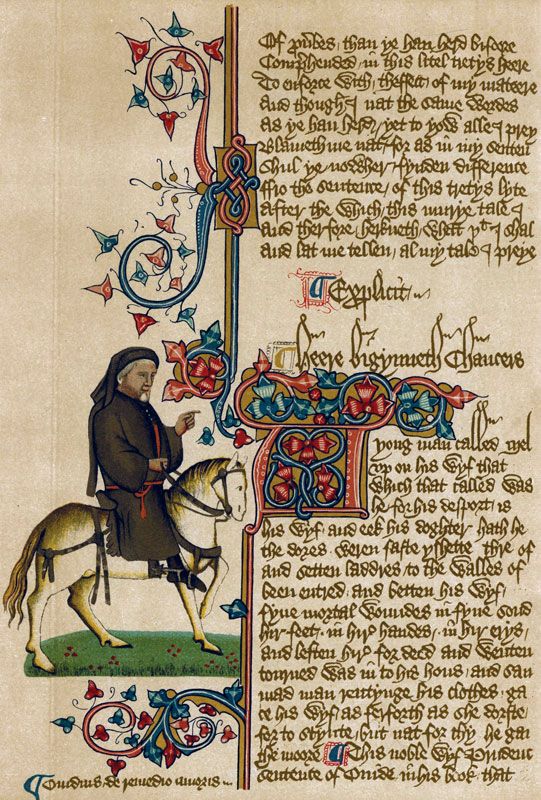
From the Ellsmere manuscript of The Canterbury Tales
Sunday
Because we have been in the grip of a weeks-long drought, the rain that fell yesterday had our hearts singing. When April showers perce the droghte of March to the roote, then longen folk like me to recite the opening lines of Geoffrey Chaucer’s Canterbury Tales.
I’ve written a lot about how another 14th century poem, Sir Gawain and the Green Knight, represented a healthy correction to death-cult Christianity, which is to say to Christianity that spurns life on earth and focuses entirely on the next world. That many in the 1300 have rejected nature is understandable given that nature attacked Christendom with full force in the years 1346 to 1353, with the Black Death killing up to half the population. Many concluded that God was punishing humankind for its sins, and one saw the rise of flagellants and other body-hating and sex-rejecting groups. People hoped that, by punishing themselves, they could ward off God’s wrath.
SGGK and Canterbury Tales were written a few decades later so memories of the plague were still fresh. Nevertheless, their response is to celebrate the regenerative powers of nature rather than reject it. When spring starts busting out all over, Chaucer tells us, “then longen fok to goon on pilgrimages.”
Some background here on British Christianity’s relationship with nature is useful here. The process of syncretism, in which a new religion incorporates elements of the old, meant that Christianity could not altogether displace the Anglo-Saxons’ cult of Ēostre, a fertility goddess brought over from northern Europe. As a result, for a while Easter was associated with a seasonal holiday, the spring equinox, when the days become longer than the nights. Christmas worked the same, being associated with the winter solstice, the darkest time of year. While this could work for the birth of Christ, however, it was less possible with the resurrection, which was connected with Passover and therefore had a long Jewish history. Eventually Ēostrian Christians had to surrender the equinox, although they did get to name the holiday and keep the symbolism of fertile rabbits and life-producing eggs.
In other words, British Christianity, whether influenced by its contact with the Anglo-Saxon or the Celtic fertility religions, always had a strong connection with nature, and poets could turn to this dimension in the years after the Black Death. The opening lines of Canterbury Tales are dripping with nature imagery as April showers inject flowers with life-generating power. The Welsh poet Dylan Thomas, drawing on his own Celtic tradition, captures this power when he writes, “The force that through the green fuse drives the flower/ Drives my green age.”
For Chaucer, bodily lust and religious devotion are intermixed so that the same west wind that awakens the birds to their mating rituals also awakens the people of England spiritually. The Canterbury pilgrimage provides the framework for one of the world’s masterpieces, a literary vision so vibrant and so teeming with life in all its variety that it leaves me breathless. My belief is that Chaucer, with such three-dimensional characters as the Wife of Bath, the Pardoner, the Miller, and many others, made Shakespeare possible two centuries later.
I share both the original and a translation below. If you can, start by giving the Middle English version as you’ll discover a richness lacking in the translation. You can listen to Morgan Freeman reading it here.
Whan that Aprill with his shoures soote
The droghte of March hath perced to the roote,
And bathed every veyne in swich licour
Of which vertu engendred is the flour;
Whan Zephirus eek with his sweete breeth
Inspired hath in every holt and heeth
The tendre croppes, and the yonge sonne
Hath in the Ram his half cours yronne,
And smale foweles maken melodye,
That slepen al the nyght with open ye
(So priketh hem Nature in hir corages),
Thanne longen folk to goon on pilgrimages,
And palmeres for to seken straunge strondes,
To ferne halwes, kowthe in sondry londes;
And specially from every shires ende
Of Engelond to Caunterbury they wende,
The hooly blisful martir for to seke,
That hem hath holpen whan that they were seeke.
Translation
When April with its sweet-smelling showers
Has pierced the drought of March to the root,
And bathed every vein [of the plants] in such liquid
By which power the flower is created;
When the West Wind also with its sweet breath,
In every wood and field has breathed life into
The tender new leaves, and the young sun
Has run half its course in Aries,
And small fowls make melody,
Those that sleep all the night with open eyes
(So Nature incites them in their hearts),
Then folk long to go on pilgrimages,
And professional pilgrims to seek foreign shores,
To distant shrines, known in various lands;
And specially from every shire’s end
Of England to Canterbury they travel,
To seek the holy blessed martyr,
Who helped them when they were sick.