Friday Memories of Books That Shook My World
The classics that we hate can teach us as much about ourselves as the classics we love. I know this from my high school reaction to Catcher in the Rye.
Bill Goldfinch, my sophomore English teacher, assigned the book, and while my negative reactions were intense, I can recall certain scenes as vividly as if I had read the novel yesterday. These include:
–Holden horsing around with his roommate and being irritated by Ackley, a student down the hall. Like me, Ackley had “a lot of pimples. Not just on his forehead or his chin, like most guys, but all over his whole face.” (My dermatologist at the time informed me that I had the worst case of acne he had ever seen.) I was particularly struck by Holden’s self-consciousness and his incessant mood swings. (Example: “All of a sudden–for no good reason, really, except that I was sort of in the mood for horsing around–I felt like jumping off the washbowl and getting old Stradlater in a half nelson.”)
–Holden smoking, a practice I found disgusting. (We hounded my mother about it until she finally gave it up.)
–Holden employing a prostitute, his awkwardness around her (they don’t end up having sex), and then his arguing with her pimps. The entire encounter felt to me unspeakably dirty and dangerous.
–His former teacher stroking his hair while he’s asleep. The scene creeped me out and only now do I connect my extreme discomfort with a man rubbing my leg two years earlier in a Paris movie theater when I was watching a Gary Cooper movie with my brothers. (I changed seats and he didn’t do anything further.)
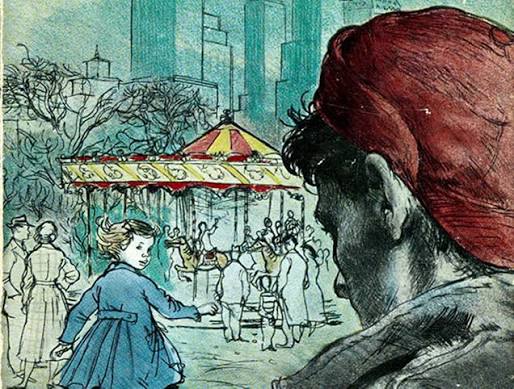
The only scene I remember favorably is Holden at the playground with his sister Phoebe, which is when he reveals the meaning of the title:
“You know that song ‘If a body catch a body comin’ through the rye’? I’d like—”
“It’s ‘If a body meet a body coming through the rye’!” old Phoebe said. “It’s a poem. By Robert Burns.”
“I know it’s a poem by Robert Burns.”
She was right, though. It is “If a body meet a body coming through the rye.” I didn’t know it then, though.
“I thought it was ‘If a body catch a body,’” I said. “Anyway, I keep picturing all these little kids playing some game in this big field of rye and all. Thousands of little kids, and nobody’s around—nobody big, I mean—except me. And I’m standing on the edge of some crazy cliff. What I have to do, I have to catch everybody if they start to go over the cliff–I mean if they’re running and they don’t look where they’re going I have to come out from somewhere and catch them. That’s all I’d do all day. I’d just be the catcher in the rye and all. I know it’s crazy, but that’s the only thing I’d really like to be. I know it’s crazy.”
Back in the 1980s, when I asked my students to list their ten favorite novels, Catcher in the Rye showed up on more lists than any other. Since I had been avoiding the novel ever since my disagreeable encounter with it in high school, I figured it was time to reread. Why had I disliked it so much?
I discovered that, although I didn’t swear, cuss, or fail classes, I had identified with Holden, seeing in his situation resemblances to my own. We were both in prep schools (although I wasn’t a boarder), the fellow students were like those I saw around me, I shared his awkwardness around girls, and I recognized myself in his sensitivity and extreme self-consciousness. Oh, and we also shared a love of literature:
I read a lot of classical books, like The Return of the Native and all, and I like them, and I read a lot of war books and mysteries and all, but they don’t knock me out too much. What really knocks me out is a book that, when you’re all done reading it, you wish the author that wrote it was a terrific friend of yours and you could call him up on the phone whenever you felt like it.
Rather than making me love Catcher, however, all these similarities caused me to loathe it. I wanted literature that would take me away from my world, not plunge me into it. I wanted Tolkien or Greek mythology (see last week’s post) or at least existential allegory that allowed me to feel elevated and sophisticated. While I desired to remain cushioned in a world of books, Catcher felt to me less like a book and more like raw, unfiltered reality.
This reality included Holden growing up and encountering the world of sex and the city. If the scene with the prostitute and her pimps traumatized me, it was because this was the world I feared was out there, one in which I would be utterly out of my depth. Perhaps the episode in the Paris movie theater had sensitized me a little more to the scene—Paris until that moment had seemed more a large playground than a city where bad things could happen—but whatever the reason, I wanted to pretend I had never read it.
Only years later did I realize that, in desiring to become a catcher in the rye, Holden longs for someone to catch him. He wants to hang on to the innocence that he sees in his little sister, returning to a time when his beloved brother was still alive and when the world seemed simpler.
Such a longing went so deep in me that I freaked out at someone else freaking out when reality sets in.
I’ve read the book since, including today for this post, and now find it brilliant, both funny and sad. I understand now why my students felt seen by Salinger. It’s just that, when I was their age, I wanted to hang out in denial.
Previous posts on memorable book encounters
The Iliad Saved My Freshman Year (Oct. 16, 2026)
At 12 I Fell in Love with Taming of the Shrew (Oct. 9, 2026)
Alice Captured My Childhood Anxieties (Oct. 2, 2026)
How Tintin Gave Shape to My Sense of Wonder (Sept. 25, 2026)
E. Nesbit’s Formative Moral Influence on My Life (Sept. 18, 2026)
Lord of the Rings: Trudging up Mount Doom with Frodo (Aug. 28, 2026)
The Silver Chair and a Childhood Love (Aug. 21, 2026)
My Childhood Encounter with Wind in the Willows April 14, 2026)