Friday Memories of Books That Shook My World
When my brothers and I were growing up we had Australian actor Cyril Richard reading Lewis Carroll’s Alice in Wonderland on a set of records. I must have been 10 or 11 when we got the recordings, and I listened to them so many times that to this day I can recite most of the poems, along with large swatches of dialogue.
I still see myself sitting in our Sewanee living room listening to Alice converse with the Cheshire Cat or to the Griffin and the Mock Turtle reminiscing about their school days. Indeed, looking back I find myself identifying with Alice’s sister at the end of the novel after Alice has recounted her dream:
But her sister sat still just as she left her, leaning her head on her hand, watching the setting sun, and thinking of little Alice and all her wonderful Adventures, till she too began dreaming after a fashion, and this was her dream:—
First, she dreamed of little Alice herself, and once again the tiny hands were clasped upon her knee, and the bright eager eyes were looking up into hers—she could hear the very tones of her voice, and see that queer little toss of her head to keep back the wandering hair that would always get into her eyes—and still as she listened, or seemed to listen, the whole place around her became alive with the strange creatures of her little sister’s dream.
Sentimentalizing children this way, however, doesn’t do justice to Alice’s intense inner life or to the multiple ways that I processed the story. There’s a constant conflict, for instance, in Alice’s desire to please adults and the effects that her actions and words have on the adult figures she encounters. I remember how she irritates the mouse when talking about her cat:
“[S]he is such a nice soft thing to nurse—and she’s such a capital one for catching mice—oh, I beg your pardon!” cried Alice again, for this time the Mouse was bristling all over, and she felt certain it must be really offended.
Her pet comes up again later when she’s addressing the birds and other small animals that have fallen into the pool of tears:
Dinah’s our cat. And she’s such a capital one for catching mice you can’t think! And oh, I wish you could see her after the birds! Why, she’ll eat a little bird as soon as look at it!
As a child negotiating the complex world of adult expectations, I recognized Alice’s passive aggression, of striving to be outwardly innocent while getting little digs in. I’ve written about how my father wanted his children to remain innocent. My mother says that he was enthralled when I was born in 1951, his first child, and I’ve come to realize that I represented for him the innocence that had been stripped from him by his World War II experiences, especially witnessing Dachau three days after it was liberated.
Later in life he used to tell me that there is nothing as bad as “the desecration of innocence,” and some deep part of me, from the beginning, made me think that I needed to hold on to my innocence so that I wouldn’t disappoint him. This wasn’t easy. Sometimes it meant putting on an act, not cussing (even though all the boys around me cussed), not talking about sex, and pretending not to like rock and roll (although I secretly loved the Beatles).
The origins of my father’s longing can be traced back to the Victorians, who made a fetish of childhood innocence. Children were supposed to offset the horrors of industrialization and laissez-faire capitalism, as a glance at Charles Dickens’s child victims makes clear. My father’s parents had the full Dickens collection and he grew up immersed in Little Nell in The Old Curiosity Shop, Oliver Twist, Smike in Nicholas Nickleby, Sissy Jupe in Hard Times, Jo in Bleak House, Florence Dombey, and Amy Dorrit.
His mother, meanwhile—who was born in 1885 in Barton, England–was sweet, kind, and as close to Victorian innocence as any adult I have ever known. Granny dressed my father in Fauntleroy velvet with lace collars as a boy, wouldn’t let him say, “Jeepers,” and complained about the bad language in Tom Sawyer. Later in life, I shocked her by playing Simon and Garfunkel on her record player. But because I loved her, I would also watch the Lawrence Welk Show with her as though I enjoyed it.
As the youngest of three boys, my father tried to stay with the program for the longest time. He finally rebelled when he was drafted and, upon returning, shocked the family with his drinking, smoking, and having voted for Roosevelt. Nevertheless, childhood innocence remained important to him, which I understood in a deep way and worked to oblige.
As does Alice, who is earnest and works hard to be good. At one point we are told that
sometimes she scolded herself so severely as to bring tears into her eyes; and once she remembered trying to box her own ears for having cheated herself in a game of croquet she was playing against herself…
She also makes a good faith effort to memorize the godawful moralistic poetry that adults are constantly requiring her to publicly recite. Unconsciously, however, she subverts the moral lessons with some of English literature’s greatest parodies. Note, for instance, what she does with “How Doth the Little Busy Bee,” in which Isaac Watts draws the following lesson from industrious bees:
In works of labor or of skill,
I would be busy too;
For Satan finds some mischief still
For idle hands to do.In books, or work, or healthful play,
Let my first years be passed,
That I may give for every day
Some good account at last.
The bee becomes a crocodile in Alice’s version:
How cheerfully he seems to grin,
How neatly spread his claws,
And welcome little fishes in
With gently smiling jaws!
We see here the fear of being swallowed up by an adult agenda.
Then there is her rebellion against sage advice from elders. Few remember the original to “You Are Old, Father William,” where a young man queries his father about his calm demeanor in the face of impending death. Robert Southey’s poem ends as follows:
I am cheerful, young man, Father William replied,
Let the cause thy attention engage;
In the days of my youth I remembered my God!
And He hath not forgotten my age.
Here’s Alice:
I have answered three questions, and that is enough,”
Said his father; “don’t give yourself airs!
Do you think I can listen all day to such stuff?
Be off, or I’ll kick you downstairs!
The crocodile and the father may carry out the violence but, in a reversal common in children’s literature (think Green Eggs and Ham), Alice fantasizes occupying the power position and turning the tables on her tormentors.
It’s noteworthy how often violence is mentioned in the book. In addition to the aforementioned examples, there’s the Duchess shaking the baby after each verse of the “lullaby” she sings to him:
Speak roughly to your little boy,
And beat him when he sneezes:
He only does it to annoy,
Because he knows it teases.
The ultimate example, of course, is the Red Queen ordering decapitations. Strong angry women were plentiful in my world, especially my sixth-grade teacher, who called me a sissy. Perhaps, for both Carroll and myself, the queen triggered emasculation anxieties.
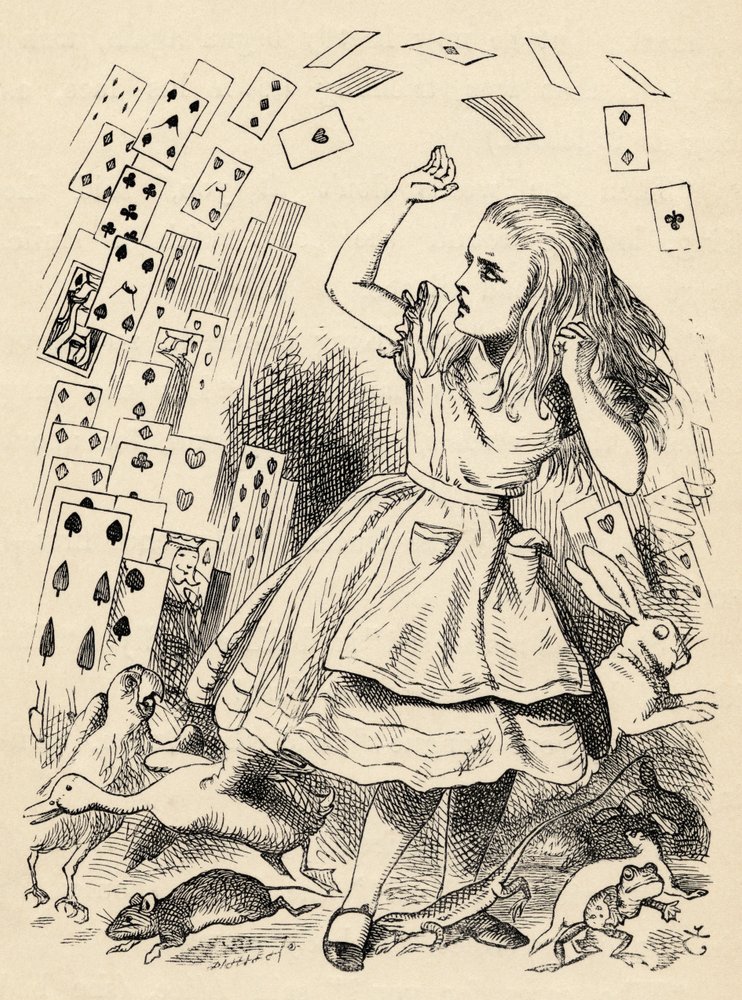
Most terrifying to me, however, was the final scene in which the cards rise up and attack Alice. It occurs because, for the first time in the novel, rather than attempting to assuage grownups or apologize for her words, Alice takes the gloves off. No longer an angelic child, she calls B.S. on the adult world:
“Hold your tongue!” said the Queen, turning purple.
“I won’t!” said Alice.
“Off with her head!” the Queen shouted at the top of her voice. Nobody moved.
“Who cares for you?” said Alice, (she had grown to her full size by this time). “You’re nothing but a pack of cards!”
I found nightmarish how the cards’ assault her, perfectly captured in John Tenniel’s illustration:
At this the whole pack rose up into the air, and came flying down upon her: she gave a little scream, half of fright and half of anger, and tried to beat them off…
Then, blessedly, it turns out all to have been a dream:
… and found herself lying on the bank, with her head in the lap of her sister, who was gently brushing away some dead leaves that had fluttered down from the trees upon her face.
Why was I so frightened? Perhaps the scene captured my fear that, if I ever ceased playing along with adult agendas, I would unleash an uncontrollable anger.
As background, I should note that my family feared anger, tiptoeing around it. (Anger always looms largest when we pretend it’s not there.) As much as I tried to be accommodating, not only with my father’s desire that I remain innocent but with my mother’s desire to dress me up as a cute little boy (with bowtie and suit jacket), some deep part of me resented it.
Carroll himself may be panicking over how Alice Liddell is growing up, a panic that is even more evident when Alice, as pawn, becomes a queen herself in Alice through the Looking-Glass. That book ends with him expressing sorrow at the end of innocence:
Long has paled that sunny sky:
Echoes fade and memories die.
Autumn frosts have slain July.
Still she haunts me, phantomwise,
Alice moving under skies
Never seen by waking eyes.
In short, I loved the Alice books because I related to how she seeks to please adults while secretly rebelling. In spite of the repressed anger, she remains innocent through it all. It was a balancing act that could not last but I found comfort in it at the time.