Tuesday
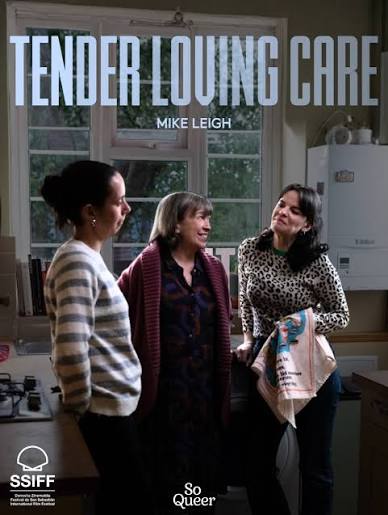
Last week Cvetka Solokov and Mirjana Želežič, two dear colleagues at Ljubljana’s English Department, took Julia and me to Mike Leigh’s latest film at the Slovenian Film Festival. Tender Loving Care is all of what the title says it is and we were deeply moved.
A quiet depiction of friends and family supporting each other when life is difficult and things go wrong, TLC shows us Kate and Birdie soldiering on through social work that sometimes seems impossible; the two supporting each other through failed relationships without allowing each other to wallow in self-pity; and Birdie’s aging parents (Rosie and Geoff) finding ways to grow old gracefully while bolstering those around them. In the end, we watch as the three women gather around Geoff as he dies.
Julia and I were especially struck by how Rosie and Geoff, each feeling aches and pains, stand by each other with a quiet understanding. Julia is gritting her teeth as she awaits a knee replacement, meaning that we don’t stride along the streets of Ljubljana as we once did. Although the defiant concession of Tennyson’s Ulysses applies to us– “we are not now that strength which in old days moved earth and heaven”—we ourselves no longer feel compelled to “smite the sounding furrows.” Life, as the film showed us, doesn’t need heroic deeds to be rich and rewarding.
As we were walking home with Mirjana, I said I felt as though I had been washed by a fresh, clean rain. I didn’t realize that such water imagery shows up in a Mary Oliver poem that had come to mind for a different reason.
I thought of “The Swan” because, as Geoff is dying, he twice refers enigmatically to swans. First, lying in bed, he mimics with his hands the movement of a swan taking off. A few scenes later, his last word is “swan.”
In Oliver’s poem, she talks of a swan “drifting, all night, on the black river” before launching. “Black river” often works as an image of death for the poet. For instance, in “In Blackwater Woods” she notes that everything she has ever learned leads back to
the fires and the black river of loss whose other side
is salvation, whose meaning none of us will ever know.
Like Oliver’s swan, Geoff has been drifting on that black river. In the poem, as in his imagination, the swan lifts off into the light, a white cross streaming across the sky (the resurrection image is deliberate). Note the rain that is “pelting the trees—like a waterfall/ Knifing down the black ledges”:
The Swan
By Mary Oliver
Did you too see it, drifting, all night, on the black river?
Did you see it in the morning, rising into the silvery air –
An armful of white blossoms,
A perfect commotion of silk and linen as it leaned
into the bondage of its wings; a snowbank, a bank of lilies,
Biting the air with its black beak?
Did you hear it, fluting and whistling
A shrill dark music – like the rain pelting the trees – like a waterfall
Knifing down the black ledges?
And did you see it, finally, just under the clouds –
A white cross
Streaming across the sky, its feet
Like black leaves, its wings
Like the stretching light of the river?
And did you feel it, in your heart, how it pertained to everything?
And have you too finally figured out what beauty is for?
And have you changed your life?
The contrasts—feet like black leaves, stretching light of the river—shows Oliver’s balance between earthly connection and transcendent spirit.
Mirjana noted that the film is Leigh’s “swan song”—the 83-year-old director says this is his farewell to directing—and he is clearly thinking of his own end. The film opens with a close-up of an old man slightly resembling Leigh gazing directly at the camera. I later mentioned to my companions that he is like Tiresias in T.S. Eliot’s Waste Land, an old man who has seen it all witnessing the human condition.
I Tiresias, though blind, throbbing between two lives,
Old man with wrinkled female breasts, can see
At the violet hour, the evening hour that strives
Homeward…
And:
(And I Tiresias have foresuffered all
Enacted on this same divan or bed;
I who have sat by Thebes below the wall
And walked among the lowest of the dead.)
While Eliot’s androgynous Tiresias is gazing at both sides of a sterile sexual encounter (thanks, T.S.), Leigh’s old man is poised between life and death. Confused by finding himself in a hospital following a heart attack, the homeless man leaves before he can be “helped” by one of the social workers. As one who has momentarily walked amongst the dead, he has a perspective on how humans struggle to find meaning, make connects, and survive. We watch with him, not sure what to make of it all, but sensing that we are witnessing a kind of beauty.
The beauty is in nature and in our fellow human beings. We can change our lives by paying attention.