Christ the King Sunday
Thanks the Journey to Jesus blog, I can celebrate the Festival of Christ of King with a wonderful Pamela Cranston poem.
I must admit that the symbolism of the feast day has never done much for me given my distaste for monarchy. Whenever I encounter Christ the king imagery—and it is to be found everywhere, from hymns to liturgy to art work to Christ the King sermons–I always do a mental adjustment: for me, Jesus is less a regal figure atop a throne than a St. Francis figure amongst lepers and birds. Or put another way, he is a man of low social status channeling the love that, according to Dante, moves the sun and other stars.
In this last regard, the king imagery has one advantage in that it works as a creative oxymoron: the very low combined with the very high. There’s a long practice of describing Jesus in this way, and Cranston draws on that tradition in “A Poem for the Feast of Christ the King”:
See how this infant boy
lifted himself down
into his humble crèche
and laid his tender glove of skin
against splintered wood—
found refuge in a rack
of straw—home
that chilly dawn,
in sweetest silage,
those shriven stalks.This outcast king lifted
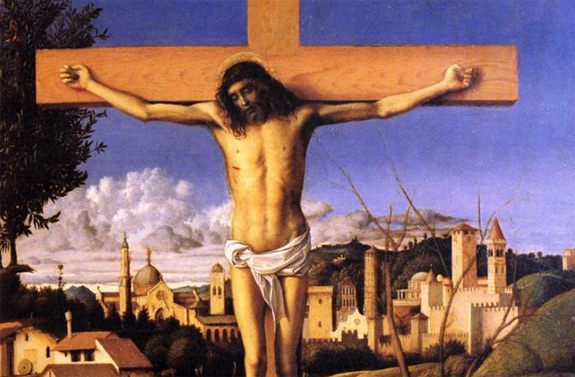
himself high upon his savage cross,
extended the regal banner
of his bones, draping himself
upon his throne—his battered feet,
his wounded hands not fastened
there by nails but sewn
by the strictest thorn of love.
The cross as high throne, Jesus’s body a regal banner, the nails as “the strictest thorn of love.” And all anticipated by his birth in a wooden rack of straw.