Friday Memories of Book That Shook My World
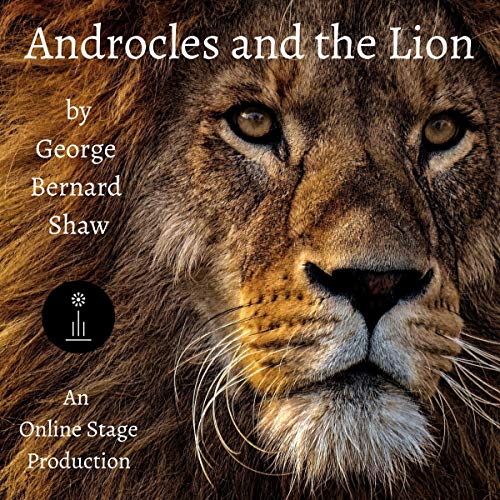
This Friday series is helping me recall intense literary experiences I had forgotten. Just because they don’t come immediately to mind, however, doesn’t mean they weren’t formative. I first learned about the deliciousness of live theatre when I saw a Sewanee College production of George Bernard Shaw’s Androcles and the Lion at eight or nine.
I can date the performance only because one of the actors signed my program when he came over to babysit a couple of days later, which means that I wasn’t yet old enough to watch my brothers myself. I even remember his (minor) role in the play. He played the spoiled Roman youth who mocks the Christian captives about to be martyred. He has just slapped Ferrovius, a giant to a man, who prepares to respond in kind:
(Ferrovius, without flinching, turns the other cheek. Lentulus, rather out of countenance, titters foolishly, and strikes him again feebly).
LENTULUS: You know, I should feel ashamed if I let myself be struck like that, and took it lying down. But then I’m not a Christian: I’m a man.
(Ferrovius rises impressively and towers over him. Lentulus becomes white with terror; and a shade of green flickers in his cheek for a moment).
FERROVIUS (with the calm of a steam hammer) I have not always been faithful. The first man who struck me as you have just struck me was a stronger man than you: he hit me harder than I expected. I was tempted and fell; and it was then that I first tasted bitter shame. I never had a happy moment after that until I had knelt and asked his forgiveness by his bedside in the hospital. (Putting his hands on Lentulus’s shoulders with paternal weight). But now I have learnt to resist with a strength that is not my own. I am not ashamed now, nor angry.)
LENTULUS (uneasily) Er–good evening. (He tries to move away).
FERROVIUS (gripping his shoulders) Oh, do not harden your heart, young man. Come: try for yourself whether our way is not better than yours. I will now strike you on one cheek; and you will turn the other and learn how much better you will feel than if you gave way to the promptings of anger. (He holds him with one hand and clenches the other fist)….
ANDROCLES. Easy, Ferrovius, easy: you broke the last man’s jaw.
(Lentulus, with a moan of terror, attempts to fly; but Ferrovius holds him ruthlessly.)
FERROVIUS. Yes; but I saved his soul. What matters a broken jaw?…
LENTULUS (falling on his knees and bursting into tears) Oh, help me. Mother! mother!
FERROVIUS. These tears will water your soul and make it bring forth good fruit, my son. God has greatly blessed my efforts at conversion. Shall I tell you a miracle–yes, a miracle–wrought by me in Cappadocia? A young man–just such a one as you, with golden hair like yours–scoffed at and struck me as you scoffed at and struck me. I sat up all night with that youth wrestling for his soul; and in the morning not only was he a Christian, but his hair was as white as snow. (Lentulus falls in a dead faint).
I’ve remembered that last line—“not only was he a Christian, but his hair was as white as snow”—ever since.
Androcles is a fun play, very accessible to a precocious child. My revelation was that stories take on a new kind of intensity when they are played out on stage. Also revelatory was the joy of playing with ideas. Raised in an Episcopalian community where everyone but my family seemed to go to church, I was struck by how different people could have different relationships with Christianity.
For instance, I recall the following scene which includes Ferrovius, Androcles, Ferrovius’s sister, and Spintho, the latter a despoiler of temples who figures that martyrdom will provide him a free “Get Out of Hell” card:
ANDROCLES. Well, you see, sister, [Ferrovius] is never quite sure of himself. Suppose at the last moment in the arena, with the gladiators there to fight him, one of them was to say anything to annoy him, he might forget himself and lay that gladiator out.
LAVINIA. That would be splendid.
FERROVIUS (springing up in horror) What!
ANDROCLES. Oh, sister!
FERROVIUS. Splendid to betray my master, like Peter! Splendid to act like any common blackguard in the day of my proving! Woman: you are no Christian. (He moves away from her to the middle of the square, as if her neighborhood contaminated him).
LAVINIA (laughing) You know, Ferrovius, I am not always a Christian. I don’t think anybody is. There are moments when I forget all about it, and something comes out quite naturally, as it did then.
SPINTHO. Don’t say that. That’s blasphemy. Don’t say that, I tell you. We shall be saved, no matter WHAT we do.
LAVINIA. Perhaps you men will all go into heaven bravely and in triumph, with your heads erect and golden trumpets sounding for you. But I am sure I shall only be allowed to squeeze myself in through a little crack in the gate after a great deal of begging. I am not good always: I have moments only.
SPINTHO. You’re talking nonsense, woman. I tell you, martyrdom pays all scores.
ANDROCLES. Well, let us hope so, brother, for your sake. You’ve had a gay time, haven’t you? with your raids on the temples. I can’t help thinking that heaven will be very dull for a man of your temperament. (Spintho snarls). Don’t be angry: I say it only to console you in case you should die in your bed tonight in the natural way. There’s a lot of plague about.
SPINTHO (rising and running about in abject terror) I never thought of that. O Lord, spare me to be martyred. Oh, what a thought to put into the mind of a brother! Oh, let me be martyred today, now. I shall die in the night and go to hell. You’re a sorcerer: you’ve put death into my mind. Oh, curse you, curse you! (He tries to seize Androcles by the throat).
I was also struck by Lavinia’s quiet assertion of faith:
THE CAPTAIN. Are you then going to die for nothing?
LAVINIA. Yes: that is the wonderful thing. It is since all the stories and dreams have gone that I have now no doubt at all that I must die for something greater than dreams or stories.
THE CAPTAIN. But for what?
LAVINIA. I don’t know. If it were for anything small enough to know, it would be too small to die for. I think I’m going to die for God. Nothing else is real enough to die for.
In the end, a terrified Spintho decides to give up Christianity (to do so one must sprinkle a pinch of incense on the altar), only to run into the jaws of a lion on his way out. Ferrovius, who ultimately can’t deny his fighting spirit and kills six gladiators while wearing no armor, concludes that he belongs to Mars more than Christ. He so impresses the emperor, however, that all the Christians are pardoned except for Androcles (since the crowds require at least one victim). Then Androcles impresses in his own way since the lion sent to tear him apart is the one from whose paw he removed a thorn years before.
I identified with Androcles for his tenderness, his desire to do no harm, and his reasonableness. The memory of his waltzing off the stage with the lion stays with me to this day.
I learned, when tutoring my eight-year-old grandson in poetry during Covid, that kids that age get a visceral joy from playing with new ideas, which expand their vision of the world. It’s another version of learning how to walk. Alban couldn’t get over how irony works, how you can say one thing and mean another.
Idea exploration as much as Shaw’s humor and the intriguing characters explains why Androcles thrilled me. It would also set me up well for encountering Pygmalion as a junior in high school and Man and Superman—especially the “Don Juan in Hell” episode—as a senior. In the latter, as our teacher and headmaster James McDowell pointed out, what a character says of Don Juan could also be said of Shaw: “Whew! How he does talk! They’ll never stand it in heaven.”
The same can be said for me. Androcles helped wind me up and I’ve never stopped.
Can you stand it?
Previous Posts of Books That Shook My World
Why Flannery O’Connor Shook My World (Nov. 13, 2026)
A Teenager Pinned and Wriggling on the Wall (Nov. 6, 2026)
Tell-Tale Heart Terrified Me as a Teen (Oct. 30, 2026)
Why I Hated Catcher in the Rye (But Not Any More) (Oct. 23, 2026)
The Iliad Saved My Freshman Year (Oct. 16, 2026)
At 12 I Fell in Love with Taming of the Shrew (Oct. 9, 2026)
Alice Captured My Childhood Anxieties (Oct. 2, 2026)
How Tintin Gave Shape to My Sense of Wonder (Sept. 25, 2026)
E. Nesbit’s Formative Moral Influence on My Life (Sept. 18, 2026)
Lord of the Rings: Trudging up Mount Doom with Frodo (Aug. 28, 2026)
The Silver Chair and a Childhood Love (Aug. 21, 2026)
My Childhood Encounter with Wind in the Willows April 14, 2026)