Friday – A Life Lived in Literature, 31st installment
I mentioned in last week’s memoir installment that, upon receiving my college’s Teacher of the Year Award (for service), I wondered if I was worthy of it. Might it not just be a sympathy award for my having lost a child. In any event, I returned from my 2001-02 sabbatical determined to earn it.
This resulted in a schedule that, in retrospect, looks crazed. I was Department chair for five years; edited a monthly school supplement called the River Gazette (for which I would eventually write 61 articles and edit the faculty contributions of countless others); ran a monthly book discussion group at the local library and a monthly film series at a local senior center; spearheaded a major curriculum revision effort that ended with the establishment of first-year seminars; and in the summer ran a film series in conjunction with the college’s summer concert series and continued to coordinate the summer faculty writing group. I also served on our church vestry and taught Education for Ministry classes. At home, meanwhile, Julia and I started taking in foreign students. And, oh yes, I was also teaching.
I mention all this, not to impress or to horrify you—horrified would probably be a more appropriate response—but to examine what possessed me. It is true that, with Darien and Toby now both enrolled at St. Mary’s, I had more time on my hands, and college service has a way of filling any vacuum. I think, however, that I was mostly seeking to shore up my community after having lost faith, with Justin’s death, in the stability of the world with Justin’s death. Our college’s mission gave my life meaning–to teach the liberal arts at a public college open to all incomes—and I felt that the success of that mission depended upon faculty and staff stepping up.
I can’t say that literature here played a role other than my having spent much of my life in Victorian and Edwardian fiction, where commitment to community is paramount (Kipling’s wolf pack and E. Nesbit’s Bastable children come immediately to mind). I therefore turn this “Life Lived in Literature” memoir to my teaching, which (as I have mentioned) had taken on a new richness. Attuned as I had become to the challenges my students were facing—many had sorrows of their own–I realized that linking their lives to the profundity of literary masterpieces would enhance their appreciation, deepen them as human beings, and provide them with strategies for moving forward.
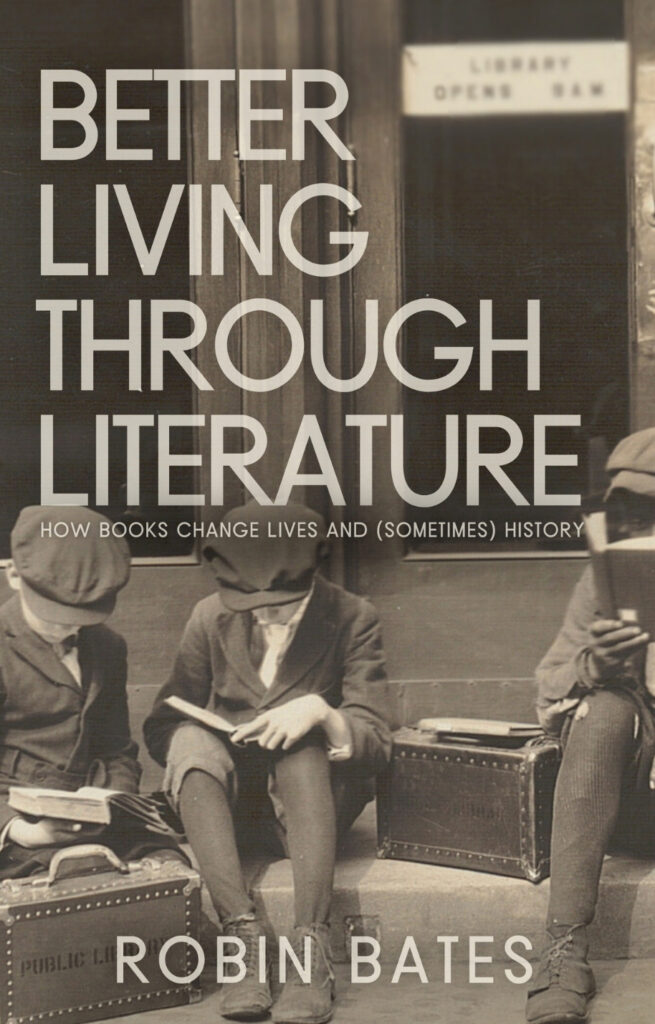
In my book Better Living through Literature I talk about how I developed what I call a “sandwich structure” for their essays. If the students wished to, in their introduction they could relate a personal story that was triggered by a work. The second part of the essay—the meat filling, as it were—had to be confined to talking about how the work handled the theme the student had identified (no personal reminiscences allowed here). In the conclusion they were to examine the insights the work has opened up into their experiences and that their experiences had opened up in the work. I didn’t want the personal story to overwhelm literary interpretation so each had its place in the essay.
What emerged were the most powerful essays I have ever received. Students were using Chaucer’s Wife of Bath to explore sexual abuse, Mary Oliver poems to explore depression, Twelfth Night to explore gender exploration, Uncle Tom’s Cabin to explore experiences with racism, Beowulf to explore grief. A student suffering from a non-stop migraine found comfort in Julian of Norwich while a student raised in a fundamentalist Alabama family used Christopher Marlowe’s Doctor Faustus to recalibrate the relationship between faith and secular learning. (She came to a more balanced understanding than that achieved by either her family or Faustus.)
I mention in my book the senior lacrosse player who identified with the wedding guest in Rime of the Ancient Mariner. In his case, he equated the gratuitous killing of the albatross with gratuitous acts of campus vandalism committed by drunken lacrosse players, and he emerged from his essay determined to live his life differently. (After hearing the mariner’s story, the wedding guest becomes “a sadder and a wiser man.”)
Another inspiring story was how Jane Austen’s Mansfield Park impacted a student who had been born prematurely with serious birth defects, including a frozen larynx. Originally pointed towards special ed programs, she was saved by an activist mother, who got her mainstreamed. Against all expectations (except her mother’s) she flourished in school and graduated from St. Mary’s as its valedictorian. If the student loved Austen’s novel, she realized, it’s because the meek Fanny Price, against considerable odds, steps into her own powers by the end. Importantly, Fanny realizes she can’t rely fully on her beloved mentor (Edmund Bertram) but must find her own way, just as my student was realizing that she would have to, upon graduating, leave behind her mother and the school system that had validated her. (I tell the story here, here, here, and here.)
Another great story, which I’ve told multiple times including in my book, happened years later. While it didn’t involve an essay, it shows what literature can unleash in students given the right conditions. Matt was an ex-marine who found himself rethinking his war experiences after reading the medieval romance Sir Gawain and the Green Knight. I quote here from my book:
Matt had become an enthusiastic English major after having served two deployments in Afghanistan, where he defused roadside bombs. In a classroom discussion about death, he remarked that he had learned to not care about dying when he was in the service.
While acknowledging that I was in no position to contradict him, I mentioned Gawain thinking he can shrug off his death fears, only to discover by the end of the poem that he can’t. “In destinies sad or merry, / True men can but try,” Gawain initially says, thinking himself calm as he prepares to keep a rendezvous with certain death. By the end of the poem, however, the Green Knight reveals he has set up his challenges to teach Gawain a lesson: he wants the Camelot knight to acknowledge that he cares for his life after all.
As we weren’t reading the poem for the class, Matt went to the campus bookstore, bought a copy, blew off the Jane Eyre reading assignment, and spent half the night reading the fourteenth-century romance. The next day he told me how true the poem was. Even as he and his comrades had joked about death, he said, they were also careful to don their Kevlar vests whenever they went out on a mission. This he compared to Gawain secretly and somewhat dishonorably accepting a life-saving green girdle from the lady of a castle, where he is temporarily residing before journeying to meet the Green Knight. Gawain is ashamed that he wears it, especially after the Green Knight reveals that he knows of its existence. The poem helped Matt re-process his war experience in ways none of us could have predicted.
As every good teacher knows, we learn as much from our students as they learn from us. I suddenly realized, from Matt’s experience, that 14th century England would have been recovering from its own trauma, having endured the Black Plague only two or three decades previously. That someone with first or second-hand experience of Europe’s greatest natural disaster could compose a comic work with vivid images of life is a marvel. At a time when society was understandably succumbing to a life-denying version of Christianity (spurn this world, focus on the afterlife), the poet helped his audience recover a life-affirming connection with nature. After encountering Matt’s response, I understood better the role the poem had played in my own grieving. (I tell that story here.)
I could go on and on. After 2009, I started sharing many of these “reading stories” on my blog (always with the student’s permission, of course), which served the students as well as the broader public. I can honestly say that, most semesters, I received a meaningful final essay—an essay where something was at stake—from every student I taught.
To elicit such work, however, took a tremendous amount of work from both teacher and student. It all began with the weekly thousand-word “free writes” I required for each work. These I would read over quickly, looking for instances where I could see that their interest was particularly piqued. (I compared it to looking for blips on a radar screen.) They would later use these moments of connection to determine the topic of their final essay, for which I would require a proposal, a rough draft, a polished essay (graded), and (if they chose) a revision.
Often the most significant professor-student encounters I have ever had were the required post-essay meeting. As I graded stringently but had a generous revision policy (the revised grade would replace the original), they had extra motivation to revise, and in any event revision became easier given how committed they had become to their topic. For the first time in my life, my teaching and their learning felt absolutely authentic.
During these years (2002-08) I was also involved in a Pew grant about ways to increase environmental awareness in our classes. More on that next week.
Past Installments of A Life Lived in Literature
A Life Lived in Literature: How It All Began (Sept. 5, 2025)
Early Reading Memories (Sept. 12, 2025)
Childhood Confusion: Reading to the Rescue (Sept. 19, 2025)
Confronting Segregation (Sept. 26, 2025)
School Reading vs. Real Reading (Oct. 10, 2025)
Childhood in Paris (Oct. 17, 2025)
My Time at Sewanee Military Academy (Oct. 24, 2025)
Existentialism for High School Seniors (Oct. 31, 2025)
Why I Majored in History, Not English (Nov. 7, 2025)
My College Search for Authenticity (Nov. 14, 2025)
On D. H. Lawrence and a Sexual Awakening (Nov. 21, 2025)
My Life as a Bildungsroman (Nov. 28, 2025)
Grad School: Literary Baptism by Fire (Dec. 5, 2025)
Early Scenes from a Marriage (Dec. 12, 2025)
Bringing Up Baby in Grad School (Dec. 19, 2025)
Grappling with Racism (Jan. 2, 2026)
Journal of a Young Teacher (Jan. 16, 2026)
Teaching and Reading in Yugoslavia (Jan. 23, 2026)
Life at 40: Barely Controlled Chaos (Jan 30, 2026)
From Secular Humanist to Christian Believer (Feb. 6 2025)
Looking Back at a Lifetime Together (Feb. 13, 2026)
To Ljubljana with Love (Feb. 20, 2026)
Forging a Separate Identity from My Father (Feb. 27, 2026)
“Better Living” Emerged from a Midnight Epiphany (March 6, 2026)
The Golden Years before Tragedy Struck (March 13, 2026)
Using Lit to Grapple with a Death (March 20, 2026)
Lit in the Year following Justin’s Death (March 27, 2026)
My Eldest Son, Named after a Keats Sonnet (April 3, 2026)
Sterne’s Uncle Toby and My Own Toby (April 10, 2026)
After the 2nd Death, a Book Project (April 17, 2026)
Making Lit Meaningful for Students (April 24, 2026)