Note: If you wish to receive, via e-mail, (1) my weekly newsletter or (2) daily copies of these posts, write to me at rrbates1951@gmail.com. Comments may also be sent to this address. I promise not to share your e-mail with anyone. To unsubscribe, write here as well.
Friday
This is the latest post in my on-going series on “My Life in Literature,” which appears every Friday. Because an informal autobiography written by my great grandmother Eliza Scott means so much to me—she discusses the novels that were important to her as she grew up in Victorian England—I figured that I should do something similar for family members who come after me. Of course, the subject is also consistent with the mission of this blog, which is to explore the many ways that literature enhances and sometimes changes our lives.
One of the happiest years of my life was the one spent in France at age 13. As I mentioned in last Friday’s post, I was desperately unhappy in seventh grade, so France gave me the opportunity to break from that. While my father was spending all his time in the Bibliothèque Nationale researching the poet Guillaume Apollinaire and my mother was at home taking care of my four-year-old brother Sam, David (8), Jonathan (10) and I attended a small, one-room, private French school named after the poet Alfred de Musset (Cours d’Alfred de Musset).
We lived at 10 Rue de Docteur-Finlay in an apartment building a block from the Seine and near the Bir Hakeim Bridge. This meant that, to get to school, we walked under the Eiffel Tower. In fact, we walked under it four times a day since there was a lunch break of two hours. The school session was 9-12 and 2-5 Monday-Friday (with Thursdays off, as was customary in France) and a half day on Saturday.
We sat in different rows, with each row a different grade level, and spent our time learning French grammar; filling out French maps with the rivers, mountain ranges, and major cities (which we also had to memorize); doing math problems; and memorizing the “resumé” paragraphs that came at the end of the chapters in our science and history textbooks. This wasn’t as onerous as it sounds because, for the first time since I was two, I became fluent in the language. This was fortunate as the teacher knew little English. A moment of pride came when, in a remark that I now recognize as somewhat classist, she told me my French was better than that of many working people.
I fell in love with French history that year—it would become my focus in college—but my favorite part of the day was the final half hour of both the morning and afternoon session. That time—a sixth of the school day—was spent memorizing poetry. To this day I can still recite poems by Apollinaire (“L’Adieu”), Paul Verlaine (“Chanson d’automne,” “Il pleut dan mon coeur”), and Jean de La Fontaine (“Le Corbeau et le Renard,” “La Cigale and la Fourmi”). I also remember solo singing the French version of “O Tannenbaum” and the class looking at me in wonder (perhaps because I was putting myself out there, perhaps because of my American accent).
Through a stroke of fortune, the American Library of Paris, originally near the Champs Elysée, moved to a location directly on our path to school. They had a wonderful children’s collection and we went through everything they had. We read the entire Freddy the Pig series, by Walter Brooks, along with Robert McCloskey’s Homer Price books, Margery Sharp’s Rescuers, and various swashbuckling adventure stories set in Medieval and Renaissance times whose titles I no longer remember. My brother Jonathan, meanwhile, was working his way through all the library’s science fiction collection, so much so that they dropped protocol for him and allowed him to roam the adult stacks. Not infrequently we would check out our books during one lunch hour and return them the following day or sometimes the same day.
Other high points included seeing the Royal Shakespeare Theatre performing Love’s Labours’ Lost and (one of the highlights of the year) a performance of Cyrano de Bergerac in La Comédie Française, France’s most famous playhouse. My father had given me a translation of the play before attending and I fell in love with Cyrano. As I recall, the actor received at least seven curtain calls.
We also went to London for spring vacation, where I remember us attending a performance of Thomas Dekker’s Shoemaker’s Holiday (1599). In short, I was in my element.
Of course, we didn’t only read. Every Saturday my father would give David, Jonathan, and me money to see a film anywhere in the city (we had the Metro system memorized), and thanks to that we saw movies starring the Marx Brothers, Cary Grant (Arsenic and Old Lace), John Wayne (a French favorite), Gary Cooper, Jean Paul Belmondo, Jean Marais, Cary Grant, and others. I remember us once mistakenly walking into the wrong theater (in the Latin Quarter sometimes theaters were squeezed together), and instead of watching the British comedy Tight Little Island, we instead watched Fellini’s 8 ½. Although this autobiographical film is today considered Fellini’s masterpiece, we were American kids watching a film about a film-maker’s midlife crisis (there’s a rocket ship in the film within the film that never takes off—Fellini is never subtle with his symbolism). But even though the film was in Italian with French subtitles, we had paid our way in and so I felt obligated to watch it all the way through. And Jonathan, at least, was excited about the rocket. The carnivalesque film score still haunts my memories.
Of particular pleasure was the newly opened Cinémathèque, which at the time housed the world’s largest international film collection. There we watched old silent films starring Charlie Chaplin, Buster Keaton, Harry Langdon, Harold Lloyd, Ben Turpin, Fatty Arbuckle, and Douglas Fairbanks, as well as movies directed by Jean Cocteau and Jean Vigo. We would sit in the front row, sometimes down on the carpeting, and marvel. I remember once seeing a Buster Keaton film with Czech subtitles since curator Henri Langlois was gathering prints from all over the world.
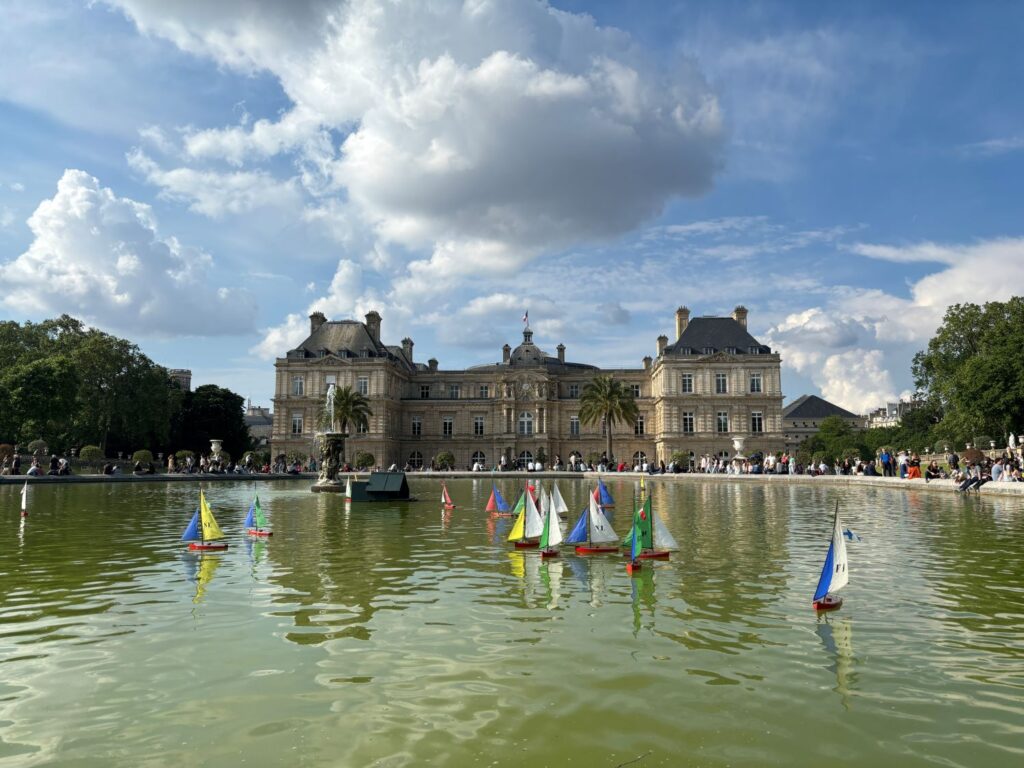
At home we collected toy warriors from Roman and medieval times; acquired every one of the Tintin books (all in French, of course); purchased magical tricks from a magic store; purchased a foosball table from the large department store Galeries LaFayette (we loved visiting it during the Christmas season); and visited museums, including the Louvre, the Nautical Museum, Notre Dame, the Chateau de Vincennes, the Cluny Museum (with the unicorn tapestries), the Luxembourg Gardens (where we watched children sailing toy sailboats in the garden and where we ourselves played boules). Most of these we visited on our own, without parents.
We also, for the first time in our lives, had a television, which riveted us. We watched British shows, dubbed in French, featuring Ivanhoe, Robin Hood, and Sir Francis Drake (who fights the Spanish, never the French). There were also two French shows we liked: Thierry la Fronde (a French Robin Hood) and Rocambole (an underground adventurer). Oh, and there was also the American series Mr. Ed, which seemed so much better in French than in English since, after all, whoever knew that a horse could speak French?
Every morning for breakfast we would go out and buy hot croissants from the local bakery, along with the Herald Tribune, in which we would read the comics. (I especially remember Dick Tracy and The Phantom.) For lunch I always had camembert and a baguette, along with strawberry yoplait. Oh, and we also drank hard cider, not knowing that it was alcoholic. The French back then (and perhaps still?) were more relaxed about alcohol, and I know that during a later sabbatical trip to France, my brother David’s school celebrated his 15th birthday with champagne.
The only downside we country boys saw to Paris is that it could sometimes feel a bit confined. Only the Bois de Boulogne had open spaces where one could run freely. This drawback felt minor compared to everything the city offered, however.
As I look back, I realize that, even at the time, I sensed my childhood was drawing to a close. I knew, even though I didn’t openly acknowledge it to myself, that when I returned to the States I would be attending the Sewanee Military Academy, the best education the mountain had to offer. In France I felt no pressure to grow up or to impress peers (there were none), but I knew that couldn’t last. One way I tried to hold on to my childhood was wearing the short pants of the school uniform the entire year, even though we had the option of switching to long pants when it got cold. I’ve talked in past posts how, for my father’s sake, I tried to hold on to childhood innocence, and this was another variant of that. Once again, I was playing to what I sensed was his Peter Pan fantasy.
Ten years later, after I graduated from college, I came across a description of a related longing. In John Knowles’s A Separate Peace, we learn about a magical summer (or so it appears in the narrator’s mind) when time seems to be held in suspension. The school masters know that, when the boys graduate, they could well end up in the World War I trenches, so they loosen the reins. As the narrator describes it,
This was the way the Masters tended to treat us that summer. They seemed to be modifying their usual attitude of floating, chronic disapproval. During the winter most of them regarded anything unexpected in a student with suspicion, seeming to feel that anything we said or did was potentially illegal. Now on these clear June days in New Hampshire they appeared to uncoil…A streak of tolerance was detectable…
The narrator reflects,
I think we reminded them of what peace was like, we boys of sixteen. We were registered with no draft board, we had taken no physical examinations. No one had ever tested us for hernia or color blindness. Trick knees and punctured eardrums were minor complaints and not yet disabilities which would separate a few from the fate of the rest. We were careless and wild, and I suppose we could be thought of as a sign of the life the war was being fought to preserve. Anyway, they were more indulgent toward us than at any other time; they snapped at the heels of the seniors, driving and molding and arming them for the war. They noticed our games tolerantly. We reminded them of what peace was like, of lives which were not bound up with destruction.
In my case, it was not an indulgent faculty that allowed me to remain a child but an indulgent setting. I felt a kind of freedom and peace that I sensed I would lose once I entered my own military experience. I know I was in denial because, when I took the high school placement test, I didn’t put down where I would be attending high school (SMA got hold of it anyway).
Nor was I entirely wrong in my foreboding as the military academy proved to be a painful shock. More on that next week.